




In September 1826, the disappearance of an obscure stonecutter in upstate New York unleashed a decade of political and social unrest in America. Nowhere was the turmoil felt more acutely than in Vermont, where it divided towns and even families.
The stonecutter, William Morgan, had been seeking revenge against members of his local Masonic lodge after they denied him membership. Morgan swore he would reveal the secret traditions of the Masonic Order in a book. The threat was too much for some Masons, who by all appearances kidnapped and killed Morgan.
Many Americans claimed they saw a vast conspiracy behind the murder. That feeling was exacerbated by the subsequent cover-up of the crime, abetted by sympathetic judges and sheriffs, who were fellow Masons.
Until the Morgan incident, people hadn’t realized the prevalence and prominence of Masons in American society. Now they understood that many leaders of the American Revolution, including George Washington, were Masons, as were countless current members of Congress, which led some to fear that a dangerous secret society had taken over their country.
This anxiety brought a pair of words into America’s political lexicon: “Antimasons” and their political philosophy “Antimasonry.” The new terms gave voice to old complaints. Behind the attacks on Masons were long-festering disputes over morality, religion and economics.
A month after Morgan’s disappearance, Antimasons in Vermont claimed that local Masons had carried out a scheme that was equally vast and wicked. The supposed plot involved Joseph Burnham, then Vermont’s most notorious criminal. Burnham, a farmer and laborer from Pomfret, was convicted of raping a 14-year-old girl. The crime attracted wide attention because of its bizarre circumstances.
Burnham and his brother Zenas had become estranged from their wives when the women were converted during a religious revival. As part of their conversion, the women decided to save more resources for their families. To ensure that they would bear no more children, the women apparently swore off sex.
In response, the Burnham brothers began sexual relationships with a young niece and a destitute servant woman in town. Eventually, Joseph Burnham decided to expand the circle to include the 14-year-old sister of the servant. One night, the two women locked the girl in a room with Burnham, fully understanding the girl’s fate.
The crime shocked Vermonters. Burnham was sentenced to 10 years in the new state prison in Windsor. While there, Burnham complained about intense abdominal pain, but his pleas were ignored. Whatever he was suffering from soon killed him. In October 1826, he was buried in Woodstock village.
This time, it was the Antimasons’ turn to claim a dead man was still alive. They alleged that Burnham had been spirited out of prison and another body lowered into his grave. The prison superintendent and many of the guards had perpetrated this outrage, Antimasons asserted, because they were Masons.
Burnham was reportedly alive and well and living in New York City. Antimasons could not be shaken from this belief. It didn’t matter that the New Yorker purported to be Burnham was discovered to be a recent Irish immigrant; that Burnham’s casket had had a glass panel through which mourners had seen his face; or that the state agreed to disinter his body. The corpse was too decayed to be identified, they countered. Antimasons were not even convinced by strong evidence that Burnham had never been a Mason.
Democratic ideals
Attacks of Masonry extended well beyond the specifics of the Morgan and Burnham cases. Masonry posed a great threat, claimed Antimasons who gathered in Randolph in May 1827, because it promoted “an unnatural and unwarranted distinction, a species of favoritism and aristocracy, derogative to the equality of a free and independent people.” In short, Masonry violated the country’s democratic ideals.
But prosperity in Vermont was spreading unevenly. Although some communities were booming, populations were declining in more than 20 percent of Vermont towns as people headed west for a new start.
To Antimasons, the idea of a grand Masonic conspiracy helped explain why some succeeded in America, while others did not.
Antimasonry’s theory understandably found little support in prosperous parts of the state. Residents there were largely comfortable with the way Vermont was changing from a primarily agricultural society to one based more on trade and commerce.
Early settlers had come to Vermont as a frontier laden with possibility. In some areas, the settlers’ children and grandchildren were finding themselves increasingly in debt.
Antimasonry blossomed in towns where people felt they were being left behind as the state adapted itself to the increasingly industrial nation. The Antimasonic Party found large pockets of strength scattered around the state: in the northeast in Caledonia County, in the west in Addison County and parts of Rutland County, in the southeast in Windsor County, and in the center in poorer sections of Orange County.
The party was much weaker, however, in flourishing areas, like Chittenden and Washington counties.
When Antimasons saw Masons getting ahead, they assumed it was because of a plot to promote each other’s interests. They overlooked the fact that Masons were often prosperous and prominent citizens before they joined the organization. In fact, Masons were often admitted to the group because of their success.
If Masons regularly did business with each other, it was more out of a sense of familiarity than fulfillment of a secret oath.
Political convention
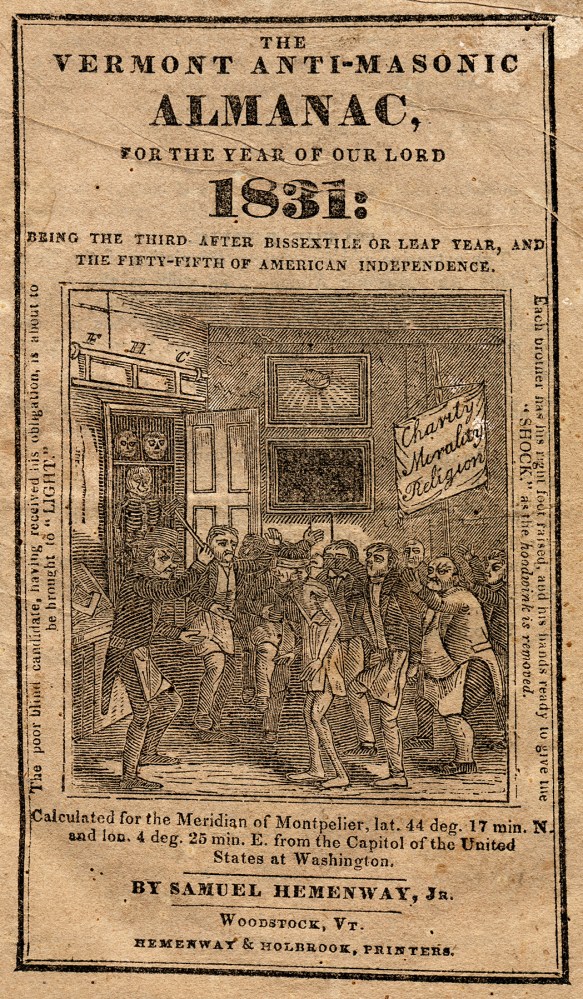
Animosity toward the Masons was fed by a growing number of newspapers that were launched for just that purpose. While launching the Anti-Masonic Republican newspaper in Middlebury in 1829, publisher Edward Barber wrote that the publication would attack the Masonic Order to reveal “its pernicious character and tendency, as well as, the expediency and necessity of demolishing it entirely through the instrumentality of the BALLOT BOX.”
Barber further informed readers that “(w)e expect all the Anti-masons in the region round about to take this paper. We expect every one who possibly can to pay the whole or part in advance. We expect our friends, in general, to give us all the advertising patronage they can command, as this is an essential ingredient in the support of a newspaper.” If Masons could advance their mutual cause by assisting one another, then so could Antimasons.
When Barber launched his paper, Antimasons were still organizing themselves into a statewide party. They gathered for the first time in Montpelier in August 1829 in what would be Vermont’s first-ever political convention.
The main plank in the party’s platform, virtually the only one, was that their candidates were opposed to Masonry. Where they stood on other issues varied widely.
Antimasons used any connection with Masonry to pillory an opponent. Ben Bailey, a brilliant and popular lawyer from Burlington, ran for Congress in 1830. His campaign manager was his law partner, George Perkins Marsh, who would later become a pioneering environmentalist.
Bailey and Marsh were targeted by the Antimasonic Burlington Free Press — Bailey for allegedly being a drinker while espousing pro-temperance sympathies, Marsh for being an aristocrat.
The election featured three candidates, none of whom could gain the then-required 50 percent of the vote. After nearly two years and 10 ballots, the race was still deadlocked. Then, tragedy struck: Bailey, 29, contracted measles and died. On the 11th ballot, the National Republican candidate won.
Marsh could be forgiven if he had had enough of Antimasonry’s potshots. In the end, he probably agreed with a comment attributed to his father, Charles Marsh: “Masonry was the silliest thing in the world except anti-masonry.”
Going underground
But the Antimasons could not be taken lightly. In 1831, the Antimasons proved they had come of age. That year, they found a prominent Vermonter to run as their gubernatorial candidate.

William Palmer was a Danville native who had served in the Vermont Legislature, on the Vermont Supreme Court and in the U.S. Senate. No candidate won 50 percent of the vote in the election, so the decision fell to the Legislature, where the Antimasons had enough clout to maneuver Palmer to victory. It was the first of four one-year terms he would serve. During that same time, the Antimasons also controlled the Legislature.
In 1832, Vermont demonstrated what an Antimasonic bastion it had become; it was the only state carried by the Antimasonic Party ticket during that year’s presidential election.
Antimasons had won the public debate over Masonry in Vermont. Membership in the Masons now virtually disqualified a person for office.
It was a shocking fate for Masonry, which had long seemed unassailable. Masons had established their first lodge in Vermont in 1781. Within a half-century, that number had ballooned to more than 70. Now, suddenly, Masonry seemed doomed.
Leading Masons suggested the organization dissolve entirely in order to deny Antimasons their cause. Many local chapters disbanded, or at least went into a state of dormancy.
But stalwart supporters resisted the calls to close and kept the group alive. The Missisquoi Lodge in Berkshire openly admitted new members during the period. It was the only chapter to do so. Other lodges resorted to holding annual meetings in private homes to avoid detection.
If the Antimasons had not completely vanquished the Masons, they had at least driven them underground.
Opposite sides of the grave
The pressure Masons felt often came from members of their own churches. In Norwich, Dr. Israel Newton, a Revolutionary War veteran and a deacon in the Congregational Church, refused to attend communion with Masons.
In 1831, Peacham resident Hazen Merrill wrote to his brother Samuel, who had moved to Indiana, that Masons belonging to their church had agreed “to dissolve all connection with their institution and (expressed) a determination to have no more to do with it as long as they live.”
If the cause of Antimasonry managed to unify a town like Peacham, it did far more to divide others. In nearby Danville, feelings on the issue grew so intense that mourners at a funeral in 1830 divided themselves between pro- and anti-Masons. During the service, the two sides refused to speak to each other, even members of the same family. Later, at the burial, Masons and Antimasons stood on opposite sides of the grave.
The factions found a sort of accommodation in Bristol, where the gristmill was jointly owned by a Mason and an Antimason. They agreed that members of the order would visit the mill one week and their opponents the other.
Tensions rose at times to almost murderous levels. A Dr. Ira Davis of Barnet reported that several members of the local militia, after their drills one day, wandered the streets, “declaring that they would shoot the Masons! — and did actually fire upon some of them but without injury.”
End of a cause
In the end, Antimasonry’s victory sowed the seeds of its decline. The party had come into being with the lone goal of tearing down the Masonic Order. When the order appeared to dissolve, the Antimasonic Party went with it.
The decline in Antimasonry was mirrored by the newspapers that arose to support it. Seemingly to broaden its appeal, the Anti-Masonic Republican changed its name to the Middlebury Free Press. The reborn paper was short-lived. It died with the cause of Antimasonry in 1837.
Other papers didn’t last that long. The Antimasonic Vermont Free Press lasted less than a year. Samuel Knight, a satirical writer from Dummerston, wrote a mock obituary for the paper, which was based in Fayetteville, as Newfane was then known. Knight wrote:
“Died of starvation at Fayetteville, Vt., Feb. 14, 1835, The Vermont Free Press aged 37 weeks.
“Its death was occasioned by the neglect of its guardians to supply it with proper nourishment. … It was never known to utter an untruth but that it stuck to it with the greatest pertinacity even to its dying hour, literally fulfilling the maxim, ‘that a lie well stuck to is as good as the truth.’ ”

