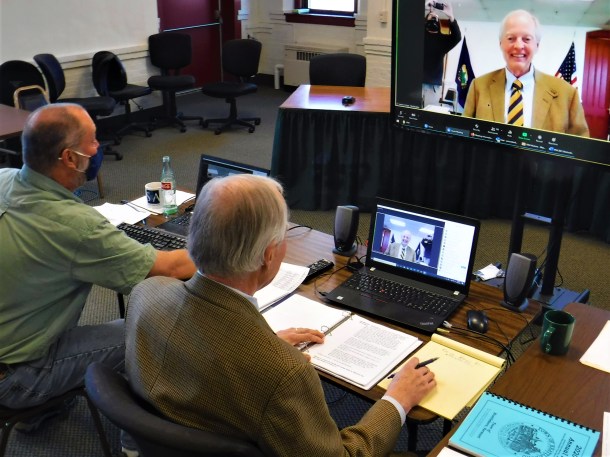
BRATTLEBORO — In a tradition usually associated with nickel-and-diming, this politically progressive community held a record two-day online town meeting this weekend that increased a nearly $20 million annual municipal budget in hopes of helping people with lower incomes.
“Our recent live meetings have more often been marathons than sprints,” Dr. Robert Tortolani told a Zoom audience at the start of proceedings Saturday morning. “We should all do our best to be efficient.”
But that didn’t stop more than 130 meeting participants from devoting 15 hours of debate well into Sunday to multiple motions to raise spending for the 2021-22 fiscal year.
Townspeople, for example, voted to boost the salaries of Brattleboro’s five-person selectboard from $3,000 to $8,000 for each member and from $5,000 to $10,000 for the chair, with additional reimbursement to care for children and other dependents.
“My goal here is to try to open the potential field of selectboard candidates to include some folks who are often underrepresented,” resident George Carvill said. “I’m not suggesting that money is the primary motivation for a candidate, but economic adversity can be the primary obstacle for a person with a real passion for serving the town and bringing a different point of view to the board.”
While some argued the increase would help locals with lower incomes, others questioned if the resulting tax increase would hurt them.
“In the last few years there has been a constant and relentless movement to spend ever-increasing sums of money — and some more than requested — on issues and things,” said resident Rick Sullivan, repeating an argument he made in a recent letter to the editor. “There must be more care shown by members in funding the budget in a fiscally responsible manner so that tax bills remain manageable for all.”
After an hour and a half of debate, meeting participants adopted the raises 87-42.
“It definitely is a place of privilege and comfort to be able to say that it’s satisfying and important to serve your community but to not recognize the number of people who wouldn’t be able to do this because of the amount of work that they have to do just to make a living,” resident Bethany Ranquist said in summing up the opinion of supporters.
Meeting participants also approved:
- $37,551 for the “Love Brattleboro VT” community marketing campaign, but only after rejecting an amendment to change it to “Love Wantastegok,” the Abenaki name for the area.
- $75,000 to upgrade the town government’s website to be more accessible to the public and, specifically, marginalized populations.
- $530,000 for capital projects, including sidewalks, paving and a new senior center elevator.
- $18,643,040 for general fund expenses, but only after rejecting a resident’s call to add $13,000 to the police training budget.
Brattleboro police had proposed increasing their training budget by 48% — from $27,000 to $40,000 — to boost its diversity, equity and inclusion efforts after a Community Safety Review Committee study found the department had a disproportionately high rate of stopping and searching minority drivers.
But in a split decision in January, the town selectboard voted to freeze the training budget until local leaders could consult with marginalized populations to determine how best to spend more money — a move affirmed at town meeting.
“I think an amendment like this is a back door to relitigating program choices that are made through other processes in town government,” resident Zachary McLaughlin said. “Once you start rolling down this hill, I think you can go off in all kinds of directions that were not the intent of town meeting.”
Townspeople also allocated $276,400 to support area nonprofit human service agencies, although they balked at raising next year’s figure from the current 1.4% of the municipal budget to a proposed 2%.
“This is going to squeeze some of the very people we want to help,” resident Christopher Chapman said of the projected resulting tax increase. “I do think that we have reached the limit.”
Most Vermont municipalities decide budgets and other ballot questions at annual town meetings in early March. Brattleboro, the state’s seventh most populous locality with about 11,000 residents, aims to keep attendance manageable by electing some 140 representatives who wait to gather later in the month.
This weekend’s gathering marked the 60th anniversary of the first such meeting in 1961.
The state won’t allow most cities or towns to hold official town meetings online because of concerns those communities don’t have the ability to open participation to all locals and close it to nonresidents. But the Vermont Legislature approved an exception for Brattleboro, which shared its Zoom meeting link only with locals approved in advance and invited everyone else to watch on public access television.
Until this weekend, the longest Brattleboro town meeting in memory was in 2019, when participants began at 8:30 a.m. and ended at 9:27 p.m. The technical challenge of this year’s online format was just one reason for the record length.
Local gadflies took up time by seeking to unmute everyone (a request rejected 113-16) and sparking debate on why the electronic yes-or-no voting system didn’t allow for abstentions. For their part, some Christian participants had hoped to take a break Sunday for morning services, only to spur a back-and-forth from others who noted Jewish and Muslim residents had to miss their own religious observances Saturday.
“You have approved article 77,” meeting moderator Lawrin Crispe said after the second-to-last of the agenda’s 28 articles passed Sunday. “Feels like that.”