

Updated at 5:26 p.m.
Joe Biden was sworn in as president of the United States on Wednesday, handing control of the White House and the U.S. Senate to the Democratic Party.
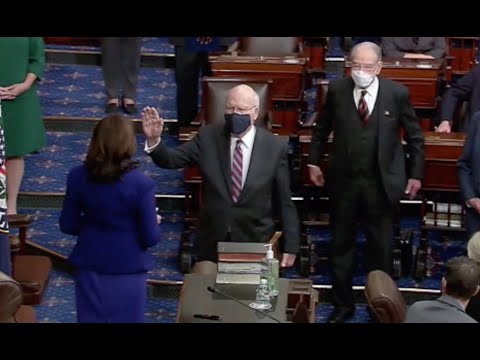
Hours later, Sen. Patrick Leahy, D-Vt., was sworn in as president pro tempore of the Senate, placing him third in line to the presidency.
Leahy was escorted to the front of the Senate chamber by incoming Majority Leader Chuck Schumer, D-N.Y., and Sen. Chuck Grassley, R-Iowa, whom he replaced as pro tem. After Vice President Kamala Harris administered Leahy’s oath of office, the two switched seats and the senator from Vermont took over as presiding officer.
Leahy, 80, reassumed the top ceremonial role in the U.S. Senate at a time of heightened security concerns in the nation’s capital. He has been expecting a robust security detail, much to his dismay.
In an interview, Leahy said people have been congratulating him on becoming pro tem. The senator said he has responded by saying, “Do you mean congratulations or condolences?”
Leahy, who held the position from 2012 to 2015, said that, if it were up to him, he wouldn’t have the added security that comes with the role. On the morning of Jan. 6, the day the U.S. Capitol was stormed by supporters of President Donald Trump, Leahy had told his wife, Marcelle, he didn’t need additional protection from the Capitol Police.
Hours later, with rioters running unchecked throughout the Capitol, Marcelle Leahy texted her husband, asking if he still thought he shouldn’t have a few bodyguards.
“I wish there was no need for security — I’d be just as happy not to have [a security detail], but they have said, ‘You don’t have a choice,’” Leahy said.
Though the pro tem position is largely ceremonial, Leahy could soon find himself presiding over the expected Senate trial of former President Donald Trump.
The U.S. Constitution calls for the chief justice of the Supreme Court to preside over trials of sitting presidents, but there is no precedent for an ex-president to face such a proceeding. Multiple news outlets have reported that Chief Justice John Roberts could bow out, raising the possibility that Vice President Kamala Harris or Leahy — the top officers in the Senate — could preside.
With Democrats taking control of the Senate — membership is split 50-50, but Harris holds the tie-breaking vote — Leahy also became chair of the Senate Appropriations Committee.
Vermont’s junior senator, Bernie Sanders, an independent, assumed a powerful position as chair of the Senate Budget Committee.
John Hudak, a congressional politics expert at the Brookings Institute, said both of Vermont’s U.S. senators are likely to play “significant roles” in shepherding Biden’s agenda into law, and both will have a chance to push their own policy priorities.
While any committee chair is immensely influential, Hudak said, he gives the edge to Leahy in terms of the power he can wield. “He’s going to be able to really carve out new priorities and fund those priorities in the Senate,” Hudak said.
Sanders now heads the committee that handles spending priorities, and Hudak said the Democrats’ narrow majority in the Senate may dampen his ability to push his own agenda.
“Those types of policies are not going to pass the Senate and they’re not necessarily going to be in line with what the Biden administration is looking for,” Hudak said. “That could actually become a bit of a contentious relationship in the next Congress.”
Leahy has expressed support for bringing back earmarks — federal grants allocated by individual members of Congress to specific projects, typically in their home states. Earmarks have been the subject of great controversy because they have been used to direct federal largesse to lawmakers’ friends, family members and donors. They have been banned since 2011.
But Leahy and other members of Congress have supported bringing back earmarks to help win bipartisan support for appropriations bills. Leahy has argued that requiring members of Congress to affix their names to earmarks would prevent their misuse.
If earmarks returned, Leahy would be the person to whom senators would turn to request them — a powerful bargaining chip.
“If you are the gatekeeper for earmarks in the Senate, you can use that to negotiate on other unrelated pieces of legislation — whether that’s done openly or in a wink-nod way,” Hudak said.
Leahy has already had multiple discussions with Biden about spending priorities, the senator said, and specifically an expected Covid-19 aid package. The two men entered the Senate within two years of each other — Biden in 1973 and Leahy in 1975 — and have a strong friendship.
Leahy said he intends to convene a private meeting of the Appropriations Committee to discuss how to pass top priorities.
For Vermont, Leahy said he would make sure any coronavirus relief bill gave states with small populations a minimum level of funding. He did the same with last year’s CARES Act, which provided Vermont $1.25 billion — more per capita than any state other than Wyoming.
“I want to bring Republicans and Democrats together,” Leahy said, noting that Republican Gov. Phil Scott called him Jan. 6, congratulating him on the Democrats taking the Senate and his new role as Appropriations chair.
Xander Landen contributed reporting.

