


Tarnished Badge is a three-part series that looks at credibility questions raised by Vermont prosecutors about law enforcement officials. Part 1 explains why prosecutors file so-called “Brady letters” and other documents when a law enforcement officer’s credibility is questioned. Part 2 examines why some Vermont prosecutors have filed more cases against officers than others. Part 3 looks at what happened to the officers named and where some of them are now.
A Bennington cop who had a sexual relationship with a drug informant didn’t get a Brady letter.
A Rutland police officer, who notarized the sworn statement of another officer without reading it, did.
Prosecutors across the state unevenly draw the line when cops have broken their trust with dishonest or unethical behavior. At issue are the letters and listings that Vermont prosecutors provide to defense attorneys about law officers they believe have issues with truthfulness.
They are known as “Brady,” or “Giglio,” letters and lists, named after national cases that require prosecutors to tell defense lawyers about potential credibility issues with an officer who might be called to testify.
However, the standard for when an officer gets a “Brady letter” varies greatly across Vermont, depending on the location and the prosecutor.
“It is definitely very different in different counties,” said Bennington County State’s Attorney Erica Marthage.
A Brady letter can be the death knell for an officer’s career, particularly if the county prosecutor won’t take their cases anymore.
But the fact that there is no centralized database for Brady letters and that the standards are not applied consistently means that dishonest cops can get passed from one town police department or sheriff’s office to another.
The letters and lists have become a frequent and at times contentious topic among prosecutors, law officers and criminal justice reform advocates, particularly as police conduct has come under closer scrutiny in the wake of high-profile misconduct cases, including the death of George Floyd, an unarmed black man, killed by police in May in Minneapolis.
That increased scrutiny is occurring locally as well as nationally.
“I know there’s been a national conversation about Brady lists,” said Chittenden County State’s Attorney Sarah George, “and law enforcement was freaking out about it, wondering how that decision would be made that their name would be put on these lists.”
George, the top prosecutor in Vermont’s most populous county, has issued a half-dozen Brady/Giglio letters since taking office in January 2017.
“I personally have a low bar,” she said. “If there is any finding that would go to their credibility, I issue a letter.”
In addition, George said, she makes clear in the letters she will no longer prosecute cases in which those officers are the leading investigators.
“It’s not worth the risk if they end of being a witness in a homicide or a sex asault or some other major case,” she said. “It ruins everything.”
George added she wouldn’t file a letter without careful consideration.
“I wouldn’t make such a drastic decision unless I felt very confident in it,” she said.
Different standards
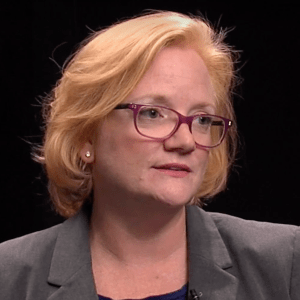
Meanwhile, in Bennington County, Marthage hasn’t issued any Brady letters in the past five years. She said several factors go into that decision for her, including whether the person is still working in law enforcement and the exact nature of the untruthfulness.
“It’s not necessarily the issue of what they are doing; it’s if they are lying about it,” Marthage said.
Rutland County State’s Attorney Rose Kennedy has written up the most officers — nine — among Vermont’s 14 state’s attorneys.
“Prosecutors might look at Giglio differently. I think I take a sort of broad view,” Kennedy said. She doesn’t view it necessarily as a “bad cops” list: “I try to look at it as what could a defense attorney use to cross-examine a police officer for bias or credibility.”
She then said, “It’s possible another prosecutor views it differently, but I think I’m viewing it correctly.” In some instances, Kennedy still takes an officer’s cases; in others, she won’t. It depends on whether she believes an officer can adequately explain to a jury the situation that put them on her Giglio list.
Under the law, prosecutors are required to disclose to defense attorneys any information that might be exculpatory, including questions about the credibility of the police officers investigating a case.
Marthage said that, a few years ago, “it came to my attention” that a Bennington police officer, who she didn’t name, had been having a sexual relationship with an informant in drug cases.
“My approach was I called the chief,” Marthage recalled, and said to him, “I need to know if he was truthful with you when you were talking to him about this. And if there is any issue with his truthfulness, I need to know about it.”
Then she said, “He didn’t lie about it when he was confronted, so is that a Giglio letter?”
Ultimately, Marthage said, she didn’t have to make that decision. “It didn’t get to a letter because he resigned,” the prosecutor said. The officer is no longer in law enforcement.
“The purpose of the letter is to inform others of the fact that this law enforcement officer has credibility issues,” she said. “If they are no longer in law enforcement and no one is going to be calling them as a witness, there is no need to issue one.”
What’s the best way?
A review of the 14 state’s attorney offices reveals a total of 28 officers named in letters and lists in the past five years.
Some of the prosecutors, like Kennedy, George and Washington County State’s Attorney Rory Thibault have named several officers in the letters and lists since 2015. They work in three of Vermont’s biggest counties.
Other state’s attorneys haven’t issued any Brady letters in the past five years.
Some prosecutors, including Addison County State’s Attorney Dennis Wygmans, have proposed other ways to handle police misconduct questions — in particular, because of the appearance of a conflict of interest between prosecutors and police, who often have close relationships.
One suggestion: Take the Brady letter decision out of the hands of prosecutors and leave it to an independent review.
Why has that never happened? Wygmans had a one-word reply: “Money.”
He suggested a licensed attorney appointed by the governor, with one or two investigators, could issue Brady letters. That office could also keep a centralized list of Brady and Giglio letters from around the state.
David Cahill, a former Windsor County state’s attorney, said there was a move five years ago, when he was the executive director of the Vermont Department of State’s Attorneys and Sheriffs, to make the system more centralized.

“What you’ve uncovered is accurate,” Cahill told a reporter during an interview, referring to the scattered, uneven system.
“There is variation in the sets of disclosures from jurisdiction to jurisdiction,” he said. “What it highlights is the need not only for a statewide standard on which to disclose, but a statewide system and a statewide clearinghouse.”
The consequences of the state’s lack of consistency and no centralized database could be significant.
“We really shouldn’t be relying on the hard drive on a given prosecutor’s computer in a county,” Cahill said, “because what happens if that prosecutor quits or retires?”
Also, according to Cahill, when a state’s attorney writes a letter about an officer in one county, it is not distributed to state’s attorneys in other Vermont counties.
“Problem cop A may start in jurisdiction X and then jump to jurisdiction Y and Z and so on,” Cahill said. “So it’s a bit odd to be relying on a county-based disclosure system when the employment of problem officers crosses county lines and often crosses state lines.”
And, he said, from his experience, those problem officers tend to move from department to department the most.
George, in Chittenden County, agreed that a centralized system makes sense, and she would expand the review process to include the local prosecutor as well as citizen involvement.
It might make sense for a centralized entity to decide whether the matter rises to the level of issuing a letter, she said, while the local prosecutor could still have the option to continue to accept cases from that officer.
“That way, a state’s attorney could still go above and beyond if they wanted to,” George said.
Police-prosecutor tensions
In Rutland County, the letters have led to tension between Kennedy and the county’s largest force, the Rutland City Police Department. Six of the officers on her list have worked there.
Most recently, Kennedy put on hold a request to approve Rutland City Police Detective Jimmy Plakas as a “death scene investigator.”
Plakas got a Giglio letter from Kennedy after a video contradicted a statement he made in a sworn affidavit. Plakas said a suspect who was thrown to the ground by another officer was not handcuffed; the video showed otherwise.

At worst, Kennedy said, some people could view Plakas’ sworn statement as an attempt to cover for another officer, who was his supervisor, by making it seem like the use of force was justified, since the suspect would have a free hand if he weren’t handcuffed.
Rutland City Police Chief Brian Kilcullen has said Plakas didn’t have a good view of what was happening and made a “mistake” in reporting that the suspect wasn’t fully cuffed.
Kennedy said that, while other prosecutors could view the credibility issue with Plakas differently, she said a death scene investigator is often involved in homicide cases where the stakes are high.
Kennedy said she was not willing to take a risk with an officer whose integrity has been questioned for such an important post.
In the Brady/Giglio letter Kennedy sent to defense attorneys in Rutland County about Plakas, she also named his supervisor, Sgt. Adam Lucia, who threw the suspect to the ground. Lucia notarized Plakas’ sworn statement despite not having read it or seeing the false statement, the letter stated.
As noted, a Brady letter can cause backlash for the prosecutor and is one reason some think a different person should decide whether to issue that letter.
In an internal report on the holding cell takedown, David LaChance, the Rutland City Police standards commander, not only reviewed the police actions, but he also called into question Kennedy’s response.
“In November Ofc Plakas was at a DUI hearing with RCSA Kennedy and before the hearing RCSA Kennedy pulled him into a conference room to discuss the affidavit and Giglio,” LaChance wrote. “RCSA Kennedy told Ofc Plakas she had confidence in Ofc Plakas and it was not her doing this, she blamed it on the court and the judges. She told him this was the way of the courts and it was not her doing.”
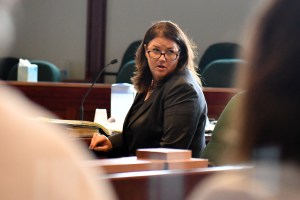
Kennedy said that wasn’t her view.
“I can’t speak on what their take on it is,” she said of the city police department. “I have in front of me an affidavit that is false, and I think the video was very clear that the affidavit was false, and to me that’s a serious issue.”
She added, “I’m an elected official, I believe in the criminal justice system, and I think the way we maintain confidence in the criminal justice system is to present accurate affidavits in courts. These affidavits are powerful tools; they charge individuals with a crime.”
Kennedy spoke of working with the Rutland police leadership to address the issues she has seen, including providing proper supervision and oversight to ensure that any inaccuracies are caught and corrected before a case makes it to the prosecutor’s office.
A judgment call
Franklin County State’s Attorney Jim Hughes has not issued a single letter about an officer in his jurisdiction since 2015, either, even though several St. Albans police officers have been linked to a number of cases involving inappropriate conduct in that county.
In one case, an officer allegedly struck a woman in the face. Another was accused of pepper-spraying a handcuffed man. A third was facing kidnapping and sex assault charges.
Hughes did not respond to repeated requests seeking comment.
Criminal charges against an officer, however, do not necessarily prompt a Brady letter.
That’s because the letters deal with issues of credibility, said Essex County State’s Attorney Vince Illuzzi. He’s been the prosecutor for 12 years in the state’s smallest county, with just over 6,000 residents. In that time, he has written a letter in just one case involving a law enforcement officer. The issue was whether the officer had permission to take a computer with him when he left one job and went to work at another.
“There are cases that are clear-cut that are mandatory Giglio disclosures, then there are other cases where you have to make a judgment call that it needs to be disclosed,” he said. “Someone else may have concluded otherwise.”
Marthage, Bennington County’s state’s attorney, has also not filed a Brady letter in recent years. A situation arose recently when a Manchester police officer was charged with stealing money from evidence storage at the police station, she said. That officer no longer works for the department, Marthage said, and as a result didn’t get a letter.
In another instance, an officer many years ago said he couldn’t make it to a court hearing because he had injured his arm. As a result, she said, she filed a motion to put off the court matter because of that officer’s injury.
“Then I see on social media a photo of him at a Red Sox game,” Marthage said. He did have a cast on his arm, but if he could make it to a baseball game, she said, why couldn’t he make the court hearing?
She said she didn’t issue a letter, but she did confront him, telling him he needed to take his job more seriously. “My impression of you,” she told him, “is like you’re some juvenile frat boy.”
Read Part 3: Questions of credibility sink some officers while others keep working.


