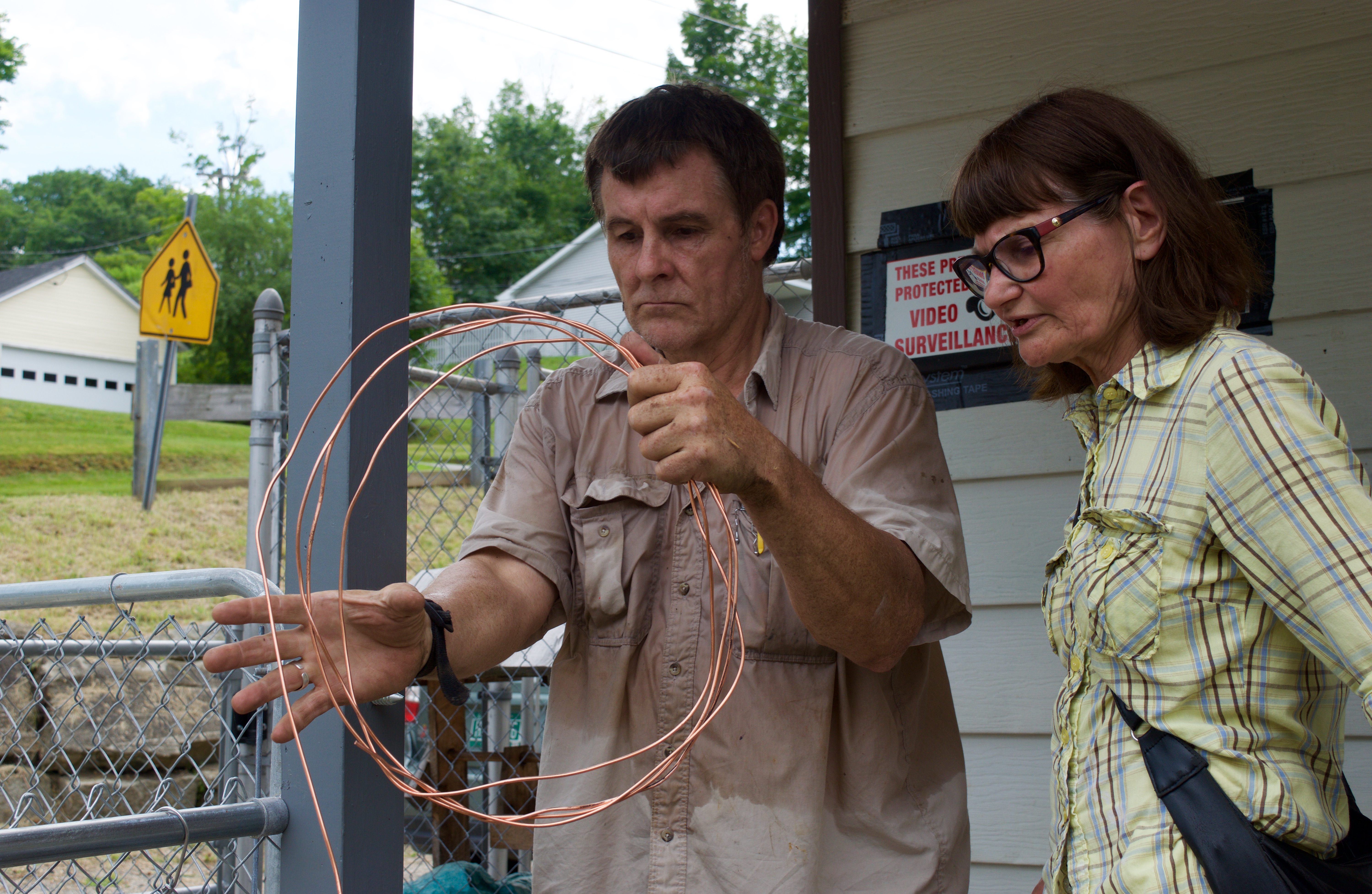
[N]EWPORT — Diane Peel emerged from Butterfly Kisses Child Care Center and into the oppressive Friday afternoon heat.
There was a problem. The two-man crew she was with couldn’t get into the basement, where the electrical system is, to run a copper wire out to the building’s facade on Pleasant Street. But navigating aging structures — and the “logistics nightmare” they pose — is nothing new in Peel’s work.
The 67-year-old is the director of Newport Wireless Mesh, a nonprofit that, through a technology called “mesh internet,” provides low-cost wireless access to a low-income neighborhood in the city’s downtown. As others in the Northeast Kingdom are trying to increase the availability of high-speed broadband, the Newport group is focused on one of the barriers to basic internet access: the price tag.
“Access to information is the whole future,” Peel said. “It’s not fair to low-income people that they can’t afford access to that information.”
The project started about four years ago and began in earnest last year, with eight households now signed up and more planned on the horizon, Peel said. In June, it received a $3,000 grant from the Vermont Community Foundation to cover the costs of equipment, like the kind the crew had started to install at Butterfly Kisses that day.
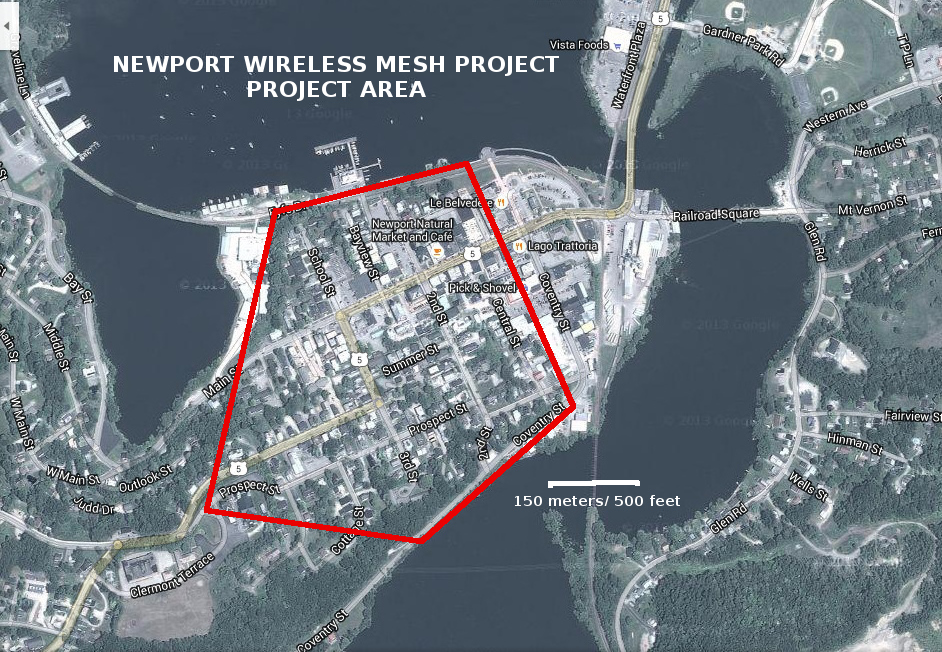
The service zone covers an area from St. Mary’s Catholic Church on the west side of the city to Coventry Street on the east, and from the portion of Coventry Street on the south side of the city to the waterfront on the north. According to City-Data.com, most of that area has a median household income of about $20,450.
Peel’s hope is that hooking up those households with relatively cheap internet, at $15 per month or $150 per year, will help people search for and apply to jobs and engage them in an uplifting community effort.
“This is their project,” she said.
The technology behind it all, mesh internet, works like this. Fiber-optic cables are connected to devices — like one mounted atop the United Church of Newport — that broadcast wireless signals to “access points” stationed around the area.
The signal is picked up by a conventional router at an access point and sent to a specialized mesh router. Both are fixed to a pole and secured above the ground. The mesh router sends the signal to a home router that someone can connect to with a phone or computer.
It’s like a bucket brigade, one device handing the wireless signal to the next, creating a kind of grassroots network that blankets a community. Once the system in Newport is more developed, “it’ll be like you’re floating in wireless,” Peel said.
Right now, there are challenges.
With only three access points built, the devices can get overworked when traffic surges, slowing the connection.
Buildings in the service area are often aging, difficult to route through or both. Take the United Church: Peel said it took five hours alone to get the wiring through the building to the outside, climbing on old, unstable ladders that eventually were replaced so the crew could work. And there was still more to do after that.
The installation crews are mostly made up of volunteers from the neighborhood, and the stress of poverty and the problems that come alongside it can cause them to drop out.
“There are people with a lot on their minds, as far as survival, in this neighborhood,” Peel said.
And community members have responded almost too well to the effort. The group doesn’t yet have the equipment and number of users needed to boost service, Peel said.
Still, she can recount the project’s success stories.
School-age kids from two families covered by the mesh can now more easily turn in assignments online as expected. An older woman, at home because of illness, can now stream news programs.
The group plans to set up four more access points this summer, including at the child care center where the crew worked Friday, and is applying for grants to cover bucket-crane service. Peel said the organization wants to upgrade its equipment, too, to improve internet speeds and coverage. The speed currently sits at about 4 megabits per second at a minimum, she said.

The nonprofit should be able to provide faster speeds when it has more subscribers, which will allow it to buy more bandwidth, Peel said. “It should be self-sustaining at some point,” she said, explaining that, at the 35-subscriber mark, the group will break even.
A couple hours into their work on Friday, the two volunteers at the child care center had found a way to route the wire from the basement to the outside of the building. They started stringing it along the left side, heading toward the front, where an access point will be set up by a second-floor window.
“If this works here, it’ll work anywhere,” Peel said, standing nearby. “This is probably the hardest place on earth to do this.”
One block over, on Third Street, 32-year-old Alan Quintal praised the mesh project, which services the house he lives in.
“I give it a 10 out of 10,” he said. “You just can’t beat the price.”
He turned and called out to a woman he knows a few feet down the street.
“You like it?” he asked her of the mesh.
She nodded, and Quintal expanded: “Honestly, I wish all other towns had it.”