

Editor’s note: Mark Bushnell is a Vermont journalist and historian. He is the author of “Hidden History of Vermont” and “It Happened in Vermont.”
[W]hen Rev. David McClure of Dartmouth College ventured down the Connecticut River to Bellows Falls in 1789, he was on a scientific mission. As a natural philosopher – what we might today call a scientist – McClure was interested in stone carvings he had heard about from a local man. The carvings, cut into an outcropping on the Vermont side of the river, depicted a series of faces.
“The figures have the appearance of great antiquity,” McClure wrote, noting that the British colonists who first settled the area a half-century earlier had observed them. The faces were life-sized images consisting of a simple oval with markings for eyes, nose, mouth and perhaps ears, McClure wrote. Some had lines sticking out of their heads that various observers have taken to be feathers, horns or rays.
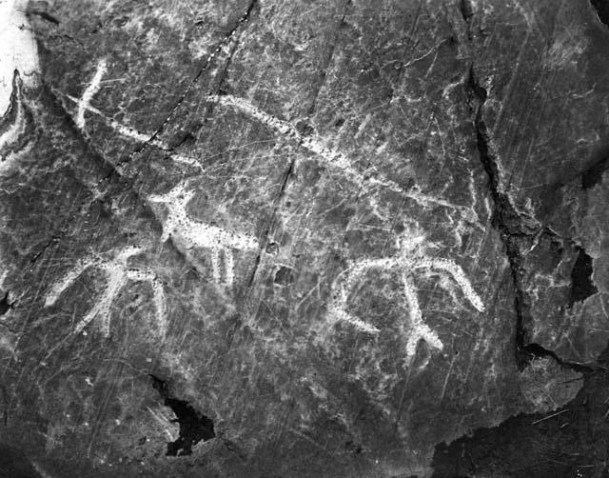
McClure’s was apparently the first written account of the carved rocks, which have been described as the oldest pieces of art in Vermont. How old? Though experts agree the carvings were made by Native Americans, they are unwilling to ascribe a specific date, or even era, to the petroglyphs, which literally means “stone carvings.” They could be anywhere from 300 to 3,000 years old.
The written observations of McClure and subsequent visitors during the 19th and early 20th centuries are invaluable because they offer a snapshot of these artifacts, which have been changing over time. If descriptions of the petroglyphs have varied since McClure’s visit, so too have the interpretations of their meaning.
McClure saw something sinister in the faces. He believed the Native Americans who carved them were marking the spot as “the residence of evil spirits.” English traveler Edward A. Kendall visited the spot in 1808 and saw something benign. He imagined them to be the result of “idle hours spent among these rocks.” The river section near the falls was a productive fishing area.
A half century later, in 1857, Henry Schoolcraft, an ethnologist and geologist, visited the site and decided the carvings depicted a battle scene. The following year, historian Benjamin Hall wrote the petroglyphs, representing an Indian chief and his tribe, were carved to mark an important event.
In these historical explanations of the site, people were “just sort of running with their European impressions,” says Rich Holschuh, a Tribal Historical Preservation Officer for the Elnu Abenaki of Southern Vermont and a member of the Vermont Commission on Native American Affairs. More recent interpretations by scholars, he says, are more accurate.
In 1994, anthropologist William Haviland and researcher Marjory Power wrote that the site at the falls was a sacred location visited regularly by Native American shamans, who would enter a trance there and record their visions on the rocks. Some of the carved faces are superimposed over others, which Haviland and Power argued is because “it is virtually impossible for individuals in trance to look at a surface without seeing their visions projected on it, new visions would appear as projections either over or next to ones already carved.”
More recently, in 2002, archeologist Edward Lenik wrote in his “Picture Rocks: American Indian Rock Art in the Northeast Woodlands” that the carvings were the efforts of Native Americans to connect with the spiritual power present at the site.
Holschuh agrees the area around the Bellows Falls site is a “sacred landscape.”
“What the carvings are is evidence of the medicine people exercising their responsibilities to their people to balance the power, the spirits, the energies that are there,” he says. That people took the time to make the stone carvings is proof that they viewed the site as being of “extremely high spiritual significance.” He is quick to add that this “is not just historical fact. That is a fact today.” Native people still view the site as sacred.
When Rev. McClure visited in 1789, he only described three faces. Today, about two dozen are visible. Did McClure see others, but decide to write only about three that caught his eye? Did he fail to notice others? Were they covered in some way, or were they carved after his visit?

A photograph taken in October 1866 shows the petroglyphs as they appeared before a stonecarver was hired to deepen the markings where they had become weathered. Photo courtesy of the Vermont Historical Society.
The carvings are located in two clusters. An Amherst College professor photographed one of the groups in 1866. Two carvings can be seen in that photo. A visitor to the site in 1907 wrote that those petroglyphs had nearly been destroyed—the rock face is frequently underwater in spring and scoured by rocks and grit. Oddly, in 1928, another visitor wrote that the petroglyphs were gone, but a researcher in 1931 wrote that he could still discern two petroglyphs. In 1995, 11 were noted.
Part of the reason that more carvings can be seen today than a century ago is because of the work of the Daughters of the American Revolution. During the early 1930s, the organization, in a misguided effort to save the petroglyphs, hired a stone carver to deepen the markings he saw on the outcropping. So, in a sense, the original carvings are gone and researchers have been left to try to determine what was there before that stone carver set to work.
Some untouched petroglyphs might still exist, however. Large boulders dumped at the site in about 1890 to prevent erosion along a railroad line might be protecting other petroglyphs.
The Bellows Falls carvings are among only a handful of known ancient Native American petroglyph sites in Vermont. Another well-known set was carved at the confluence of the Connecticut and the West Rivers in Brattleboro, but is now underwater because of the construction of the Vernon Dam. Efforts are underway to preserve that site. Other possible Native American petroglyphs have been found in such far-flung places as Guilford, Jericho and Swanton.
The number of stone carvings in Vermont and the Northeast as a whole – which is several dozen – is miniscule compared to the number discovered west of the Mississippi, which is more than 15,000. One possible reason, suggests retired State Archeologist Giovanna Peebles, is fairly simple. Before European settlers invaded Vermont, the region was thickly forested with massive trees, some reaching five to six feet in diameter. “In an environment where you had so many trees, it may not have been as functional to carve on rock,” explains Peebles.
In fact, Edward Kendall, the English traveler who visited Bellows Falls in 1808, described seeing such a tree in Wethersfield. The trunk of the pine, which is surely long since gone, bore carvings on all four sides. Three of the sides had carvings of a single person each. The fourth showed a pair of people, which Kendall took to represent a mother and child. That interpretation fit what Kendall had been told: that the carvings were made by a Native American to depict the birth of a child born in what is today Vermont. Kendall said the mother had been kidnapped during the 1704 raid on the village of Deerfield, Massachusetts and had given birth while being marched toward Canada. He seems to have his facts tangled here. He was apparently referring to a similar story about the birth of a child to a mother who was being marched north after having been taken captive in 1754 in Charleston, New Hampshire.
It is exceedingly difficult now to see an intact Native American petroglyph in Vermont. The ones in Guilford are “way off the beaten path,” Holschuh says. The ones in Bellows Falls have been defaced and perhaps no longer look as they originally did, and the ones in Brattleboro are not only underwater, but buried under feet of sediment.
That might be disappointing to “spectators and tourists,” Holschuh says, but these petroglyphs remain powerful symbols to native people. “There is an understanding that those are messages from the past that in a way they are still speaking. They are still telling their story. They are bearing the witness that they are supposed to.”

