

BRATTLEBORO — A year ago, after a dozen local Fourth of July opiate overdoses sparked headlines throughout New England, town Police Chief Michael Fitzgerald knew something had to change.
Many residents, frustrated with news of drug dealing and related panhandling and burglaries, have called for a strong-armed crackdown. But law enforcement leaders say that’s easier said than done.
“My stance is we’re not going to arrest our way out of a problem,” Fitzgerald says. “We’re not soft on crime, but we’ve got to recognize the difference between those who victimize others, those who make a bad decision and those who need our help.”
That’s why Brattleboro Police have spent the past year working with area health and human service providers to launch Project CARE — Community Approach to Recovery and Engagement — to connect people who overdose or face arrest for minor drug offenses with local treatment options.
“You’re still going to be held accountable for the crimes you have committed,” Fitzgerald says, “but if someone says, ‘I need help,’ we can get them what they need.”
Brattleboro, like many communities statewide, is wrestling with a spike in opioid abuse and related crime — so much so, many locals have grown numb to news about it.
“It’s still a huge issue,” Fitzgerald says, “but it has affected everyone to the point it’s not shocking anymore.”

Brattleboro Police will have “more of a presence than ever in the areas most prone to criminal activity,” they said in a recent statement, “and we will continue to hold those that victimize others accountable.”
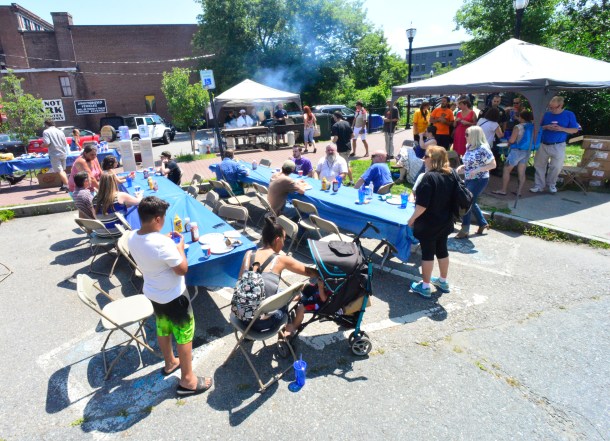
But they’re also reaching out to the public and drug abusers seeking help. They started Friday with a community cookout at a Flat Street parking lot known for its proximity to drug dealing.
“I’ve heard more times than not from educated people, ‘why don’t they just stop?’” Fitzgerald says. “People don’t understand the true depth of this addiction.”
Police didn’t either until they began talking with representatives of Brattleboro Memorial Hospital, the Brattleboro Retreat and Health Care & Rehabilitation Services of Vermont, recovery specialists at the Habit OPCO Brattleboro Treatment Center and Turning Point of Windham County, and providers of support services at Brattleboro Union High School and Groundworks Collaborative.
The result is Project CARE — “a community partnership focused on healing addiction with dignity, respect, and compassion,” its pamphlet says, “to connect people living with addiction to people and supports that can help achieve and maintain recovery.”
“More people in recovery,” it adds, “means fewer people overdosing, committing crimes, and cycling through jails and hospitals.”
Police, working with the Windham County state’s attorney office, will give minor drug possession offenders the opportunity to seek help and have their charges dismissed or sent to court diversion.
“We’re going to judge each incident on its own merits,” Fitzgerald says.
Police are careful to note that although they’ll offer help, they can’t promise immediate results. Addiction recovery centers, for example, often have waiting lists.
“We can’t guarantee a bed will be available,” Fitzgerald says, “but we’ll do everything we possibly can to get the road to recovery started.”
People don’t need to have an overdose or minor offense to take advantage of the program. They can visit the local station, surrender their drugs and paraphernalia “without fear of arrest,” police say, and receive assistance.
Brattleboro credits the national Police Assisted Addiction and Recovery Initiative for offering ideas to sort through and select from.
“We’re not blazing trails here — we’ve cherry-picked different programs from other agencies,” Fitzgerald says. “No one answer is going to fix this, and I’m sure there are going to be some bumps and learning curves. But these are not bad people, they’re just in a really bad situation. Something needs to be done.”
