

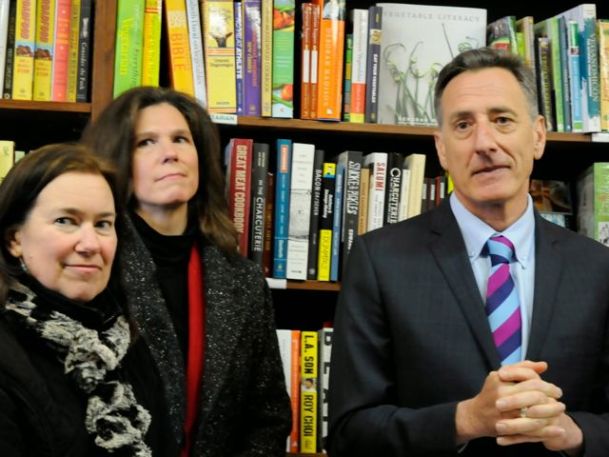
Gov. Peter Shumlin wants to increase the state’s minimum wage from $8.73 per hour to $10.10 per hour, by 2017.
Shumlin’s pitch matches that of President Barack Obama, who’s calling for the same target at the federal level, from the current rate of $7.25 per hour. Three other New England governors have joined the chorus, too.
At a press conference Monday announcing his position, he said too many Vermonters have been left behind in the state’s economic recovery after the recession.
More than 16,000 Vermonters earn less than $9 per hour, according to a report prepared by legislative economist Tom Kavet and Joint Fiscal Officer staffer Deb Brighton and presented to the House Committee on General, Housing and Military Affairs in late February. About 24,000 more wage earners made up to $10 per hour in non-agricultural sectors as of 2012, the report states.
The report also harkens back 15 years to a legislative report on livable incomes published in 1999. It was at the end of a decade of “unprecedented growth in aggregate U.S. income, wealth and prosperity,” the report said. “These stellar aggregate measures of economic progress, however, mask a dramatic shift in the distribution of income and wealth over the past 20 years that has effectively excluded tens of millions of Americans from these gains.”
Now, Vermont is creeping toward recovery from the deep recession of 2008. Tenuous progress is often invoked at the Statehouse as reason to avoid or minimize any new regulations or burdens on businesses.
Opponents point especially to the inevitability of “wage creep.” Raising the minimum also pressures businesses to elevate the higher pay tiers, they argue, so the cost of raising the minimum wage extends far beyond just minimum wage jobs.
“I’m a governor who’s for wage creep,” Shumlin said with a smile. He wants everybody to make more money, and he suggested that members of the business community who oppose raising the minimum wage are misguided.
“I don’t think anyone in Vermont thinks it’s fair,” Shumlin said, to only earn about $14,000 per year as a full-time employee. He said raising the minimum wage is good economic policy, good for business, and the compassionate thing to do.
His proposal would raise the minimum about 45 cents annually for three years, starting in January 2015. Current state law inches it up to keep pace with inflation in the Consumer Price Index. That would be suspended until the minimum reaches $10.10, Shumlin said.
Alternative proposals already under discussion include H.552, which would bump the minimum up to $12.50 per hour. A different bid to establish a “livable” wage as the minimum would set $15 per hour as the floor.
Another labor issue gaining traction this legislative session is a proposal to require most businesses to provide employees with paid leave for health and safety needs.
Many Statehouse watchers suspect it’s politically unrealistic to pass both a “paid sick leave” mandate and a minimum wage hike.
Shumlin, House Speaker Shap Smith, D-Morrisville, and Rep. Tom Stevens, D-Waterbury, all say they still support it. Shumlin said his public support for a minimum wage increase does not mean paid sick leave won’t pass.
But it is the minimum wage bill he said he “very much” wants to see on his desk this session. He added that the economic impact of minimum wage increases is better vetted than that of paid sick leave.
A third labor policy also is implicated in any discussion of minimum wage: eligibility for public assistance.
Most programs, such as child care subsidies, food assistance or housing vouchers, operate with an earnings cutoff. If people earn a dollar more than the eligibility threshold, they can lose so much assistance as to render the raise counterproductive.
“We’ve got to find a way to have assistance programs that don’t discourage work,” Shumlin said.
But the solution is complicated, he said, indicating that waiting for a solution should not hold up raising the minimum wage in the meantime.

