

Editor’s note: This commentary is by award-winning journalist Telly Halkias. It first appeared in the Portland Daily Sun.
The weathered photograph arrived from another lifetime, sent by my sister. It heralded a great lesson from human history: that Goliath ever lurks in the eye of a storm, and someone must confront him.
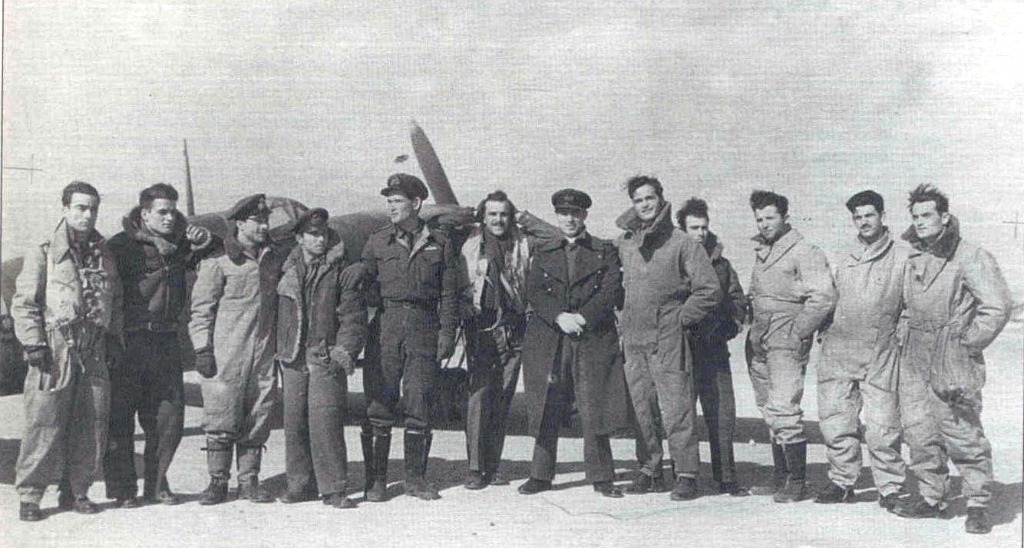
With Veterans Day upon us, it’s been on my mind. On the back, an inscription framed it: “Circa 1943. 336th Royal Hellenic Fighter Squadron.”
Turning the picture over, 12 young Greek men looked out at me through the fog of history. They were less than half my age; while enjoying a brief repose, it was clear they had endured plenty by the time of that frozen moment. Pausing in front of a Spitfire, one of the premier Allied fighters of World War II, they seemed grateful to be alive, and smiling.

Scanning the scene, I found a familiar face. Wearing a wool greatcoat, and with dress cap off-kilter as fighter pilots do to this day, stood my father Christos, one of the squadron’s flight leaders. He held his trademark cigarette and wore an expression that belied the chaos from which those boys called to me.
Worthy of Homer
With the world ablaze around them, those pilots were the best their homeland had to offer in defense of global freedom. Chased from Greece years earlier after resisting the Axis onslaught, they regrouped in North Africa and formed one of the foreign fighter squadrons of the British Royal Air Force. For the rest of the war, they fought and died alongside their Allied counterparts.
My father’s journey to that photo was an Odyssey unto itself. Captured by invading Germans in 1941 and held as a prisoner of war, he attempted escape several times with the intent of joining local guerilla forces. Having failed, he then suffered the required beatings and interrogations before heading back to prison.
As a fighter pilot, though, his skills were needed elsewhere. In 1942, a band of Greek partisans operating in concert with covert Allied operatives sprung the cohort of aviators. Then they began a four month trek to freedom.
Moving by night, the group made its way from Northern Greece to the Middle East along the coast of Asia Minor. They hid during the day, stole fishing boats to avoid dangerous stretches of land, and had their share of small skirmishes and near-misses with the enemy.
Finally, they reached Palestine, joining the Allies’ campaign against Erwin Rommel’s Afrika Korps. The pilots defied all odds and survived almost intact from the North African desert to the subsequent invasions of Sicily and Italy.
Their finest hour
What they didn’t know at the time of that photograph, was that while the Allied cause would find victory, they were far from done with the stench of carnage in their lives.
After two more years of combat, the Greek people afforded them a hero’s welcome upon the liberation of Athens in late 1944. Then they were thrown into the middle of not one, but two civil wars which lasted another five years, until 1949.
The outcomes saved Greece from falling behind the Iron Curtain. Shortly following their victory in the first internecine conflict, a second, larger scale Communist insurgency backed by the U.S.S.R. gripped the small Mediterranean peninsula.
Once, 90 percent of their homeland was under siege. Yet with assistance from the United States and the United Kingdom, the Greeks turned the tide. As a result, their country remained the lone Eastern European nation to elude four decades of Soviet repression.
My father’s luck ran out in 1949 when Communist ground fire brought his fighter down in the Grammos-Vitsi mountains of northern Greece, during the second civil war’s final campaign. Ironically, this wasn’t far from where he had been a POW years earlier.
Not able to bail out, he went down with the aircraft. A British patrol was in the area and rushed to the crash site. They extricated Dad from the cockpit, battered, burned and unconscious, before flames engulfed the Spitfire.
The Greek government dispatched my father to the U.S. for medical and psychological treatment. He stayed on for two decades, intermittently serving in the Greek embassy in Washington, D.C., and the consular office in New York City.
At the latter posting, he met and married my mother, a Brooklyn, N.Y., native and daughter of Greek immigrants. Together they raised three children.
Lands of the free
My father never sought American citizenship, even after he retired from his military and diplomatic positions. He was, however, proud that my sisters and I were born on U.S. soil. Our family later moved back to Greece, yet Dad rejected dual citizenship for his children, always urging that our future was in the New World.
“In America, if you work hard, you can do whatever you want, and be whoever you want to be,” he used to tell us.
Nonetheless, despite my father’s vision for our future, he was a tortured man who had fallen victim to the wars of his youth. Once out of combat, he then fought demons for the rest of his life. As a child, one has no way of fathoming this maelstrom, now known as post traumatic stress disorder.
Decades later, a father and a veteran myself, I understand better but still regret what was stolen from our family, and from Dad.
Someone who fought so long for other people’s freedom deserved a long and happy life in peace. When he died in 1996, masses attended his state funeral in Greece, and the public hailed his wartime record. Yet few knew what those boys had endured, both in battle and beyond.
Today, the pilots are all gone. A remnant of their valor rests in the hands of an American son in New England — once home to a kindred group of upstarts seeking freedom, the Minutemen. Recently, I recounted Dad’s adventures to a friend and showed him the squadron photo. His excitement was so palpable that we continued our history chat into the night.
At one point he gushed: “Can you imagine? These guys from some little country knew nothing but war through their entire youth, and many of them went on and volunteered to fight in Korea just a few years after that — all because free will was at stake. Where can you find that today?”
What it takes
On this Veterans Day, and three generations removed from the photograph, the question lingers.
My father’s squadron, from tiny Greece, carried with it the legacy of the 300 Spartans who had held their ground at Thermopylae two millennia earlier, against a half-million Persians: they had no choice but to fight.
When I was growing up, I never heard Dad glorify war or suggest that killing was the only way to dispatch an enemy. He did, however, consider it a last resort to defeat greater evils — to take down those who would oppress, subjugate and exterminate anyone weaker.
While never calling themselves heroes, those flyboys helped to beat back a tide of evil that made the difference in their fate, and ours. Only now, and by not forgetting them, can we comprehend their sacrifice, and that of a million other veterans from that era who never came home.
When Dad died he was ill in body and broken in mind, but in 1943 he was young and strong, and part of something far bigger than himself. And so, from his desert airstrip, a dozen young Greeks looked out at the world’s dim future with hope — and defiance.
Somewhere, they seemed to tell me, an unflinching David still waits to scramble his Spitfire full throttle into the darkest clouds.
You may e-mail Telly Halkias at tchalkias@aol.com or follow on Twitter: @TellyHalkias

