


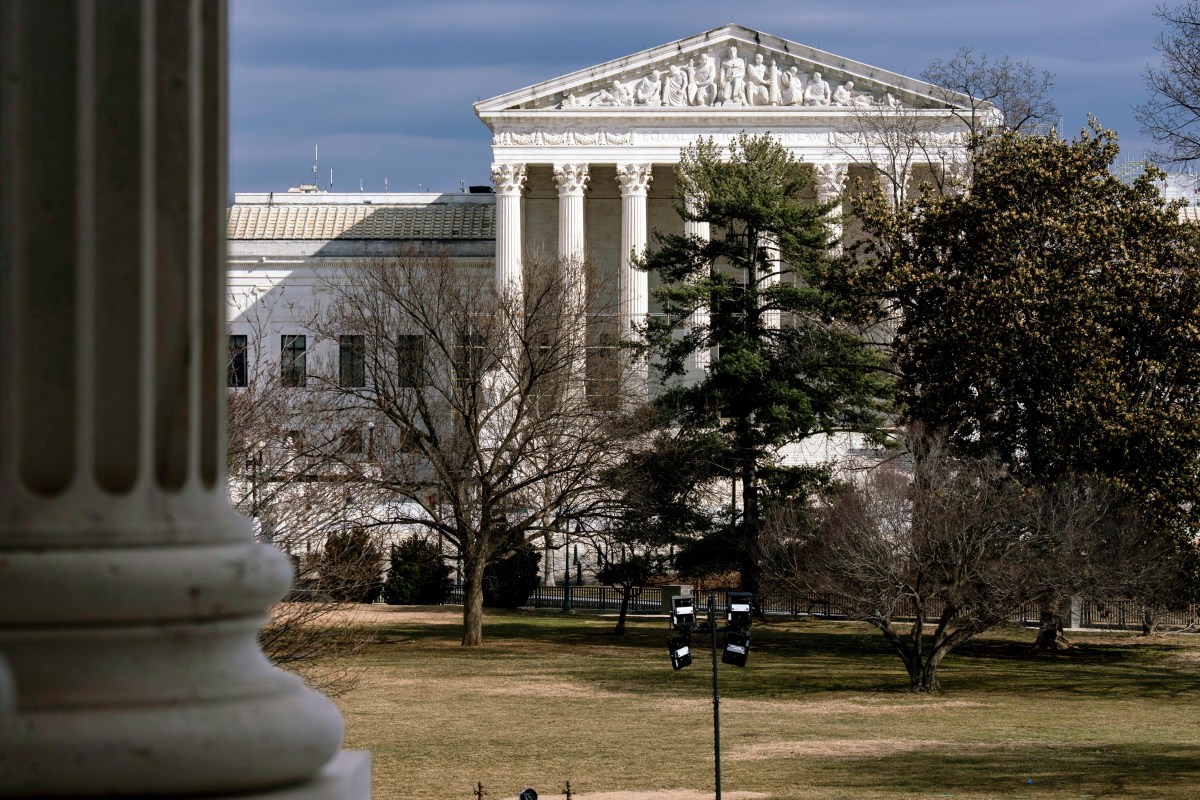
The U.S. Supreme Court ruled 6-3 on Monday that a Vermont State Police officer is immune from an excessive-force lawsuit stemming from the forcible removal of a protester from the Vermont Statehouse in 2015.
The court’s conservative majority overturned a lower court ruling that Sgt. Jacob Zorn’s use of a wristlock on protester Shela Linton constituted excessive force, finding the law did not clearly establish his conduct as a Fourth Amendment violation, protecting Zorn under qualified immunity.
“The majority today gives officers license to inflict gratuitous pain on a nonviolent protestor even where there is no threat to officer safety or any other reason to do so,” Justice Sonia Sotomayor wrote, joined by Justices Elena Kagan and Ketanji Brown Jackson in dissent.
The case began in 2015, when protesters occupied the Vermont House of Representatives during then-Gov. Peter Shumlin’s inaugural address, unfurled a banner and refused to leave. Linton was among 29 demonstrators demanding action on universal health care.
When Zorn tried to remove Linton from the chamber, she “passively resisted,” according to the court’s opinion, refusing to stand up from a seated position. Zorn then pinned her arm behind her back in a “rear wristlock” and lifted her to a standing position, resulting in permanent injuries to her wrist and shoulder and post-traumatic stress disorder, according to the suit.
A lower court had found that Zorn’s conduct was “gratuitous” and violated a standard for use of the wristlock technique established in a previous case, Amnesty America v. West Hartford. Yet Monday’s decision reversed the lower court’s decision, arguing that Zorn’s conduct did not match the precedent in the Amnesty America case closely enough.
According to the majority opinion, Zorn warned Linton before applying the wristlock, which it argues is enough of a deviation from the previous case to meet the standard for qualified immunity.
Keegan Stephan, Linton’s attorney, disagreed with that interpretation and said Wednesday that reports of Zorn’s warnings were disputed, calling the majority’s argument “disingenuous.”
Jared Carter, a law professor at the Vermont Law and Graduate School, explained that the Court’s ruling has made challenges to qualified immunity even more difficult by narrowing possible cases of misconduct to almost exactly prior cases, effectively stopping many cases of misconduct from reaching the courts.
“In practical terms, that almost never happens,” Carter said.
Carter said that Sotomayor’s dissent points to the high burden that this ruling creates to overcome qualified immunity, making that immunity almost absolute. That potential precedent is even more relevant considering calls for investigation into police conduct during anti-ICE protests in South Burlington, wherein protesters have questioned whether that use of force potentially violated their Fourth Amendment rights, Carter said.
Disclosure: Jared Carter has provided pro bono legal assistance to VTDigger in an unrelated public records case
