
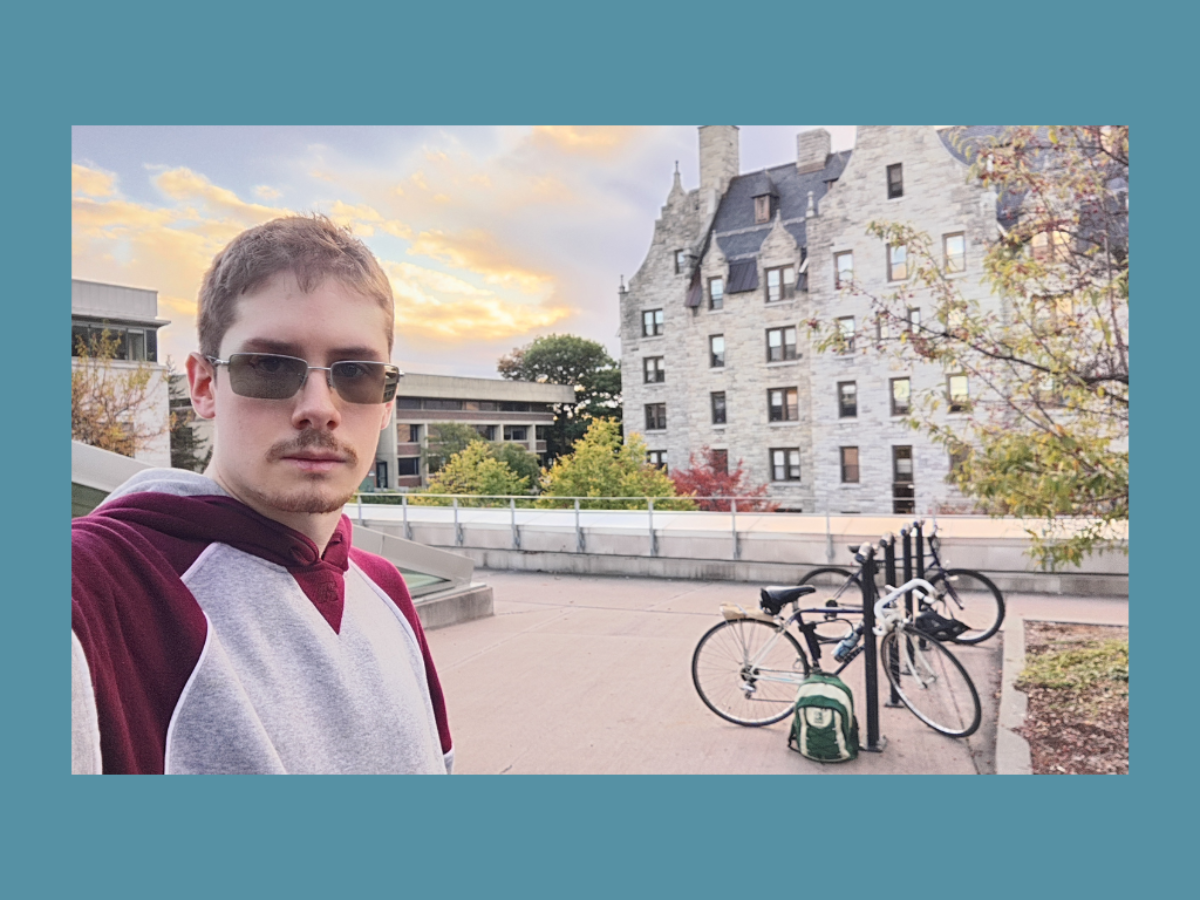
Imagine taking the Rural Community Transportation (RCT) bus at 6:00 AM from St. Johnsbury to Montpelier, then catching the 7:30 AM Green Mountain Transit (GMT) LINK Express from Montpelier to Burlington, followed by either a bike ride or local bus from Burlington to Winooski—arriving just in time for an 8:30 AM class. And then do it in reverse, to get home that afternoon.
For Brad Hubbs, this journey across the state in the morning and the return trip in the afternoon has been a twice-a-week occurrence over the past semester as he’s worked toward completing his associate degree at Community College of Vermont (CCV). One thing is for sure: for Brad, a college degree isn’t measured in credit hours alone, but in the miles traversed and connections made along the way.
Brad relies entirely on Vermont’s public transportation infrastructure and his trusty bicycle to get to class. He doesn’t own a car and bikes everywhere he can, considering it a “badge of honor” that he makes it work. While he lives within walking distance of his job at the Fairbanks Museum and Planetarium in St. Johnsbury, the college courses he needs for his degree are offered 75 miles away at the Winooski CCV center. Not one to shy away from a challenge, Brad found a transportation solution that works for his budget and lifestyle, and gives him the human interaction and communal experience he missed during COVID.
A non-linear path through college
Brad first started taking college classes online at CCV in 2020. He was a few years out of high school at that point and had initially shied away from going to college as he didn’t know what he wanted to study. Because he didn’t quite know what subject area he wanted to pursue, he spent some time working at a local grocery store and then in an internship-turned-job at the local science museum. As his interests expanded, he started leading education programs and learning as much as he could about science, space exploration, and astronomy.
And as Brad moved into adulthood, VSAC resurfaced in his life. In high school, Brad had worked with VSAC Outreach Counselor Marti Kingsley. In the years that followed (after Marti had transitioned from working with teens to helping adults access college and career training services with VSAC’s Educational Opportunity Center) she was there once again when Brad sought guidance. Brad calls Marti an “absolute wizard” for her ability to simplify the labyrinth of financial aid. With her guidance, he accessed a package of scholarships and grants, including a generous scholarship from the Curtis Fund, that covered nearly all of his tuition and books at CCV. “Things were tight for me, so not needing to worry about tuition was huge, and it made a complicated process a lot simpler,” Brad shared.
Brad’s path through CCV wasn’t seamless. As he navigated the dueling priorities of his full-time job and his classes, he had some ups and downs in his grades. He took a year off to focus on two big work-related projects about the April 2024 solar eclipse. When he returned to school in the fall of 2024, he committed to attending in-person classes. That’s where public transportation came in. That semester, Brad aligned all the courses he needed on the same weekday at the CCV Montpelier campus, resulting in a two-and-a-half-hour round-trip commute. That weekly commute helped him prepare him for the longer treks that would come a year later.
“I was 26, taking the bus at 6:00 AM. It was a bit surreal being in a classroom setting again after the pandemic, a bit like being in high school again,” he says with a laugh. “But the classes were diverse, and it was my best semester experience. I realized I missed that human interaction.”
In the spring 2025 semester, he was able to secure transportation via a local bus and a family member to the CCV Newport campus. “I’ve been getting around, all over the northern half of the state to attend college,” he remarked. “It’s been a valuable learning experience in navigating Vermont’s transportation services, something I never got when I used to just drive my own car where I needed to go.”
Brad’s commute became an educational journey in and of itself. Along the way, he met course coordinators, fellow students, and volunteers on the bus, building a spirit of community and camaraderie which he feels is often lost in the isolation of a car. And he learned to deal with the ups and downs of public transportation: On his birthday, his bus broke down in Burlington. Luckily, his bike was aboard, allowing him to navigate to the CCV Winooski campus. He says he views that day as part of the experience and something that made his education memorable. On the journey home from that important day, Brad was also transporting an unanticipated second-place table tennis trophy with him, via bike and a backup shuttle bus.
Exploring his interests in STEM studies and world affairs
Brad is currently enrolled in the STEM Studies program at CCV and expects to finish his associate degree by the end of the calendar year. A cultural anthropology class tapped into a deep-seated curiosity about how people from different backgrounds collaborate. His interests have expanded to include international relations and global affairs as well.
This led him to apply to the Vermont Council on World Affairs (VCWA) Global Leadership Program. While the professional development program required a fee and another commute once per month to Burlington, Brad stacked the class with one of his CCV courses to make the time commitment more manageable. He notes that his time was stretched thin by these commitments and his full-time job. But it’s worth it, because his interest in global affairs is growing.
“I’m interested in living abroad—maybe Canada or Europe,” he said. “My dream is to do work that feels meaningful and impactful, whether that’s in space, science, or international communication.”
“I want to be excited and engaged every day,” he says. He describes how when he first started at Fairbanks Museum shortly after high school, there was a workspace downstairs with a 3D printer in it, which he used to print models of rockets and spacecraft for educational programs. That space is now where he meets with his CCV advisor, or with Marti, as they plan out his academics and financial aid. It feels full circle, especially as his childhood interest in astronomy and science fueled his desire to work at the museum and then to pursue his degree.
As he works toward graduation, Brad says he is thankful for his academic journey and the non-traditional commute he takes to make it happen. He has learned a lot in school and in life from the experience, which he’ll no doubt parlay into a career as fascinating as the road he took to get there.
The Vermont Student Assistance Corp. was created by the Vermont Legislature in 1965 as a public nonprofit agency. We advocate for Vermont students and their families to ensure that they have the tools they need to achieve their education and training goals. We create opportunities for all Vermont students, but particularly for those—of any age—who believe that the doors to education are closed to them. Growing families save for education with VT529, Vermont’s official 529 savings program. To help Vermonters plan and pay for college or job training, our counselors work with students in nearly every Vermont middle school and high school, and are also available to work with adults. Our grant, scholarship, and workforce development programs create opportunity, help students re-skill or learn new skills, and grow the economy. VSAC’s loan, loan refinance, and loan forgiveness programs provide competitive education financing to students and families. Find us at www.vsac.org or visit Facebook, Instagram, or LinkedIn.

