




In the early morning of Dec. 7, 1952, Dave Jennings took a moment to write his parents, who were half a world away in Burlington, Vermont. By his watch, it was 2:50 a.m.
“Of course I’m tempting fate by saying it, but if things will just keep quiet for a short period of time, I’ll manage to get a few lines off and attempt to fill the gap in my correspondence,” he wrote. “Hope my silence hasn’t got you worried.”
Jennings, a 1st lieutenant in the U.S. Army, was camped in Korea, atop what the military had given the unpoetic name of Hill #930. The weather had been merciless. Three days of temperature no higher than zero. “In spite of the ‘wonderland’ beauties of Hill 930 and its Stowe-like view, life was just a bit uncomfortable,” Jennings joked. “Tonight, however, the temperature is back in the twenties and ‘it might as well be Spring.’”
Jennings was in a chipper mood. He thanked his parents for an early birthday gift he had just received. “Your package with that jumbo hand warmer arrived and it’s a beauty,” he wrote. “(Y)ou couldn’t have sent a more timely birthday present.”
He sent his love to his grandmother and aunt and “all the folks.”
“(E)ven if I’m lucky it doesn’t look like I’ll get out of here before April, so keep the mail coming — it’s going to be a long winter —
“Loads of love,
Dave”
The next morning, James and Nadine Jennings probably woke up thinking of Dave. It was his 23rd birthday. At some point that day, a Western Union employee arrived at the door of their North Winooski Avenue home and delivered the telegram they always feared they would receive.
“The Secretary of the Army has asked me to express his deep regrets …” it began. Earlier that day, the telegram announced, Dave had been killed in action.
Jennings was one of more than 33,000 Americans, including 92 Vermonters, killed in the Korean War. What makes him noteworthy — other than the humor, courage and other traits that drew people to him — is the remarkable correspondence home he left behind. His last letter, and the telegram that beat it home, is preserved along with dozens of others at Silver Special Collections at the University of Vermont’s library. Like all good historical letters, these bring to life a moment in time and offer a glimpse of the writer’s experiences.
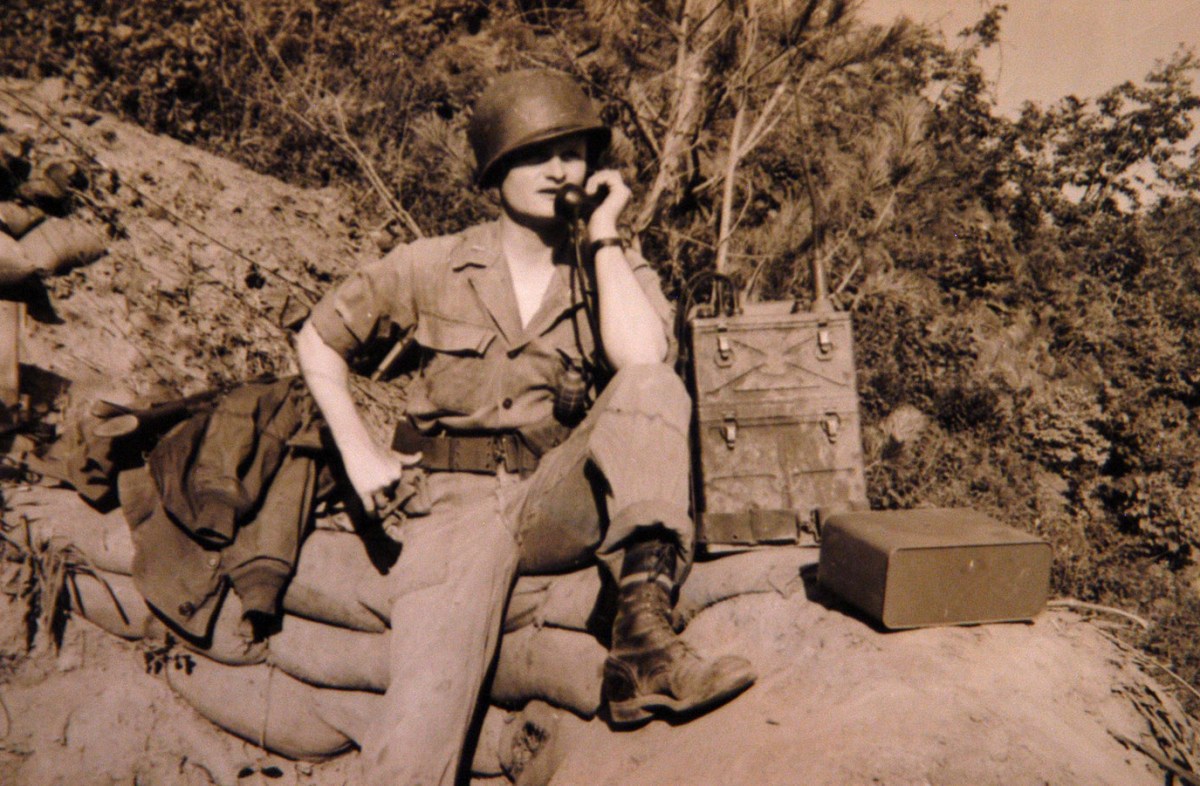
In hindsight, the Korean War was perhaps inevitable. The country, located on a peninsula in eastern Asia, was unified for roughly 1,300 years before the Japanese occupied it in 1910. World War II put an end to Japanese domination of the peninsula, but split Korea in two. An international post-war agreement divided the peninsula roughly in half, along the 38th parallel, creating two new countries: North Korea, which allied itself with the Soviet Union and China, and South Korea, which was supported by the United States.
The precarious peace ended in June 1950 when North Korean troops invaded the South. President Truman ordered American troops to repel the invasion. Fifteen countries joined the United States under the United Nations’ flag.
By September, however, North Korean forces had pushed United Nations troops, led by U.S. Gen. Douglas MacArthur, back to the Pusan region in the southeast corner of the peninsula. MacArthur counterattacked with an amphibious assault at Inchon, halfway up the peninsula’s west coast, and within two months had driven the North Koreans north to the border with China. Feeling threatened, the Chinese entered the war. Their forces pushed U.N. troops south of the 38th parallel, which for most of the rest of the war would be the fulcrum on which the balance of power on the peninsula would tip. Dave Jennings’ tour of duty occurred during this stage of the fighting. (The 38th parallel remains the dividing line between the two Koreas today.)

When the Korean War erupted, Dave Jennings must have known it would affect him. He was about to start his senior year at the UVM and was a member of the school’s Reserve Officers’ Training Corps. In exchange for help with tuition, he had agreed to serve at least two years as an Army officer after graduating.
ROTC was something of a family tradition. Jennings’ older brothers, John and Jim, had been commissioned through ROTC. (His younger brother, Patrick, would eventually follow suit.) Dave, however, was the only one who would see combat.
Jennings was well suited to being an officer. Though he was short and slightly built, he was strong and physically brave. He had played football in high school, and had worked farm jobs in Williston and also in Iowa, to which he hitchhiked one summer when he couldn’t find work locally.
After graduating with an English degree, Jennings was commissioned a first lieutenant and sent to Fort Benning in Georgia, then to Fort Dix in New Jersey. In his free moments, he wrote home to explain his odd new life.
In a December 1951 letter, he described helping lead a training on a wet, snowy day at Fort Dix.
“Imagine those kids digging foxholes in the blinding snow,” he wrote. “ Don’t ask me how I worked them up to any kind of enthusiasm. All I know is that I walked all around that area offering criticism, suggestions, + encouragement all afternoon. We kept hitting them with aggressor attacks so that they were in + out of their holes all afternoon. Many of them struck water about 2 ft. down. I came upon one ‘yo-yo; (NCO slang for a bewildered trainee) standing in his foxhole and shivering. He had gotten down into the water and the bottom of his foxhole looked like a rather muddy well. I asked him what he intended to do about it, thinking to draw some sort of plan for drainage out of his frozen brain. All he could offer was ‘all I know is I ain’t gonna dig no further, sir.’ I had to laugh in spite of his predicament. There he was up to his ankles in freezing mud + water. He’d have stayed there all afternoon but be damned if he’d dig ‘no further.’ Well, we finally threw some bricks and stones into the hole for him to stand on.”
The incident taught Jennings something.
“It’s funny,” he explained, “but you’ve got to take an almost insane interest in the slightest little exercise the trainees do – otherwise they sense that their foxhole, or whatever the project happens to be, isn’t too important and immediately goof-off. Never before has a hole in the ground been discussed as thoroughly as on Friday afternoon.”

His own training complete, Jennings boarded a troop ship for Korea in mid-April, 1952. The vessel sailed out of the Puget Sound. The first stop would be Japan. Along the way, he wrote his parents, “2/3s of the ship’s passengers were laid low in various degrees of active and passive nausea.” Not him, though. Jennings wrote: “my appetite never for a minute faltered.” He credited his experiences in the family sailboat “in the worst that Champlain could offer.”
After a brief stop in Japan, he got his first glimpse of Korea. He was unimpressed.
“So far, Korea is a land of filth, foul smells, and squalor,” he wrote his parents on May 6, 1952. He was in Pusan, in the extreme southeastern corner of the country. “Japan was easy to accept as a new, if temporary, home. I think you might say our first look at Korea left us with a feeling of ‘homesickness’ for Japan.”
Two days later, he wrote that he had been moved north to Chuchon, nearly to the battlefront, which lay about half way up the peninsula.
“How (to) describe the scene all around us?” he began. “I don’t really know. This narrow valley created by the muddy Han (River) is like a gigantic ant hill, the center of the cone a swarm of human and vehicular ants, the sides formed by the sudden slopes of surrounding mountains, their peaks rising very nearly perpendicular (from) the valley floor. Down here among the swarm, all is dust and piercing sunlight. …(T)hrow in some more dry, powdery dust and dirt and perhaps you can get some sort of picture.”
The area was swarming with soldiers, living in a sea of tents and listening to the buzz of helicopters and airplanes at the nearby U.N. airstrips and “the squalling of decrepit Korean locomotive whistles” at the rail hub for the central front.
Jennings’ journey north to Chuchon had been sobering.
“I guess I indicated the sad state of affairs in Pusan. Well, Pusan appears to be about a hundred times better off than Seoul,” he wrote. “Our train ride north taught us a lesson in the ravages of war that will never be erased. Everywhere the spring crops are coming along as usual but every village shows its scars, the farther north one travels, the worse the damage becomes, until you reach the vicinity of Seoul where very few permanent buildings stand. Those that have survived are so riddled as to be almost useless. Bridges are a luxury and every stream and river shows the twisted wreckage of a destroyed span. Here in the valley of the Han the railroad tracks are littered with the burned, shrapneled and rusting hulks of freight cars. Veterans of the campaigns in Europe during W.W. II are shocked by the totality of the destruction.”
The devastation helped Jennings sympathize with the situation Koreans faced.
“The immediate reaction to this mess is the old buck-passing frame of mind. Viz a viz: why not pull out completely and let the dirty little Koreans fight it out among themselves?” Jennings wrote. “Certainly the greater part of the civilian population is indifferent to this war. Surely enough, the average Korean doesn’t care which side of the fence he’s on. Personally I’ll be the last to blame the Koreans for anything that is happening over here. If I were the poor devil who’s living in a little rice straw hutch the size of a pup tent along the railroad tracks in Seoul (and there are literally thousands doing it), I wouldn’t remember anything but thirty years of Japanese domination, and the present see-saw plunder of my country. Undoubtedly I would sell my soul to the highest bidder and if stealing were the only means to keep my life, I’d steal (thus the two Koreans who were shot at last night trying to get into our compound.) South Korea is still infested with guerilla bands no matter what the authorities say. …A run-down of a situation like this merely serves to raise questions. But the questions raised have no apparent answers.”
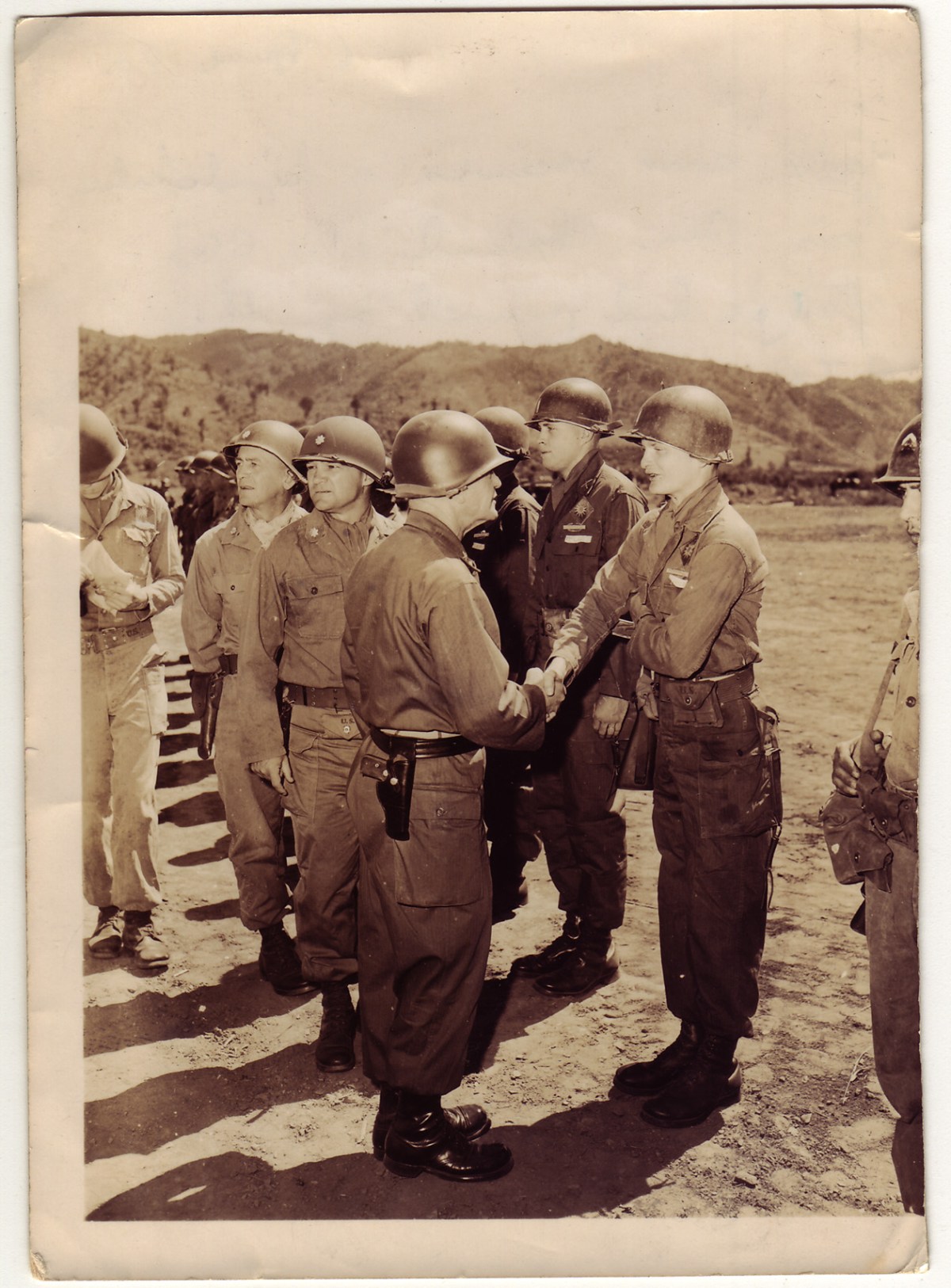
Jennings got his first taste of battle less than two weeks later. The Army sent 44 Patton tanks within several hundred yards of the Chinese advance positions. The Chinese fired on the tanks and Jennings was rousted from bed to spot incoming enemy artillery rounds. “I watched, fascinated, as one tank suffered a near miss and burst into flames,” he wrote. “The adjoining tank pulled up close and four crew members dashed from the burning Patton and clambered aboard. There was a pause as the flames crept higher around the turret. Everyone on our hill held his breath. Then another figure appeared out of the hatch and leaped over the flames just before a billow of orange and black obliterated our view. You could feel the sigh of relief.”
Jennings seemed as worried about friendly fire as enemy fire. He mentioned a rumor, which he didn’t believe, that the Chinese were planning an assault on their position. Fox Company, located to the left of the company he commanded, was “trigger happy,” he wrote, and nearly shot at one of his patrols two nights earlier. He said they were “jumpy as newborn colts” because a nearby platoon had suffered a “tragic infiltration” recently. He spared his parents the details. “I can’t especially blame them,” he wrote, “but if they’d get more sleep and save their ammo we’d all be a bit better off.”
Jennings’ letters were starkly different from the ones he was receiving from home. Those were full of good news—his father, who was in public relations, had a new project; one of his brothers was getting married; another brother was having success at school. In one letter home, he confessed that the world he had left in Vermont had become distant. “With every month that I’m away,” he wrote, “it becomes more difficult to keep in mind that this isn’t life as I’ve always known it.”
But his experiences in Korea still had the power to astound him.
On Aug. 30, 1952, Jennings wrote his parents about a surreal trip he had just taken to Seoul. It was an urgent mission, of sorts. He and his company had been moved back from the front to Yeongwol for some rest. But ever since they had arrived, the movie projector they’d been issued had been broken and the supply officer was having no luck getting it fixed.
“Last Sunday night, I decided the time had come for action,” he told his parents. So, at 4 a.m. Monday, with the necessary work orders and directions, he and his driver, Red, headed out on what he said was a 300-mile round trip to Seoul to get the machine repaired. The route was circuitous—Yeongwol and Seoul are about 100 miles apart.
They headed out onto a road dubbed Route #2. “Gad, what a shock! It was a single lane goat trail which wound into some formidable looking mountains,” he wrote. “It was raining and the road was sheer mud! Well, it was too late to turn back. On and on we drove… Because of the holes and washouts in the road we were never able to go above 25 or 30 mph., which, incidentally, seems like 90 on a Korean road.”
After catching breakfast at a base in Wonju with a Capt. Leahy from Rutland, they pushed on and hit a paved road around noon. “The first I’ve ridden on since April,” Jennings noted.
They reached Seoul in the early afternoon. It was pouring. They dropped the projector off for repairs, but were disappointed to learn that it wouldn’t be ready for four or five days.
They went in search of food, finding that the Air Force canteen and other mess halls had finished serving lunch.
“Finally we decided to try the Seoul P.X., a four-story building in the ‘downtown’ district. As soon as we parked the jeep it was surrounded by urchins and elderly beggars trying to beg or steal just about everything,” he wrote. “I went in and had a few hamburgers and a real chocolate Sunday while Red guarded the jeep. Then he took his turn.”
They started to head back at about 3:30 p.m. As they left Seoul, Jennings looked at the decimated city passing by his window.
“Business seemed to be going on as usual in that city, but most of the buildings show gaping holes, bullet pock-marks and only portions of roofs. Guess the philosophical Koreans figure it’s a little too early in the game to start rebuilding only to have the city change hands again,” he observed. “From the extent of damage in the Western half of the city, it’s easy to visualize just how the marines moved through from the hills (near) Inchon, past the Seoul Railroad Station, to the center of the city. But surprisingly enough, one sees relatively few GIs in the city itself. At the P.X. there were French, British, Canadian, Turkish, + Filipino troops.”
On the drive back, Jennings stretched out in the back, his legs extending between the Jeep’s from seats, and managed to catch a couple hours of sleep.
They stopped again at the base at Wonju. “It was dark when we arrived back at Capt. Leahy’s little establishment, but he was bound he was going to show me a ‘big time’ in the ‘big’ city. We drove out to the Officers’ Club (a quonset hut) at the 11th Evacuation Hospital and had a few drinks. …Next morning we made the three hour trip home to Yongwol and found everything running smoothly.”
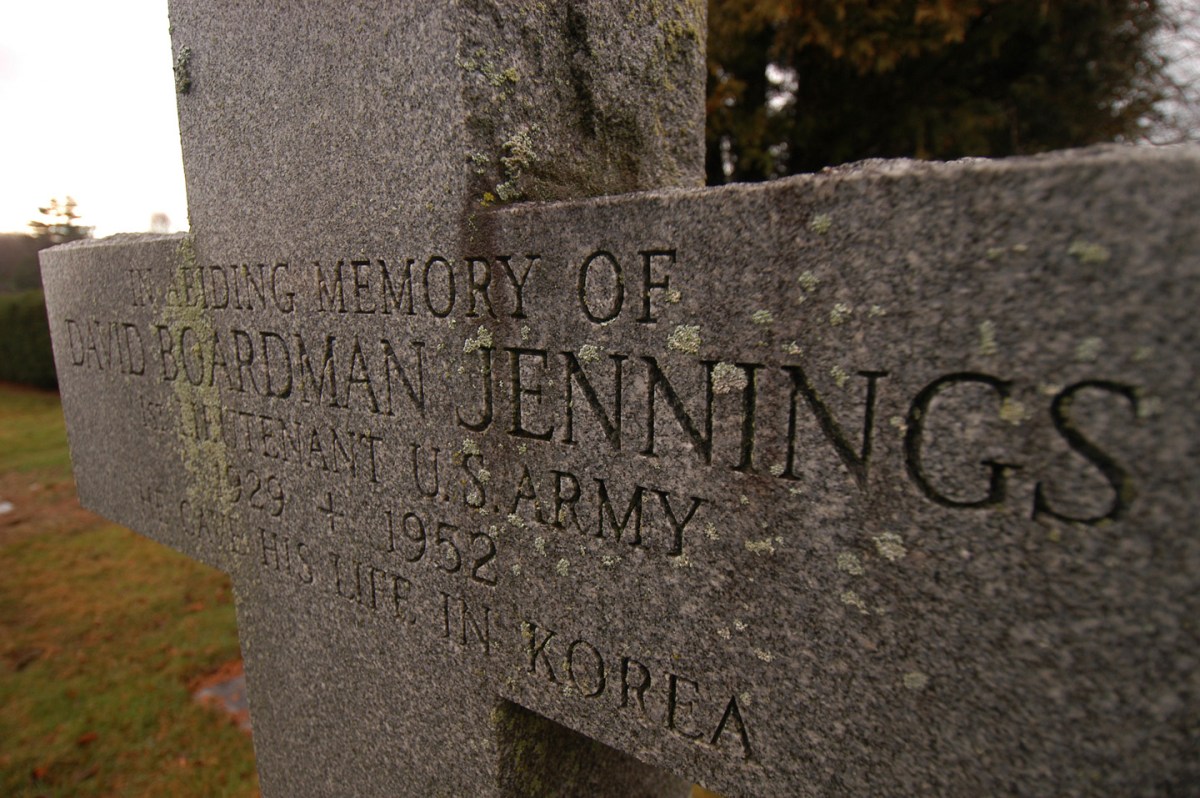
The body of Dave Jennings was returned to the United States, along with another 150 other Americans who died in Korea, aboard the SS Iran Victory. He is buried in Resurrection Park Cemetery in South Burlington. Photo by Mark Bushnell
By early November, Jennings’ company had been returned to the front.
To his brother Patrick, he wrote that “we are now located on the rim of what they call ‘the punchbowl,’ I guess because of the tremendous effort it took to claim this piece of terrain as our. It is actually a circular valley about seven miles wide with an almost circular rim running all the way around. … Just imagine a large cereal bowl and you get the idea.”
Then he described other nearby features the war had made prominent. “A few miles to our left lies Heartbreak Ridge, Bloody Ridge, and running into our ridgeline and about 1600 yds away is No Name Ridge (which, off the record, I hope no one decides we should try to take where others have failed!)”
U.N. troops had managed to take both Heartbreak Ridge and Bloody Ridge in a series of intense battles that ended only two weeks before Jennings arrived in the area. Casualties were high. U.N. forces lost roughly 6,400 killed or wounded. The Chinese and North Koreans suffered an estimated 40,000 casualties.
When he wrote his grandmother in Stowe later that first week at the Punchbowl, Jennings tried to avoid the topic of war.
“Dear Nanno,” he wrote. “Somehow, the dark, snowy night, the lantern-lit bunker and the little stove reminded me of Vermont and Stowe and winter in the Green Mountains… (I) understand you’ve been doing some mighty concentrated praying for your grandson on the far-flung battlefields. That’s good news too, cause I can use your prayers and I think by this time you must have some pretty good friends up above.”
Jennings, who was raised Catholic, regularly mentioned religion in his letters, most often describing how he managed to find a place to celebrate Mass on a given Sunday.
“Nanno, I could talk shop about smoke, and noise and guns and men, but I’m sure that it would mean little to you,” he wrote. “And as for the scenery hereabouts … well, hills are hills the world over, but the difference seems to be that the hills of home are friendly. Actually the purpose of this note is just to let you know that you are in my thoughts and prayers and that I wish I could be home with you all for Thanksgiving.”
A month later, he sat down to write what would be his last letter home.
The telegram his parents received the next day only told them that he had been “killed in action” and that there would be a “confirming letter following.” No details. It was nearly four months before they learned what had happened.
A friend of Jennings’, a fellow 1st lieutenant named Roy J. Herte, Jr., wrote the family on March 28, 1953. “I don’t know if you all were told the way Dave was killed but you can be proud of him,” wrote Herte, who nominated Jennings for a Silver Star, which he received posthumously.
Herte had been leading a daylight patrol that was hit by enemy fire. Within minutes, Herte was the only member of his squad left unwounded. They were in clear sight of the enemy, who were shooting and firing artillery at them. Herte radioed Jennings to warn him not to try to help. Jennings ignored the warning and brought three stretcher teams with him.
“As we laid side by side in the snow trying to figure how we would get the wounded out, a call came in on the radio,” Herte wrote. “I moved over about a foot to answer it, still not more than two feet from Dave, when a mortar shell landed between us. It killed Dave outright, he never knew what hit him and at no time was he ever in pain. God made the choice, I did not even get a scratch.”
“…I can’t help but feel God took Dave because he had an express ticket to heaven while I would have had to make a few stops along the way.”
Herte wanted the Jennings’ family to know that “(t)hroughout the afternoon it was Dave’s courage and example of self sacrifice that drove us on. Because of the help he brought it was possible for me to evacuate the wounded. It was Dave’s life that paid for three boys getting to the aid station in time to save their lives.”

