


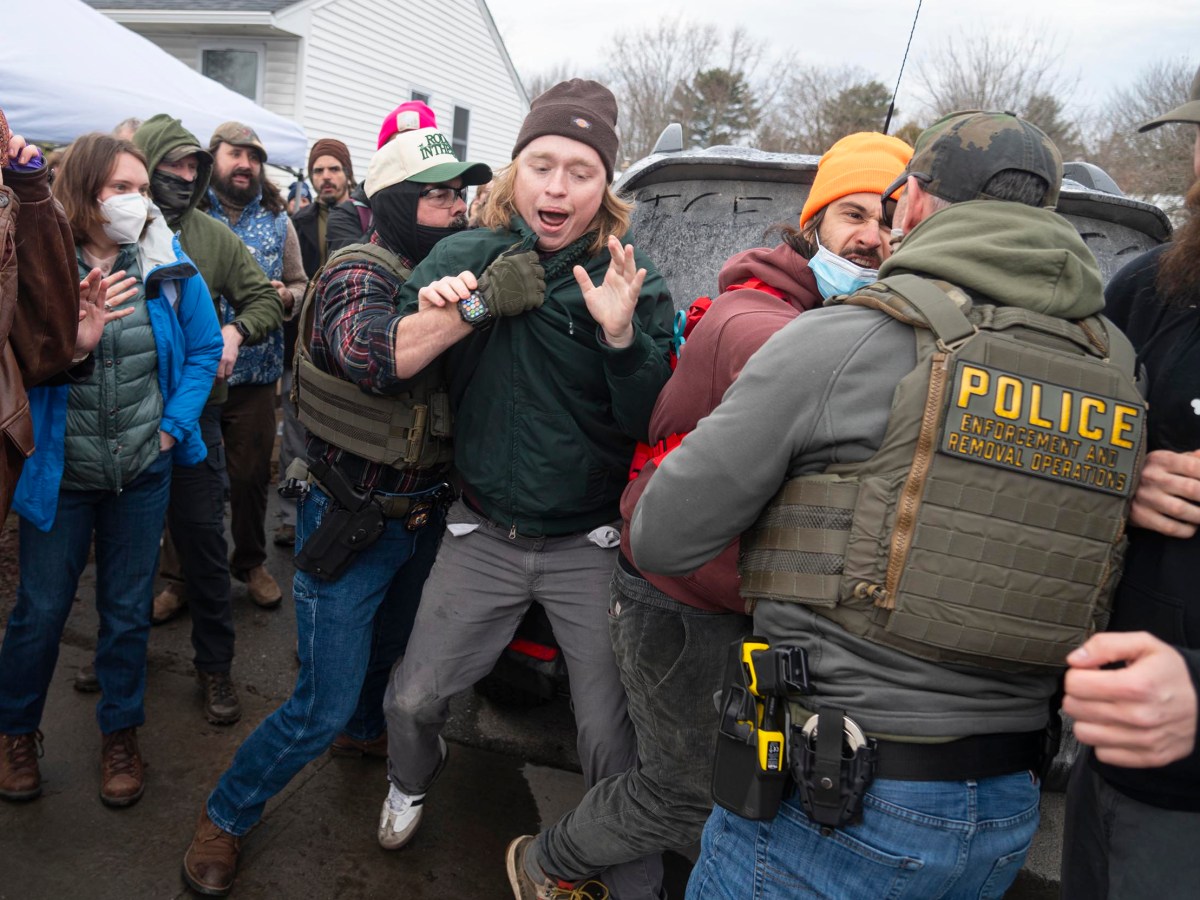
MONTPELIER — Days after a U.S. Immigration and Customs Enforcement operation sparked chaotic clashes between police and protesters in South Burlington, the Vermont House on Friday passed a bill that would create a new legal pathway for people to sue federal agents they allege have violated their constitutional rights.
The bill, H.849, was in the works before Wednesday’s operation that has put intense public scrutiny on the actions of ICE agents in Vermont. During that hourslong standoff, federal immigration officers used flash-bang devices and chemical agents to break up a crowd at the scene, according to an account provided by Vermont State Police.
But supporters said this week’s legislation, which got initial approval Thursday on a 97-39 vote before winning final approval on an untallied voice vote Friday, takes on new urgency after the first major clash between federal immigration agents and protesters in Vermont since President Trump took office a second time.
“It shows an example of just why you would want to have laws like this on your books, to better protect the people of the state,” said Falko Schilling, a lobbyist with the American Civil Liberties Union of Vermont, which supports the bill and has condemned the ICE operation in South Burlington. “Rights without a remedy aren’t really rights at all.”
In a statement lauding the bill’s approval, House Speaker Jill Krowinski, a Democrat from neighboring Burlington, also tied its passage to what she called “the most invasive action taken on Vermont soil by federal law enforcement agents.”
“The events that occurred have left many unanswered questions, including whether constitutional rights were violated, and this legislation is crucial to providing an avenue to Vermonters to seek justice if their rights are violated in the future,” she said.
Now that it’s passed the House, the bill will head to the Senate for more consideration.
As it stands, an 1871 federal law allows people to bring civil rights lawsuits in federal court against state and local government officials, including police. That law, known as Section 1983, has long been used to hold police officers accountable for misconduct.
But Congress has not passed a similar law allowing for such lawsuits against federal agents, such as ICE officers, who are accused of rights violations.
That’s where Vermont’s bill — and others like it that have been enacted in one state and are being considered in a handful of others — comes into play. The legislation would allow anyone in Vermont to sue a federal officer for “the deprivation of any rights, privileges, or immunities secured by the Constitution of the United States.” Officials could, notably, still claim qualified immunity, a legal doctrine that, broadly, bars officers from liability unless their conduct violated “clearly established” law such that a reasonable officer would have known the conduct was unconstitutional.
Claims could include an infringement of someone’s Fourth Amendment rights if federal officers entered their house without a valid warrant, said Rep. Martin LaLonde, D-South Burlington, the bill’s sponsor, presenting it on the floor Thursday. Another example would be a possible infringement of First Amendment rights if officers prevent someone from engaging in a lawful protest, he said.
LaLonde acknowledged that the bill, if it became law, could be challenged by the federal government in court under the Supremacy Clause of the U.S. Constitution. The Trump administration sued Illinois — the one state that has passed a similar law — seeking to nullify the legislation after it was enacted last year.
Still, LaLonde told his colleagues on the floor he thinks Vermont would have “strong counterarguments,” and that the measure was worth pursuing.
The bill faced opposition from many Republican members of the House both in the chamber’s Judiciary Committee — which LaLonde chairs — and on the floor. The committee’s vote to advance the bill to the floor fell along party lines, with all five members who caucus with Republicans voting against it.
On the floor Thursday, House Minority Leader Pattie McCoy, R-Poultney, raised the prospect of that legal challenge and said the bill’s provisions should have gotten more review in committee.
“I will vote no on H.849. Not because I oppose accountability for government officials — I support (that),” she said. “I will vote no because there needs to be a much deeper dive into the constitutionality.”
