


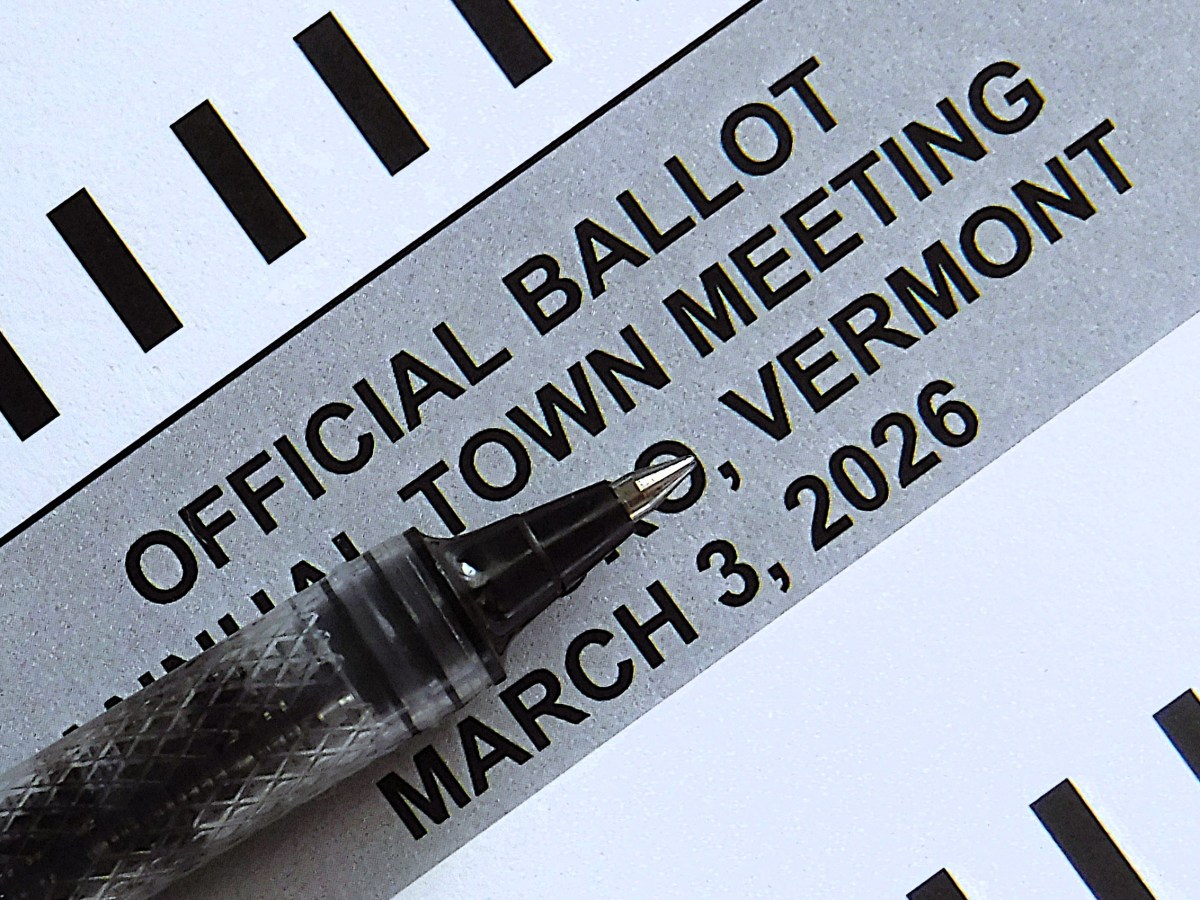
Rutland City, population 15,807, will vote for a new mayor by write-in ballot. Cabot, population 1,443, will debate spending $10,000 to dispose of 1,500 tires dumped in local waters and wetlands. And Holland, population 632, will face its own uniquely challenging issue: specifically, the lack of one that will draw a crowd.
“I really wanted to add something controversial so we might have better attendance, but I will be supplying donuts,” Holland Town Clerk Diane Judd, recent head of the Vermont Municipal Clerks’ and Treasurers’ Association, told VTDigger.
Vermonters from northwestern Alburgh to southeastern Vernon are set to chew over a varied menu of local matters this Town Meeting season as they vote on municipal and school budgets, board members and advisory articles on everything from AI data centers to state-supported universal health care.
Amid public concerns about affordability, Vermont’s 29 cities and towns with at least 5,000 people are asking for nearly $44 million in capital projects — an 84% drop from last year’s $275 million wish list of proposals.
The 218 communities with smaller populations will consider their own wide range of requests. In the biggest single bond proposal statewide, the Mountain Views School District towns of Bridgewater, Barnard, Plymouth, Killington, Reading, Pomfret and Woodstock will cast ballots on a revised plan for a new $112 million Woodstock Union High and Middle School after rejecting the project in 2024.
On a smaller scale, Morristown wants $1,000 for the Justice for Dogs animal rescue group that also helps cats. Londonderry will seek $3,000 for a tree-saving Emerald Ash Borer Infestation Reserve Fund. And Underhill will weigh spending $60,000 for a preowned rubber-tired backhoe.
Individually, such items may seem like spare change in a big-dollar budget. But collectively, Vermont cities and towns will cast ballots on what municipal leaders estimate to be three quarters of a billion dollars in annual operating costs — equal to nearly one-third of the state government’s proposed $2.53 billion General Fund for the coming fiscal year.

Bonds and big-ticket items
Facing complaints about the cost of living, local leaders have aimed to minimize tax increases, according to Samantha Sheehan of the Vermont League of Cities and Towns.
“Municipalities have been bringing forward very constrained budgets just squeezed absolutely dry,” Sheehan told VTDigger.
Even so, more than a dozen communities are seeking bond requests of at least $1 million for infrastructure improvements above and beyond regular spending, a VTDigger survey shows.
A majority of the proposals would pay for water and sewer work:
- Woodstock will vote on a $35 million upgrade of its main wastewater treatment facility.
- Montpelier is considering $8 million for its pump station and pipes.
- Hartford is weighing $7.8 million for its mains.
- Waterbury is casting ballots on $4.3 million to create more flood-reduction capacity.
- Berlin wants $2.6 million to reconstruct its sewage pump station.
- St. Albans City is asking for $1.6 million to refurbish a storage tank.
- And Middlebury is seeking $1.5 million to replace distribution lines.
Other bond requests of $1 million or more would pay for buildings or roads:
- Williston will vote on a $13.9 million plan to roughly double the size of its Dorothy Alling Memorial Library.
- Berlin wants $6.8 million to replace its town garage.
- South Burlington will consider a $2.3 million addition to its main fire station.
- Winooski will weigh $2 million for upgrades to its City Hall and police department, parking garage elevator and sidewalks.
- Windsor is asking for $1.5 million to repair a dam, complete a skate park and construct town highways and $500,000 for a ladder truck.
- Shelburne will cast ballots on $1.3 million to replace its maintenance building and truck, repave streets and repair sidewalks and its rescue station.
- Hartford will seek $1.13 million to improve downtown streets and sidewalks in its village of White River Junction.
- And Williamstown will vote on $1 million for road rehabilitation.
While most communities aren’t adding much to annual budgets that fund local governments, several are requesting more money for public safety.
Vermont’s largest city of Burlington will consider increasing its police and fire tax by 5 cents for every $100 of assessed value of local property to add two firefighters and purchase six new vehicles.
Bradford wants $250,000 to raise its police officer count from two to four. Alburgh will weigh returning to a 44-hour weekly county sheriff’s contract after reducing it to 30 hours this past year. And Leicester will seek an additional $20,000 for traffic enforcement.
Local option taxes and municipal leaders
To raise revenue, almost 20 municipalities will ask to join the nearly 40 cities and towns now piggybacking on state charges with their own 1% local option taxes on rooms, meals, alcohol and sales.
Voters will consider some combination of new or expanded 1% taxes in Bolton, Bristol, Castleton, Chester, Fair Haven, Hardwick, Londonderry, Mendon, Milton, Morristown, Peru, Pittsfield, Pomfret, Roxbury, Swanton, Vergennes, Waitsfield, Westmore and West Windsor, a VTDigger survey shows.
Stowe, for its part, will weigh whether to increase its figure to 2% — a move that, unlike other communities’ 1% charge, would require a local charter amendment and state legislative approval.
Of the eight Vermont municipalities with mayors, five will hold elections for the office this year.
In Rutland City, the recent surprise resignation of Mayor Mike Doenges halfway through his two-year term has sparked a write-in election.
Montpelier will see financial advisor Marc Gwinn run unopposed for a two-year term to replace the outgoing Mayor Jack McCullough, while St. Albans City will see teacher Trudy Cioffi run unopposed for a two-year term to replace the outgoing Mayor Tim Smith. And in Winooski, interim Mayor Thomas Renner is seeking the one-year unexpired term of Kristine Lott, who stepped down last September upon expecting her first child.
(Barre City Mayor Thom Lauzon’s two-year term extends until municipal voting there May 12, while Burlington Mayor Emma Mulvaney-Stanak, Newport City Mayor Rick Ufford-Chase and Vergennes Mayor Chris Bearor aren’t up for reelection this year.)
Several communities are set to vote on joining a growing number that are switching from harder-to-find elected laypeople to easier-to-hire appointed professionals:
- Chittenden, Granville and Ryegate want to join others that have moved from citizen auditors to public accountants.
- Berkshire, Ferrisburgh and Williston are seeking to replace citizen listers (charged with determining the value of local taxable property) with professional assessors.
- Shaftsbury and Vernon will ask to move from electing to appointing a treasurer.
- And Cornwall hopes to hire rather than vote on a delinquent tax collector.
Several communities, including Benson, Charlotte and Lincoln, will consider whether to move from voting en masse at Town Meetings to all-day balloting at polling places.
Brattleboro — the only community in the state to elect resident representatives for Town Meeting — is set to vote on whether to open its gathering to all or move to making decisions by ballot.
And several of Vermont’s biggest communities are proposing changes to their local charters — the first step in a process that also requires state legislative approval. Burlington, for example, will ask voters to formalize its Office of Racial Equity, Inclusion and Belonging into its charter to support marginalized residents.

Other municipal matters
Town Meeting voters will also chew over a smorgasbord of other subjects.
Marlboro and Readsboro will cast ballots on whether to close their elementary schools due to declining enrollments and pay tuition elsewhere, while the seven-town Addison Central School District will decide whether to permanently close Ripton Elementary School, having sent students from that community to nearby Salisbury this academic year.
Castleton will consider whether to sell 18 acres of town land to a developer seeking to build a four-story, 99-unit senior housing complex.
Wolcott will weigh the potential purchase of a third of an acre of land on Route 15 for a municipal parking lot.
Killington will decide whether to authorize and fund an independent forensic audit of its past three years of financial records — a review estimated to cost $200,000.
Waterford will ask residents if municipal employees should begin covering 10% of their health insurance premiums in 2027 and 20% in 2028.
And Springfield will again cast ballots on whether to prohibit firearms at its 85-acre Hartness Park recreation area, having overturned a past hunting ban in 2024.
As for non-binding advisory articles:
- At least eight communities — Brandon, Bristol, Cornwall, Middlebury, Putney, Ripton, Salisbury and Weybridge — are set to consider whether to ask the Vermont Legislature to vote this session on H.433, which would launch the “incremental implementation” of a state universal health care plan.
- An “apartheid-free community” pledge debated by almost a dozen municipalities in the past will be weighed this year in Hartford, Montpelier, Richmond and Underhill — in the capital city’s case, a year after rejecting it by a 1,181-887 margin.
- Westminster has a citizen-requested advisory item on its agenda seeking the removal of President Donald Trump and Vice President JD Vance “for crimes against the United States Constitution.”
- Putney will be asked to support the Vermont Secretary of State for refusing a Trump administration request to turn over information on registered voters, “thus following Vermont law and protecting the privacy of our residents.”
- Essex Town will vote on whether to encourage local leaders to continue to pursue a new municipal complex, having purchased property on Upper Main Street in 2023.
- And Royalton will decide whether to impose a five-year moratorium on the local siting and construction of data centers for artificial intelligence or cryptocurrency, even though none have been proposed.
Although most Vermont communities vote on local government matters on or around the traditional first Tuesday in March, several have different schedules.
Barre City and Barre Town will cast school ballots on March 3 but wait on municipal questions until May 12.
The city of Essex Junction, as per custom and charter, will decide local issues on April 14.
And Brattleboro will choose municipal leaders on March 3 and consider a proposed annual budget at its Representative Town Meeting on March 21.
Election clerks advise Vermonters to check their community’s voting times and places, as some are casting municipal and school ballots on different days to accommodate local traditions and larger education districts.
