

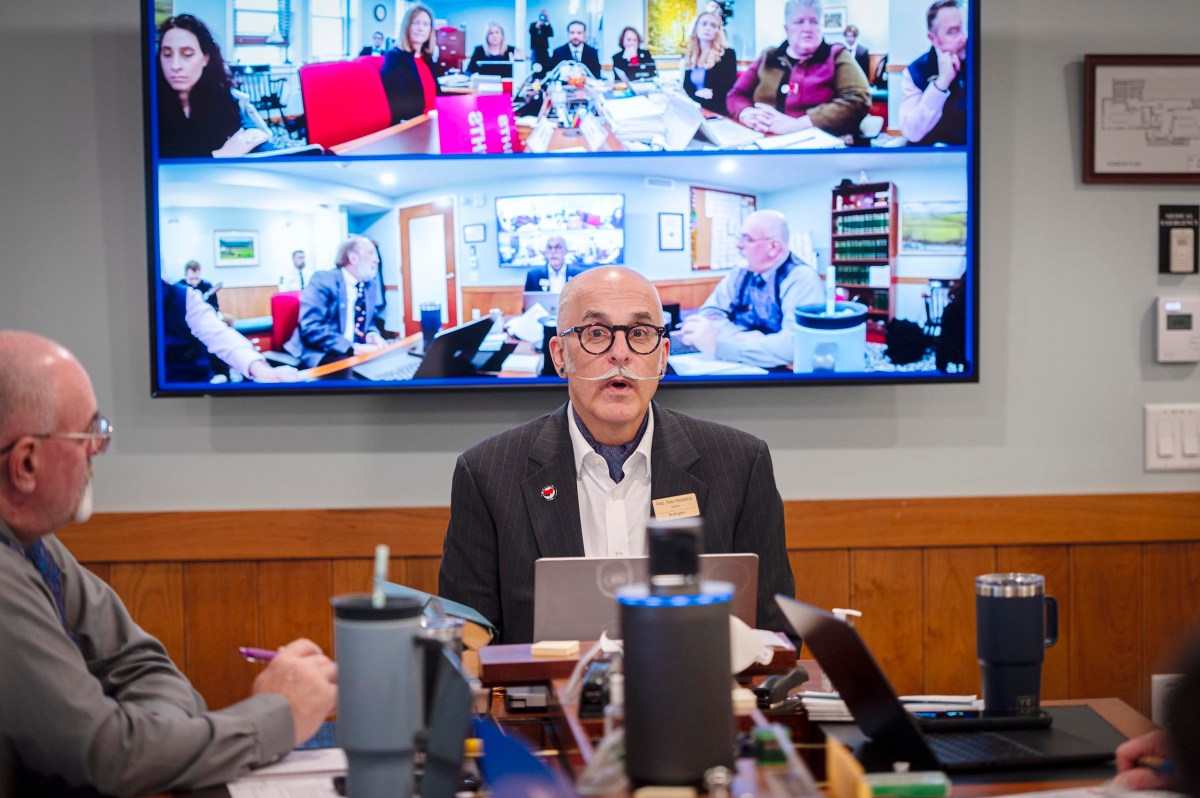
He started with an apology.
“If your inbox looks at all like mine since the introduction of this bill, I think I owe you all an apology,” Rep. Troy Headrick, I-Burlington, told the House Government Operations and Military Affairs Committee.
Why had Headrick’s bill — one of more than 600 in play in the House this session — caused such a stir?
Because H.654 is about UFOs. Sorta.
The bill proposes creating a state task force to evaluate reports of unidentified aerospace and underwater objects, assess airspace safety risks and coordinate with federal partners and academics on the topic, with the goal of recommending better policies for the future. The new body would be led by officials from Vermont’s departments of public safety and transportation, with additional membership from lawmakers and relevant experts.
In short, the legislation concerns UAPs, or unidentified anomalous phenomena, a topic that’s attracted increasing federal attention and lawmaking.
There’s potential for fun in the proposed task force, too.
“For the cryptids fans in the room, there’s an underwater provision to this as well, so if we want to investigate Champ, we can do that,” Headrick said, nodding to Vermont’s favorite sea monster. (In an interview, Headrick described himself as “agnostic” on the existence of extraterrestrial life.)
“I am not a subject matter expert at all,” Headrick said. “As policymakers, I think we have an obligation to remain attentive to emerging” trends in public safety, he added.
And he expected military and commercial airline officials would line up to testify on Vermont’s attempt to stay ahead of the atmospheric curve.
But if skeptics remain unconvinced of the need for his proposed task force, Headrick highlighted a more down-to-earth purpose.
“The proliferation of drone use — this is where I see the need for data,” Headrick told the committee. In the years to come, Vermonters might receive their groceries and packages via drones, as is already happening in other parts of the country. Buzzing propellers in the sky might not cause anyone to think twice as these unmanned aircrafts become normalized, but if they’re not regulated, Headrick suggested, there could be new safety concerns.
Whether the gov ops committee, which typically examines the inner workings of state and municipal government, has the appetite to exit the stratosphere, time will tell. The body did take testimony from Tucker Anderson, a legislative attorney, to walk through the bill in all its legal detail — the last agenda item in a morning packed with new bills.
“Appreciate the committee’s patience and tolerance for the last several hours of walkthroughs and overviews,” Anderson told lawmakers. “I always appreciate a close encounter with all of you.”
— Ethan Weinstein
In the know
“Everything is on the table.”
That’s how Rep. Teddy Waszazak, D-Barre City, framed three bills that would transform the state’s approach to taxing Vermont’s high earners to his colleagues in the House Ways and Means Committee on Friday morning.
“The rich are getting richer, and the poor are getting poorer,” Waszazak said.
Waszazak’s H.619 would create a “surcharge” tax of 3% for those earning over $1 million, while H.621 would create two new top-level tax brackets that raise income tax by 3% and 5% for those making over $500,000 and over $1 million, respectively. He described the two measures as different approaches to the same idea.
H.620 would create a “wealth tax commission” tasked with analyzing the state’s taxation of wealth with a focus on areas that are “escaping taxation.”
Waszazak pointed to his constituents in Barre City, some of whom he said are struggling to keep up with health care costs and the price of housing. “These are the folks … who we want to invest in as a state,” he said.
— Theo Wells-Spackman
On the move
The House passed a bill Friday morning that would create an emergency aid fund for farms and forestry operations affected by natural disasters. Qualifying business owners could apply to recoup up to half of damages they can’t cover another way, up to $150,000. Despite devastating damage from floods and drought in recent years, roughly 70% of farms statewide don’t carry crop insurance.
S.60, which was introduced last year by Sen. Ruth Hardy, D-Addison, will return to the Senate for consideration. Several House committees made changes to the Senate’s version of the bill, which included making forestry outfits eligible for the fund, and adding a provision legislators say will streamline the payout process.
The latest version of the bill doesn’t carry an appropriation, meaning the program won’t run — even if the bill becomes law — unless the Legislature sets aside money for it in the state budget. Some senators’ efforts to write an appropriation into the text of S.60 failed last year.
— Theo Wells-Spackman
A fancy new floor plan
What good is the people’s house if people don’t know how to get in, or — if once they do get in — they don’t know where to go?
That’s the question Sergeant-at-Arms Agatha Kessler posed to the Senate Institutions Committee. She showed the committee renderings Friday of a proposed new Statehouse entryway that a committee of lawmakers have been working to create with an architecture firm since 2023.
“If you are not a regular here, it’s actually quite intimidating to figure out how to get into the building,” Kessler said. But with a new entryway, she hopes that could change.
The proposed entrance is set to be on the west side of the building (or to the left if you’re facing it from the front). The curved glass facade would extend from the current building, giving space for a security screening area that funnels to a main lobby with a reception desk.
The public would only be required to use that entrance during the session, said David Schutz, the state curator, while lawmakers and staff could enter the building through any door with their badge.
The proposed design could address a need for enhanced security when, as Schutz put it, “important people” are in the building.
Like everything in government, the project will take time. If everything goes as planned, the new entrance could open its doors for the 2030 session, Kessler said, though the timeline could change if lawmakers don’t want construction going on during the session.
— Charlotte Oliver
Notable quotable
Vermont’s top economists had a shorter-than-usual timeframe this year to compose their January revenue forecast. Buried in one of their reports, which Tom Kavet and Jeff Carr presented to the Emergency Board on Friday, was the following:
“In an attempt to maximize our analytic time during this compressed schedule, and determine how close our jobs are to being replaced by AI, we explored feeding the economic and revenue facts we determined to be pertinent to various AI models, asking them to draft the text for this report in ‘our style.’”
The result? “Our jobs are safe for now,” the report said, though noted that “it won’t be long before AI could free up at least a day or two of time.”
— Shaun Robinson
