


University of Vermont graduate Ben Ogden — a two-time NCAA Nordic champion, 2022 Olympian and 2023’s fastest young male World Cup sprinter — “just might be on the verge of taking American cross-country skiing where it hasn’t been before,” the New York Times recently reported.
“He’s never really seen a race where he doesn’t want to burn from the beginning,” the Times wrote of Ogden’s “full-gas-from-the-start style” and “caution-to-the-wind fearlessness.”
But while the media is focusing on the skier’s future ahead of next month’s 2026 Winter Olympics in Italy, longtimers in the 25-year-old’s hometown of Landgrove, population 177, are pointing to his family’s pioneering past.
A century ago, the athlete’s great-grandfather, Samuel Robinson Ogden, was a young New Jersey visitor when he happened upon the Bennington County hamlet’s once desolate central village just before the 1929 stock market crash.
“The whole aspect was sad and dispiriting,” the man now called “Big Sam” went on to write in a memoir. “But I had some experience at fixing over old houses, and I could see possibilities.”

Buying 15 buildings for $4,500, Sam relocated his family to Landgrove and restored the properties. Upon his death a half-century later in 1985, the 88-year-old was remembered as a championing Town Meeting moderator, state House representative, author and columnist, supporter of the fledgling ski industry and a founder of such institutions as the Vermont Symphony Orchestra.
“The consequences of his work can be seen all over contemporary Vermont, though his significance lies as much on what he represented as what he did,” present-day historian Paul Searls has written. “He embodied the paradoxes and conundrums of a state struggling to reconcile the contradictory goals of embracing the modern world while trying to preserve what was best about Vermont tradition.”
Ben knows his great-grandfather through Searls’ book, “Repeopling Vermont: The Paradox of Development in the Twentieth Century.”
“On the one hand, I think it’s kind of cool,” the Olympian, taking a break for an interview, says of his ancestor’s tale of resuscitating a once ailing town.
On the other, Ben isn’t a newcomer like Sam. The self-described “native” views his environs with a different eye.
“I grew up seeing a lot of second homes, which was a confusing thing,” Ben says of a community where 60% of residences are part-time properties. “It’s sort of a waste that there are all these nice houses where Vermonters could live.”
And so the skier — striving, like the state, to push forward without careening off course — faces the same question his great-grandfather posed in a 1963 Vermont planning report: “How are we to get along in the modern world without sacrificing the values and assets we treasure most dearly?”
‘A bundle of contradictions’
Sam, born just after the first modern Olympics in 1896, grew up amid the dawn of the automobile and airplane, only to ship off during college to serve in World War I. Awarded France’s Croix de Guerre for heroism, he returned home at age 22 to his father’s insurance and real estate firm. But amid the progress and prosperity of the Roaring ’20s, he yearned for something simpler.
“I felt an intense revulsion for the life we had been living in the city,” Sam went on to write in one of more than half-dozen books he released between 1942 and 1978. “I scorned the rut that we all were in, the absence of real joy, the futility of boredom-inspired cocktail parties. I swore that we were but pawns in the uncreative game known as ‘keeping up with the Joneses.’”
That’s when Sam discovered Landgrove, founded in 1780 but at risk of disincorporation before he settled there in the spring of 1930. With few other residents other than his wife, Mamie, he became a jack of all trades: Blacksmith, selectboard member, justice of the peace, overseer of the poor and, in his most documented role, self-contrarian.
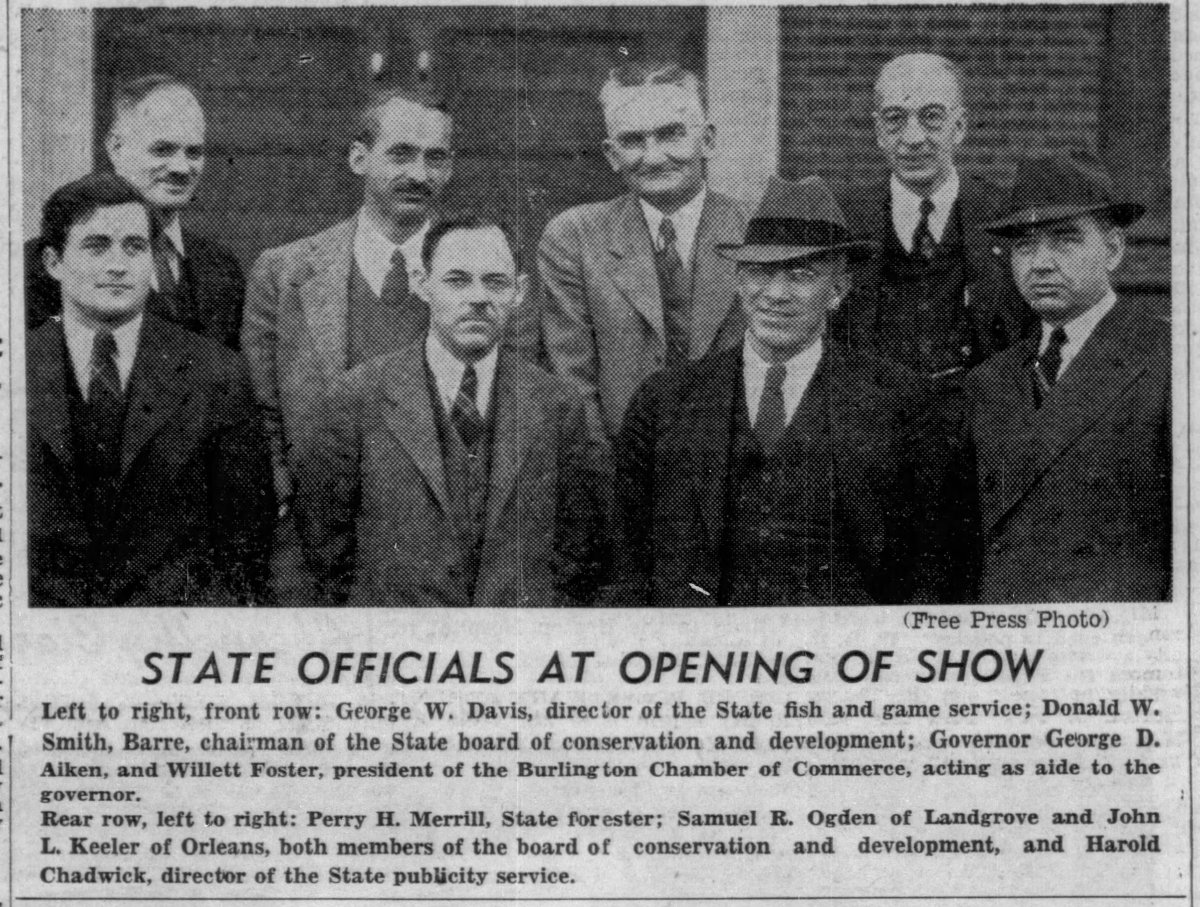
A proponent of preservation, Sam fought road plans for a Green Mountain Parkway in the 1930s and, after serving in World War II, pushed to prohibit billboards in the 1940s — two decades before the state adopted a 1968 ban.
“Country living seems to me to erect bulwarks against the mistakes and follies of the age,” the man who helped create the Vermont Natural Resources Council wrote in 1946.
Then again, Sam promoted tourism by helping found Vermont Life magazine and fostered the now billion-dollar ski industry by aiding in the installation of the first rope tow at the Bromley ski area in 1938 and the first chair lift at what’s now the Stowe Mountain Resort in 1940.
Sam acknowledged his dueling dualities.
“The winter season has become the liveliest season of all, and prosperity and increased tax revenues have made the lot of the remote towns and their citizens seem to be much more satisfactory,” he wrote in a 1967 newspaper column. “But there are times when doubts creep into my mind, and, mind you, this is the mind of one who has played some part in the development of winter sports in Vermont.”

Searls, a professor at Vermont State University, points out more paradoxes in his “Repeopling Vermont” book. It chronicles Sam’s connections with both the “most significant efforts to simultaneously preserve yet improve Vermont” and “essentially all of the state’s most important figures,” starting with governors from George Aiken in the 1930s to Philip Hoff in the 1960s.
“Ogden cherished small-town democracy, but he acted on a statewide scale to see decisions ever more determined by centralized bureaucracies,” Searls writes. “He wanted to protect the landscape built by state residents, but encouraged and enabled its change, much for the use of outsiders. He was enamored with the people he first found in Landgrove, yet shaped the town in a way that made it so those people were progressively scarce.”
That said, the historian extends Sam more credit than blame.
“There are no villains in this story, least of all Sam Ogden, who devoted himself to the good of the state and the town he loved,” Searls writes. “Anyone who was that much of a bundle of contradictions deserves association with a state defined by its ongoing struggle to find balance between contradictory impulses.”
That challenge, the historian says, is held in Vermont’s motto: Freedom and Unity.
‘Getting to the top’
Sam had children, one of them Samuel III, who had children, one of them John, who had children, one of them Ben.
Like his great-grandfather, Ben’s a paradox. Each winter he travels the world to blaze trails on skis. Come spring, summer and fall, he roots himself in his hometown, where he learned his sport from his father.
John Ogden, a Middlebury College racer, raised Ben and siblings Katharine and Charlotte as he coached a local youth league named after friend and fellow Vermonter Bill Koch, the first American man to win a Nordic Olympic medal.
John saw his son win a first-ever U.S. men’s youth medal (silver in the team relay) at the 2018 World Junior Ski Championships, a gold in the same event in 2019, a slot at the 2022 Olympics and, finally, the World Cup’s 2023 green bib award for fastest male Nordic skier under age 23.
John did so as he battled cancer for a decade before his death in 2023 at age 56.

“In lieu of flowers, John’s request was that everyone spend a little extra time outside, be it on foot, on a bike, or on skis, in his honor,” his family wrote in his obituary.
Plowing ahead amid adversity can be painful, but Ben has plenty of practice. A member of Stratton’s SMS T2 elite training team, he prepares physically and mentally to push forward no matter what.
“It can be really hard to keep your eye on the prize, so I think about the next section of the race instead of dwelling on the whole thing,” the skier says of overcoming midcourse obstacles. “If I’m on a big hill, I think about getting to the top. After that, I might get a bit of a break and can think about the next thing.”
Following his own advice, Ben returned to World Cup racing the winter after his father’s death and landed on the podium for the first time. He punctuated his third-place finish in the skate-sprint with a celebratory backflip.
‘My great discovery’
Ben’s ability to rise above runs back generations. After Sam’s wife of 51 years died suddenly on Christmas 1971, the family patriarch fell into depression and attempted to take his life.
“It was in the hospital that I made my great discovery,” Sam wrote in a subsequent New York Times column in 1973. “I discovered that all the values which my unbearable grief had twisted into a pattern of evil could be set aright once I looked at them through Mamie’s eyes; and this, by the grace of God, I managed to do. Now I resolved to live with as much joy as I could accomplish, doing the things that I knew she would want me to do.”
Sam lived a dozen more years before his death at Bennington’s Vermont Veterans’ Home in 1985.
“I hope,” he wrote in his last book in 1978, “that the denizens of Landgrove will hang on; nay, more than that, will, in fact, construct a community whose brightness will shed light on other places, a light which may be ever increasing, infectious and contagious, for if this world is to be saved, this is the sort of thing which will have to happen more and more frequently.”
Travel to Landgrove today and you won’t see many gathering spots along the main dirt road, save the 1874 Farmers and Mechanics Hall turned municipal office. But there you’ll learn the town consistently reports the highest voter turnout in the state (87.97% in 2024, topped only by Andover’s 88.65% and Ripton’s 88.36%).
Interest in Landgrove’s current favorite son is equally high, and not just because seemingly everyone is a descendant of Big Sam or knows Ben’s mother, Andrea, the town’s treasurer, assistant clerk and trustee of public funds.
Andrea is one of many with a sense of humor when talking about Ben. She’s happy, for example, to spur him to recount how he wore “wind briefs” underwear during his first major 50K race, only to learn how freezing cold and breathable fabric can lead to, in his words, “two hours of horrendous discomfort.”
U.S. and SMS T2 teammate Jessie Diggins, the most decorated American cross-country skier in history, adds that she offers support by gilding Ogden’s mustache (so signature, it’s part of his YouTube channel logo) with red and blue glitter.
When home, Ben unwinds by rebuilding a 1973 Land Rover he completely dismantled years ago.
“It started as a little project,” he says, “that has really spiraled out of control.”
A 2022 UVM engineering graduate with master’s credits, Ben says his “pipe dream” is to someday work for a company like South Burlington’s Beta Technologies.
“Vermont is not a great place to start a corporation that gigantic,” he says, “but they’re just doing it because they believe in the state and the people and the culture, and that, to me, is incredibly inspiring.”
The feeling is hereditary. Back in 1967, Sam chronicled life in a book of poems titled “Vermont’s Year.” It opens with a verse about navigating January snow:
… Each advance that now I make
Is but a single pace,
The next unmade, unknown:
Each step my ultimate …
Three generations later, his great-grandson is forging on.
