

Amelia Cunningham is a reporter with the Community News Service, part of the University of Vermont’s journalism internship for Bradford Journal Opinion.
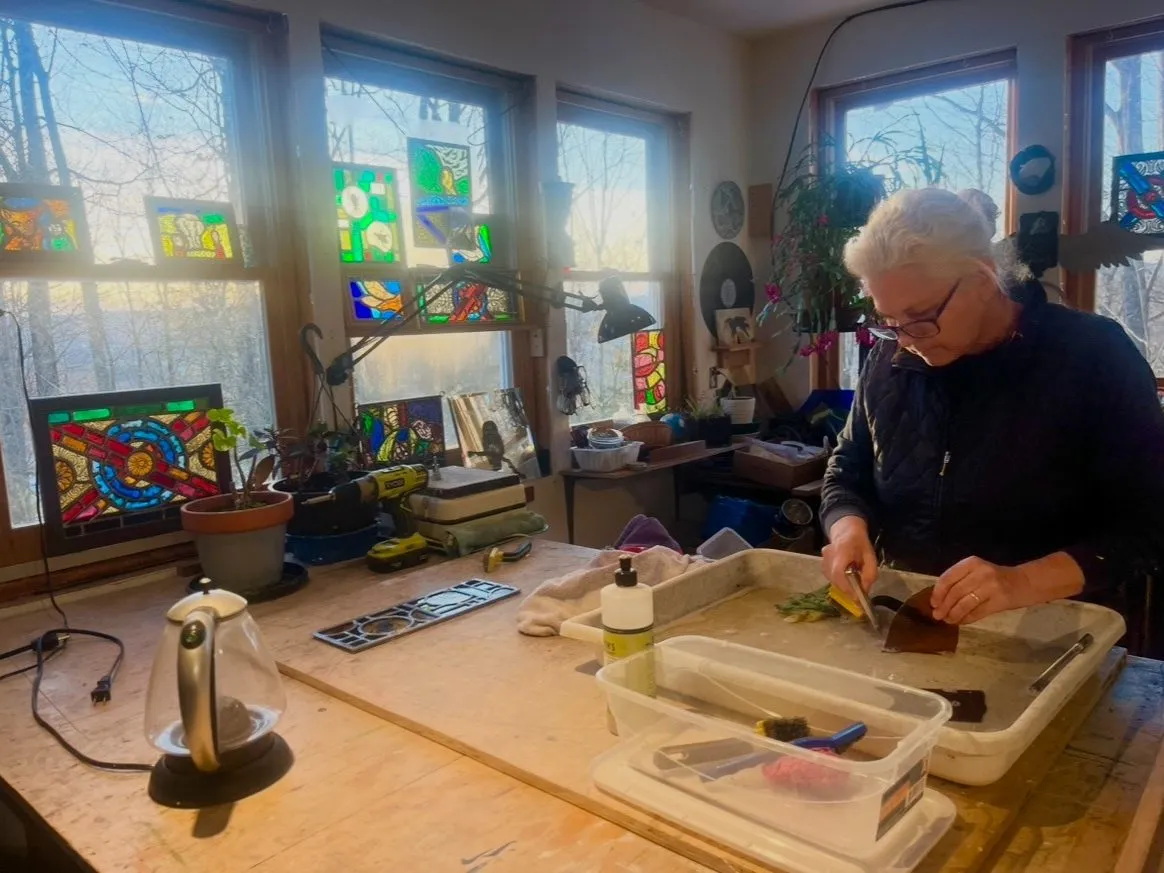
CORINTH — At the end of a long, wood-lined road in Corinth, Kathy Chapman’s studio stands nestled among the trees. The modest workspace — with panoramic views of the surrounding forest — serves as a quiet refuge from the outside world for the stained-glass artist.
Inside, a wood-fired stove keeps the workshop at a comfortable temperature even with snow outside. The studio’s walls are filled with art of different mediums, including a large array of stained glass projects.
Chapman is a stained-glass artist and painter, originally from Brooklyn, New York. She grew up spending her summers at Lake Morey and then relocated to Vermont in 1984, after graduating from college.
Chapman has always considered herself an artist, but she began working in stained glass restoration about 30 years ago. Along with restorations, she also makes acrylic paintings and custom stained-glass windows, available by commission.
For Chapman, starting a new painting is the best part of the creative process. She described the feeling as “pure excitement.”
“Something always happens,” she said. “Even if it’s terrible, you turn it around, put it upside down, and keep going until something speaks to you.”
Chapman prioritizes creativity over perfection, embracing a process that often leaves her paintings feeling deliberately “in progress.” This culminates in a corner of her studio she affectionately calls “painting heaven,” where unfinished paintings are lovingly stacked.
“Sometimes you just get tired of something and want to move on,” she said. “Later, when I’m in a different headspace, I’ll pull one out, turn it around, and start again.”
While painting gives Chapman a sense of creative freedom, stained glass forces her to slow down and really think about each piece.
“Stained glass is a real process art,” she said. “You’ve got to make a map, you want to make sure everything is the best it can be before you assemble it.”

This contrast is evident in Chapman’s studio.
On her worktable, pieces of a soon-to-be church window sit carefully arranged. For restorations, there is no space for “figuring it out.” Once a piece is cut and fired, it cannot be changed.
Chapman didn’t originally set out to be a stained glass artist. About 30 years ago, a friend and local stained glass artist, Greg Gorman, needed help removing a large rose window from the upper level of a church for restoration. Chapman offered to help.
“It was a total restoration,” she said. “We took it apart piece by piece, and I just loved it.”
At the time, there were very few people in the region doing large-scale stained glass restorations, a gap that fostered a strong working relationship between Gorman and Chapman.
For about a decade, Chapman worked out of Gorman’s studio in Lyme, practicing and perfecting her craft. Gorman saw something special in her work.
“I’m a big fan of hers,” he said. “Her stained glass and painting definitely feed each other. You can always tell it’s the same person.”
In 2002, Chapman started working out of her own private studio, which greatly influenced her work. The solitude of her studio reshaped her creative process, allowing her to fully immerse herself in her art.
Chapman has lived happily in Vermont since her early 20s. The quiet, nature, and tranquility have all become essential parts of her practice.
“I live a quiet life,” she says. “It’s easy to be alone out here. I have friends who rescue me from myself when I need it, but mostly I’m very happy being home.”
Her quiet routines allow her the room to create art as she wishes. Her lifestyle and way of living are an intrinsic part of the art she creates.
Although Chapman works in isolation, her restorations live in places that are the exact opposite. Chapman’s “bread and butter,” as she puts it, is doing restoration projects for local churches and common spaces, places that are key meeting points for the community. Churches in the area reach out to Chapman when their centuries-old windows need to be cleaned, repainted, and rebuilt.
These projects are often long and slow. Chapman just finished her fourth year working on a project for the Waterbury United Church of Christ. By next spring, she will have completed the fifth and final window for the church, marking five years spent on the project.
“For me, that feels like an accomplishment,” she said, “because then [the windows] are good for another hundred years.”
Chapman’s quiet, solitary life is essential to her craft, but her friendships, she says, are just as important to her practice.
Amy Peberdy, a fellow artist and longtime friend of Chapman, occasionally helps out in her studio.
“There’s a real humanity in [Chapman’s art],” Peberdy said. “Mostly what her artwork is saying to the world is to just relax and try to get along.”
This throughline isn’t always literal, but its tone is consistent through the quirky, slightly medieval, heavily painted art she creates. Chapman’s art is a reflection of the life she lives. A life filled with quiet beauty and art.
“There’s a story in all of it,” said Chapman. “Even if people don’t see it, it’s there.”
