

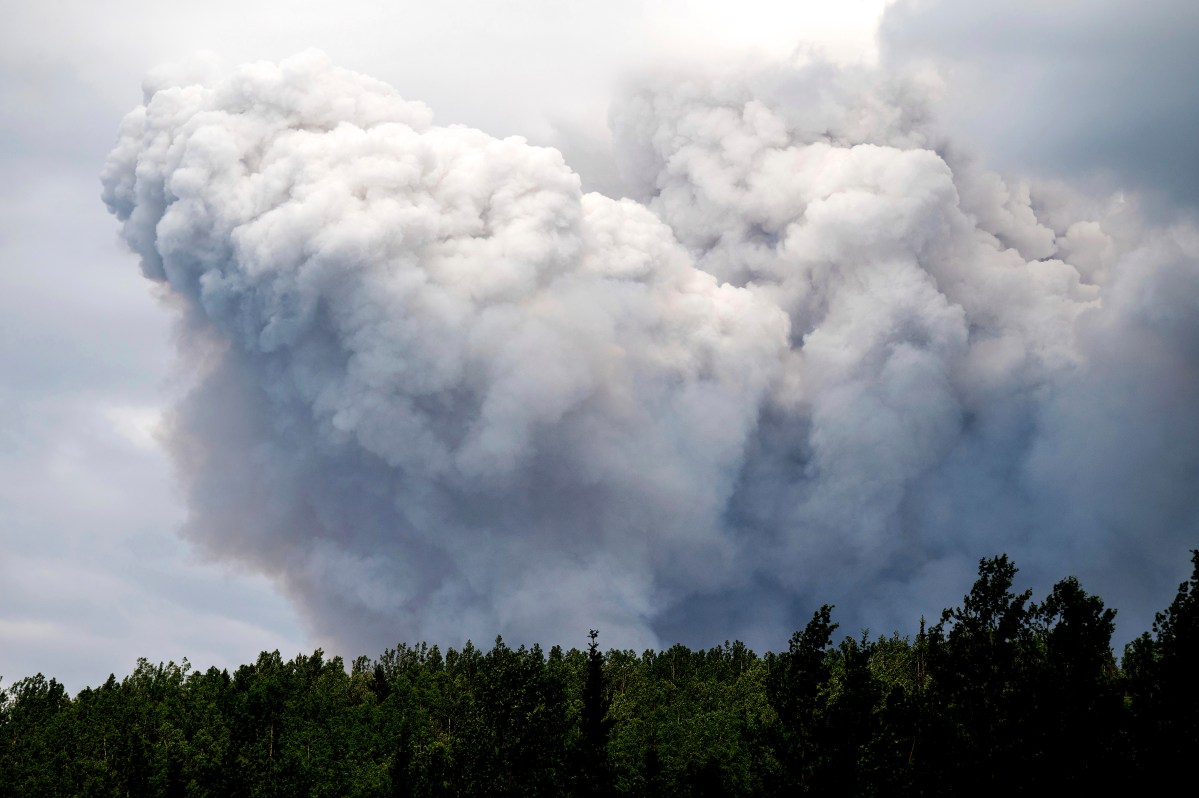
When deciding where to live when beginning her PhD, Anna Maassel was drawn to UVM for Vermont’s relative respite from climate catastrophes. Then, the summer before she moved here, the state was slammed with historic flooding and coated in a hazy smoke from Canadian wildfires.
Just over two years after the fires of 2023, Maassel, a doctoral candidate at UVM’s Rubenstein School of Environment and Natural Resources, is the lead author on a paper just published in the journal Environmental Health. She and her co-authors found that the smoke from those 2023 wildfires was linked with worsened asthma outcomes for children in the Northeast.
The study is among the first of its kind to look at the health implications of wildfire smoke in the Northeast. Although the correlation of smoke and pediatric asthma has been well studied on the West Coast, scientists are only just starting to look at the specifics of smoke in New England, a region less prone to widespread fires. The smoke from the 2023 Canadian fires served as something of a local wakeup call, Maassel said.
“We’re this mix of vulnerable and unprepared and all of a sudden facing this threat,” she told VTDigger in an interview.
Vermont has one of the highest rates of pediatric asthma in the country — one analysis found that in Vermont, 8.3% of people under the age of 17 have asthma, according to 2023-24 data from the U.S. Department of Health and Human Services. That’s higher than the nationwide average of 6.8%.
Maassel’s study, which she co-authored with Keith Robinson, a pediatric pulmonologist at UVM Health’s Golisano Children’s Hospital, found that patients struggled to manage their asthma more in the post-fire summers of 2023 and 2024 than in 2022.
Robinson said his team received a high volume of calls from parents concerned about their child’s asthma symptoms during the summer of 2023.
The paper supports his memory. He and Maassel scoured medical records from UVM Health to assess 900 young patients with asthma seen by one of the hospital network’s clinicians between 2022 and 2024. They looked at three different assessments that clinicians use in medical records to track asthma plans and management. The researchers found worse management in the years following the wildfire smoke.
Maassel said she hopes the research can help guide clinicians and parents as they help children manage their asthma.
Summer, for instance, has historically seen better asthma outcomes, in part because people are not battling winter colds and flu. It’s often when providers consider phasing patients off of their daily controller medications. Awareness of air quality can help clinicians time that better in the future, Maassel said.
Parents, too, can watch out for dangerous air quality levels to know when to close their windows, run an air purifier or encourage their child to avoid intense activity. They can also come up with an emergency management plan, like resuming use of a controller medication and having a rescue medication on hand.
“Even during these short periods of bad wildfire smoke or minor wildfire smoke, where the air quality index spikes to a medium risk level, it is still really important to take those protective actions,” Maasel said.
It’s a reminder for the region that people will need to become much more familiar with wildfire smoke in the future.
“It’s not going to be an isolated incident,” Maassel said of the 2023 fires. “It’s here, and it’s here sooner than people expected.”
