

This story by Maryellen Apelquist was first published in The Herald on Nov. 20, 2025
Human rights concerns and calls to action spanned a sweeping summit of the same name last weekend in Randolph Center, as advocates from across the state gathered to call out inequity and mistreatment, in areas from housing to policing, with an eye toward pushing Vermonters to continue to effect change.
The state Human Rights Commission hosted the three-day event, the first of its kind, largely in response to federal actions over the last several months.
“The idea for this conference really hit me like a bolt of lightning during one of many sleepless nights where my mind could not rest amidst the horror of what is happening at the national and global level,” said Big Hartman, HRC general counsel and executive director, in their opening remarks to a few dozen community members who turned out to Vermont State University’s Judd Hall on Nov. 14. At least twice that number tuned in online.
The summit “is a way to coalesce in our movement of resistance against authoritarianism, oligarchy and oppression,” said Hartman. “To strategize for solutions to the civil rights crisis that is upon us. We are not here to complain and commiserate about the Trump administration’s horrendous policies and actions, although of course a little of that is bound to happen.”
In the spirit of boosting spirits and strengthening participants’ resolve in working toward justice, the summit began by celebrating Vermont’s human rights wins over the years, such as its leadership in marriage rights for same-sex couples, gender identity non-discrimination, expansion of protections against harassment and access to housing.
José Ignacio De La Cruz of Migrant Justice spoke of his personal experiences with discrimination in Vermont that led to his and others’ advocacy work. That work resulted in a recently enacted Vermont law that expressly prohibits discrimination against immigrants in housing and in places of public accommodation, based on their citizenship or immigration status. Specifically, the new law requires landlords to accept an original or copy of an unexpired government-issued ID, an individual tax identification number or a Social Security number.
Before the law was passed, De La Cruz said, immigrants often faced discrimination because they did not have a Social Security number. He also pointed to other acts of discrimination, particularly as he and other community members in recent years began seeking employment, and subsequently housing, in areas outside of dairy farming where housing was included as a condition of employment.
For example, “when workers were leaving farms to work on sawmills or with some construction subcontractors,” they were assured there would be housing, but ultimately would find untenable conditions — such as four workers being charged $500 each to share a single bedroom, or, in the case of De La Cruz’s family member, who belongs to a queer community, being told: “You can’t have visitors at home because I don’t want the house to fill up with people like you.”
Other key voices throughout the weekend came from those who, like De La Cruz, shared their lived experience. Among them were Mohsen Mahdawi, a legal U.S. resident and Palestinian activist who last April was taken away by masked federal agents after his naturalization appointment in Colchester. During a session on Saturday, Mahdawi and one of his attorneys, Monica Allard of the American Civil Liberties Union of Vermont, spoke of his experience.
“After 16 days in a Vermont prison, a judge ordered Mohsen to be released, allowing him to return to his communities, his studies, and his advocacy,” Allard said. “But this legal battle is not over, and the [federal] government was in court just weeks ago arguing again that it has the authority to lock Mohsen back up.”
For his part, Mahdawi, who grew up in a refugee camp in the West Bank, spoke poetically of his community of Vermonters “being as sweet as the maple syrup that we get from the maple trees,” and as connected in protecting each other. A stark contrast from life in the camp, he said, where “as a child … I never felt safe.”
He also spoke of Vermont being a place in the United States where civil rights and the constitution are protected. “Democracy and human rights are aligned,” he said, and noted that what we are seeing now are “very chilling” attacks on free speech. Mahdawi contemplated what the “future could look like for humanity” if Project 2025 — a political blueprint aimed at reshaping government in line with far-right policies — is successful.
“If they succeed in orchestrating it, and demolishing and destroying human rights here in this country, silencing people, punishing people for their speech, they will be able to do it on a much larger level,” on an international level, given the influence of the United States.
A discussion about policing
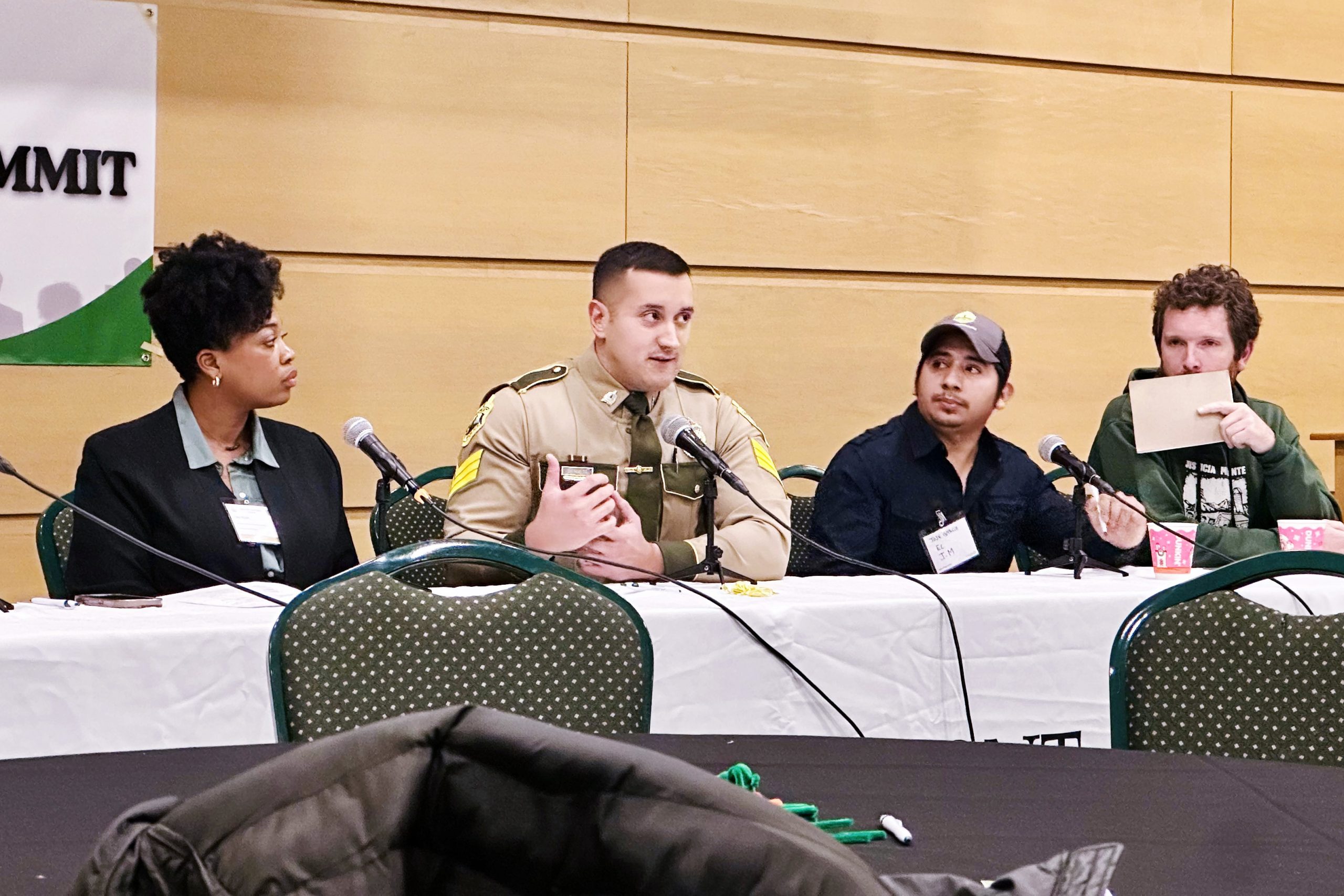
José Ignacio De La Cruz also participated in a panel centered on fair and impartial policing in Vermont, a session that frequently turned to the presence of U.S. Immigration and Customs Enforcement in the state, as well as the role of law enforcement as communities struggle to respond to mental health crises.
Among the other panelists were Vermont State Police Sgt. Daniel F. Bennett, a senior drill instructor who also serves as co-director of the Fair and Impartial Policing Committee; Lisa Ryan, community inclusion director with the Vermont Criminal Justice Council and Vermont Police Academy; and Tabitha-Ann J. Moore, an equity strategist and consultant who works with law enforcement and communities. Moore is also the founding president of the Rutland-area NAACP.
Again the topic was personal for De La Cruz, who last June, with his stepdaughter, was detained by U.S. Border Patrol while delivering food to a farm. They were held for weeks before being released following a public campaign.
He spoke of the migrant community’s fight for access to driver’s licenses years ago, but how once they had them, and were on the roads, they would get pulled over by police and end up getting turned over to Border Patrol. “Because of all the work over the past decade, I can say now that really we have changed those practices and that we’re not seeing that form of collaboration” between local law enforcement and federal immigration authorities, he said.
On what it means to be a leader in fair and impartial policing, Bennett noted that VSP has long been forward-thinking. “It’s an important distinction that Vermont State Police began this [work and have taken] it seriously, prior to all the attention and the focus on this,” the sergeant said. “We’re doing a lot of cooperation with a lot of different organizational communities.”
Ryan, the VCJC community inclusion director said that Vermont is a national leader “because we walk the walk at the top, right? We are doing and acting in what we’re saying we’re gonna do. … We have a great system of community policing in the state, people getting to know their neighbors. So I think being a small state and building those relationships between law enforcement, communities, and the different agencies that law enforcement represents is so important.”
Still, the panelists addressed instances where actions on the ground do not align with policies. De La Cruz referred to instances where Border Patrol has been called on the pretext of law enforcement needing help translating from Spanish to English. “At the end of the day, the result was that the person was being detained by immigration authorities. … These pretexts [are] put in place to try to avoid compliance with policy.”
