


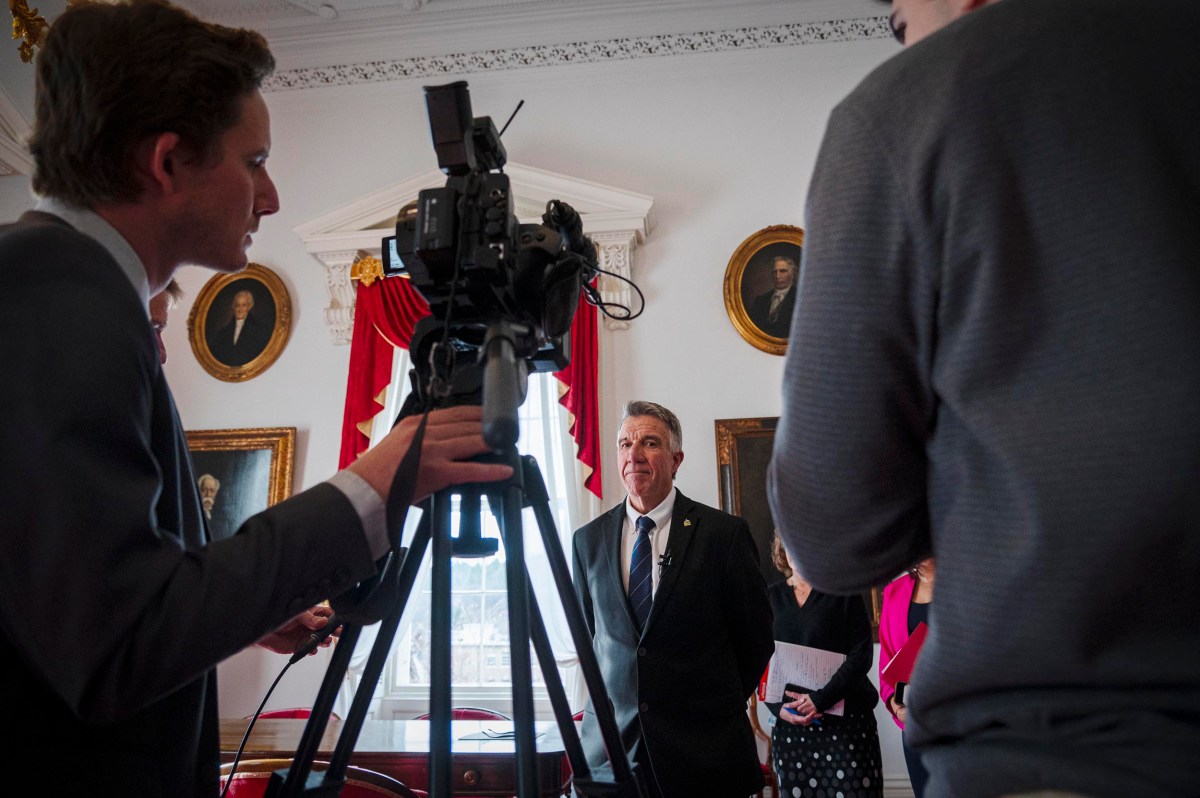
Vermont Gov. Phil Scott had some strong words for the school redistricting task force after the group endorsed a proposal on Monday to incentivize voluntary mergers of the state’s 119 school districts. The task force members, he told reporters, “didn’t fulfill their obligation.”
“They didn’t redraw the lines, and they were supposed to put forward three maps for consideration, and they failed,” Scott said.
Asked by a reporter where that leaves the state, Scott said that “it would appear that those who didn’t fulfill their obligation are OK with the ever-increasing property taxes, cost of education, and they don’t want to see change, or at least not immediately.”
“So, I think it puts us in a tough position, but I think the majority of people — I’ll include the speaker and the pro tem — understand we need change,” he said. “We need to do something. So, they’re going to have to act as soon as they get back in.”
Scott’s comments Monday underscore a growing sense of uncertainty around efforts to reform Vermont’s public education system.
Debate around public education reform will feature prominently in the next legislative session, set to begin in January. And while Act 73, the state’s sweeping education reform law, was signed in July, launching that reform will depend on the Legislature agreeing to a new district map.
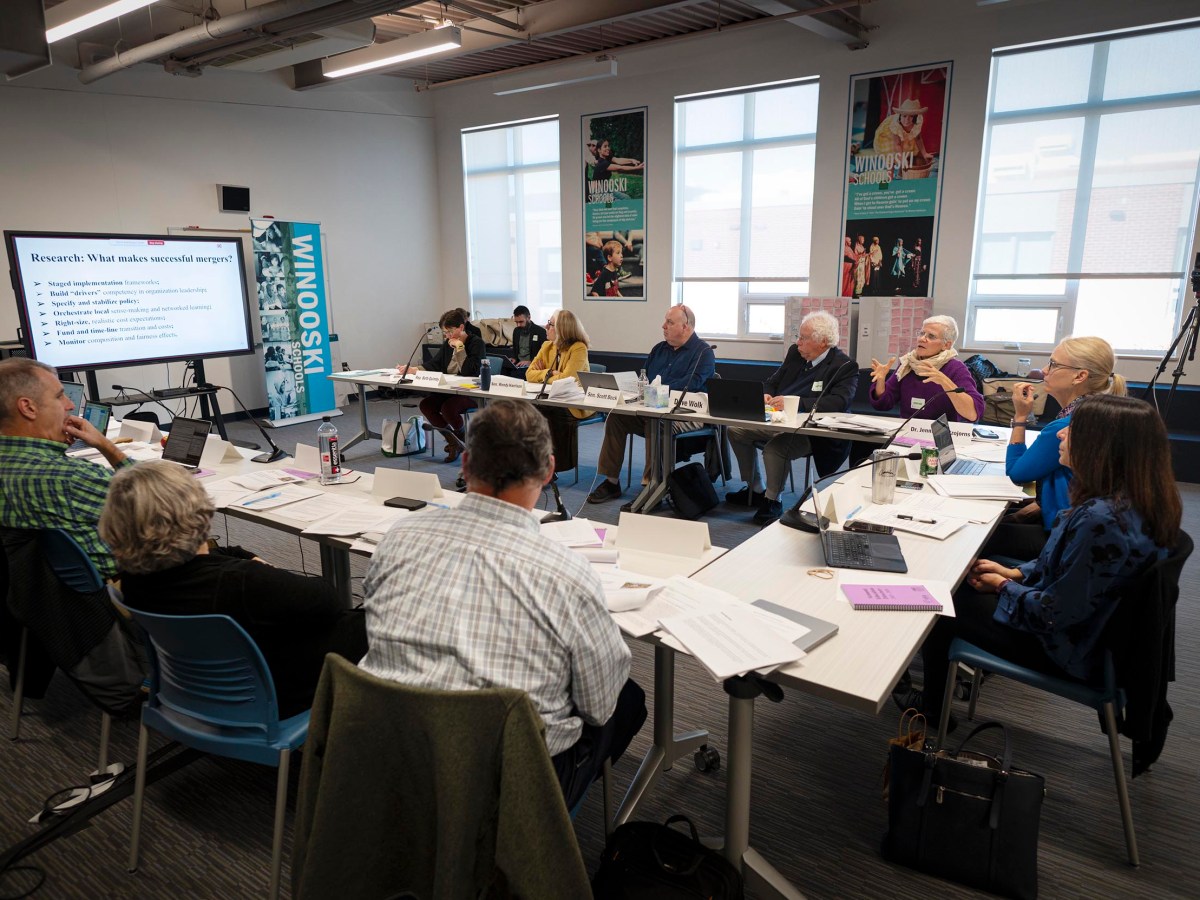
But on Monday, the 11-member task force voted 8-3 to endorse a proposal that defied a core directive of Act 73: that the group put forward at least one and no more than three new maps by Dec. 1 for the Vermont Legislature to consider in the upcoming session.
Task force members Jennifer Botzojorns, a retired superintendent for the Kingdom East School District; Sen. Scott Beck, R-Caledonia; and Dave Wolk, who is Scott’s appointee, voted no on the proposal.
The nearly 170-page proposal the group endorsed lays out a 10-year plan. Districts would be incentivized to merge to access state construction aid and to coordinate on developing regional high schools, while utilizing regional boards of cooperative educational services, or BOCES, to share the cost of services.
The only map contained within the proposal shows how the five regional cooperative service agencies proposed in the plan would layer over the state’s existing 119 school districts and 52 supervisory districts and supervisory unions.
Vermont Education Secretary Zoie Saunders said during the meeting Monday the proposal did not adhere to the intent of the law.
Sen. Martine Gulick, D-Chittenden Central, the co-chair of the task force, said in an interview that task force members did not “see evidence that there is cost savings and improvements to quality in merging districts.”
“As we peeled back the layers, as we dug deeper into the complexity of education in Vermont and the complexity of lowering costs and improving quality, we decided it would be irresponsible just to draw lines on a map,” Gulick said.
She continued that their proposal “could save money immediately” by allowing the state’s 119 school districts to share resources and create economies of scale through shared contracting.
“In three months to dig into this level of specificity, we did a great job given those parameters, and I’m really proud of the work that we did,” she said.
Senate Pro Tem Phil Baruth said in a text message that he was waiting for the task force to issue its final report before commenting.
Speaker of the House Jill Krowinski in an email said she was “focused on ensuring our kids have the best educational opportunities at a price Vermonters can afford.”
“That is my focus for the upcoming session, and it is the mission we have had since the beginning of our education transformation work,” she said. “We’ll continue to work with the education community, the Scott administration, and all Vermonters to consider the options before us and next steps to meet our education transformation goals.”
Another proposal considered by the task force, developed by Beck and Wolk, more closely adhered to those guidelines, and had Saunders’ apparent stamp of approval.
That proposal — now discontinued, at least as far as the task force is concerned — used career and technical education regions as an organizing principle to draw lines for 13 new school districts.
But the majority of task force members declined to support that proposal and raised concerns about the size of the map’s proposed district in Chittenden County. Nearly 22,000 students would be consolidated into a single district there under the plan.
Gulick in an interview said that map did not adhere to Act 73’s parameters that new districts have anywhere from 4,000 to 8,000 students.
“It’s supposed to be logistically feasible and create the least amount of disruption,” she said. “I just don’t think that that map did those things.”
The task force will meet for the last time on Nov. 20, where it will refine and finalize its final report due to the Legislature in December.
“I do hope the Legislature looks at what we’ve done. I hope they take our recommendations to heart,” Gulick said. “But there’s no guarantee that that will happen.”
VTDigger reporter Theo Wells-Spackman contributed reporting.
Correction: An earlier version of this story was wrong about the no votes for the redistricting task force’s endorsed proposal. Rep. Beth Quimby, R-Lyndon, voted yes. The other no vote was Jennifer Botzojorns, who helped develop part of the proposal.
