


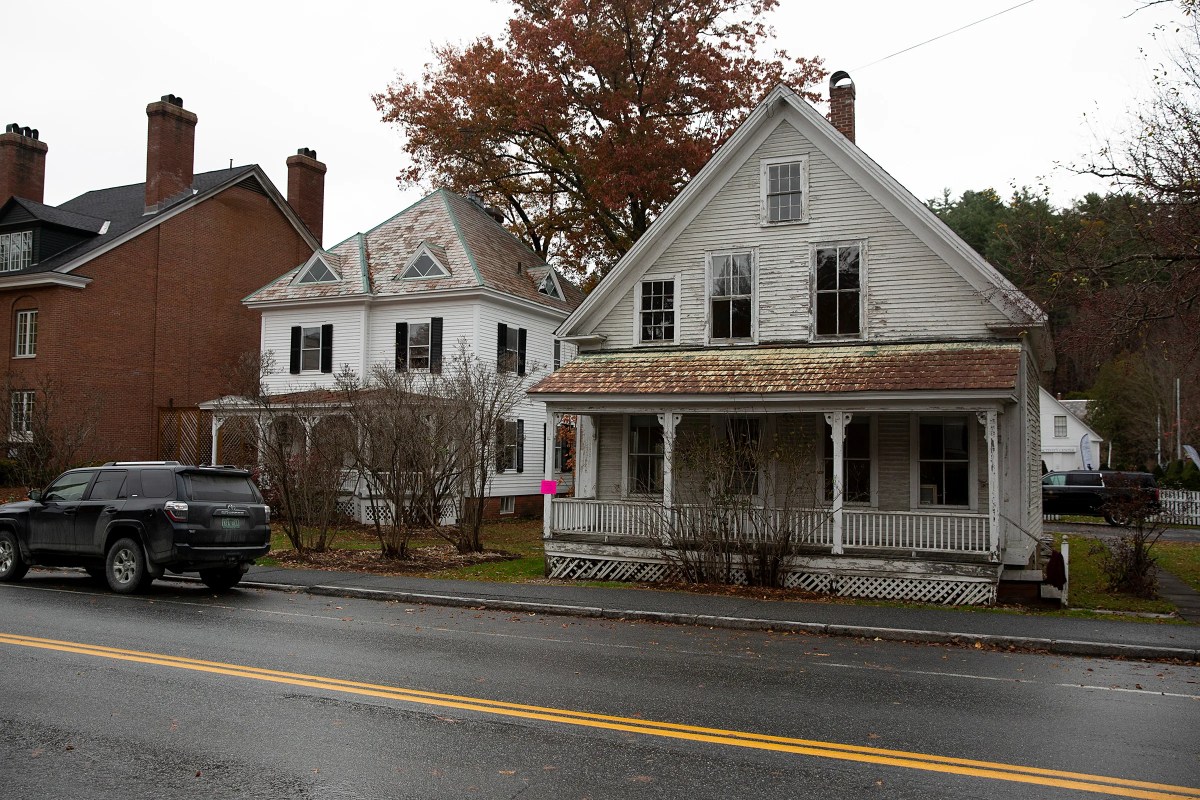
WOODSTOCK — The Village Development Review Board narrowly granted approval to the Woodstock Resort Corp. to demolish two vacant, historic homes it owns on South Street.
In a 3-2 vote, the board approved the private company’s zoning permit to take down the structures during its meeting last Monday. The board deliberated in private before announcing its vote to the public. Jane Soule, the board chair, and Randy Mayhew, the vice chair, cast the no votes.
The two houses, located at 14 and 16 South St., count as “contributing structures” in the Woodstock Village Historic District, which is on the National Register of Historic Places.
Though they have fallen into disrepair in recent years, their proposed demolition has proven controversial.
The board’s decision came a couple of weeks after the Village Design Advisory Committee voted against the demolition. The committee serves in an advisory role and its decision was not legally binding, Woodstock Village Zoning Administrator Emily Collins wrote in an email.
Mayhew questioned why the inn did not consider turning the houses into residential properties.
“It’s quite clear that Woodstock, like the whole state of Vermont, has been concerned about the housing stock numbers,” he said during a recording of last week’s meeting.
Soule wanted to know if it was possible to renovate the homes for employee housing.
“If these houses were employee housing it seems to me it would be more efficient for the inn,” she said in the recording of the meeting.
The Beach House located at 14 South St. was built around 1905 and 16 South St. was built around 1840, according to a report presented by Benjamin Pauly, director of property operations and design at the Woodstock Inn & Resort, the better known name.
The inn has owned 14 South St. since 1968 and 16 South St. since 1987. Employees lived in the houses until 2004-2005, when the heating systems failed, Pauly said in the recording.
“At the time it was determined that it didn’t make sense to renovate the buildings for employee housing because there wasn’t a need for employee housing at that time,” Pauly said at the meeting.
In the decades since, Woodstock Resort Corp. evaluated different options for the houses, including a spa and a guesthouse, said Pauly, who serves on the Woodstock Planning Board. Those plans were dismissed, in part, because they were not economically feasible, she said.
The inn built its spa in 2010. During that process, it relocated another historic structure and demolished a second one.
As part of the permitting process under Act 250, Vermont’s land-use law, to build the spa, the state’s Division of Historic Preservation told the Woodstock Resort Corp. it “shall” inspect the South Street houses annually and “address and repair in a timely and appropriate manner, any deterioration or damage identified during the routine inspections,” according to the report Pauly presented.
Some of the residents who spoke at last Monday’s meeting argued that the Woodstock Resort Corp. did not maintain the South Street houses, intentionally allowing them to fall into disrepair. In recent years, historic preservations have claimed Woodstock Resort Corp. had followed a strategy known as “demolition by neglect.”
“I feel let down significantly by the inn’s response to the expectations set out by the Act 250 permit for the spa,” Wendy Marrinan, a member of the Village Historic Preservation Commission, said at last week’s meeting. “For the last 15 years, Woodstock Resort Corp. has made very little effort to maintain both 14 and 16.”
Pauly pushed back against assertions that the inn has neglected the houses, noting that the inn has painted them and made repairs to the roofs.
“There’s obviously been a lot of local chatter about how the inn has treated the buildings over the years,” he said. “There was at no point a day that somebody woke up and said, ‘Let’s neglect these buildings and let them fall into disrepair so we can take them down in 20 years’.”
At this point, it would cost nearly $2.8 million to renovate 14 South St. and around $3.2 million to renovate 16 South St., Pauly said, noting the estimates in the report. Demolition costs, by contrast, are up to $46,000 for 14 South St. and up to $54,000 for 16 South St.
It “makes no financial sense whatsoever” to renovate the homes for employee housing because the construction costs would make the rents on the homes unaffordable, he said.
“It distresses me a little when we’re talking about the historic district that we’ve spent 99.9% of our time speaking about the economic viability of the inn,” resident Isabelle Bradley said at the meeting.
Bradly urged the board to keep the historic district intact. “It will change the neighborhood a great deal to lose those houses,” she said. “There’s no way around it.”
She also noted the housing shortage. “They could sell the properties,” Bradley said. “Someone else could take on the financial responsibility and convert them to single-family residences or multi-family housing.”
Earlier this summer, the inn tried to sell the houses for $1 each, with the caveat that buyers would be responsible for moving them to a different property, Pauly said. There were no serious inquiries.
The permit the Village Development Review Board approved is valid for two years. The demolition is still being evaluated by Vermont’s Land Use Review Board as part of the Act 250 land permit process.
Once the homes are demolished, the Woodstock Inn plans to turn the area into green space for the time being, Pauly said. If the inn was going to expand, it would be on that location. “There is no plan to build right now,” he said.
