

Owen Bradley-Meal is a reporter with the Community News Service, part of the University of Vermont’s Reporting & Documentary Storytelling program.
SOUTH BURLINGTON — Over a sunny Friday afternoon on Oct. 10, dozens gathered in the multipurpose room of Faith United Methodist church. At the head of the room stood Nic Longo, director of aviation at Patrick Leahy International Airport (BTV), preparing to tell the story of the past and future of the institution he leads.
About 1.4 million people annually fly in and out of BTV, which is owned and operated by Vermont’s most populous city, Burlington. A joint-use military and civilian airport, it is the state’s busiest airport by a large margin.
Longo’s presentation began with a brief overview of the history of the airport, from the land acquisition in the early 1920s and beginning of commercial service in the 1930s to today.
By 2008, said Longo, BTV had risen to the status of one of the busiest airports in New England from number of operations. Operations, in aviation terminology, refers to landings and takeoffs.
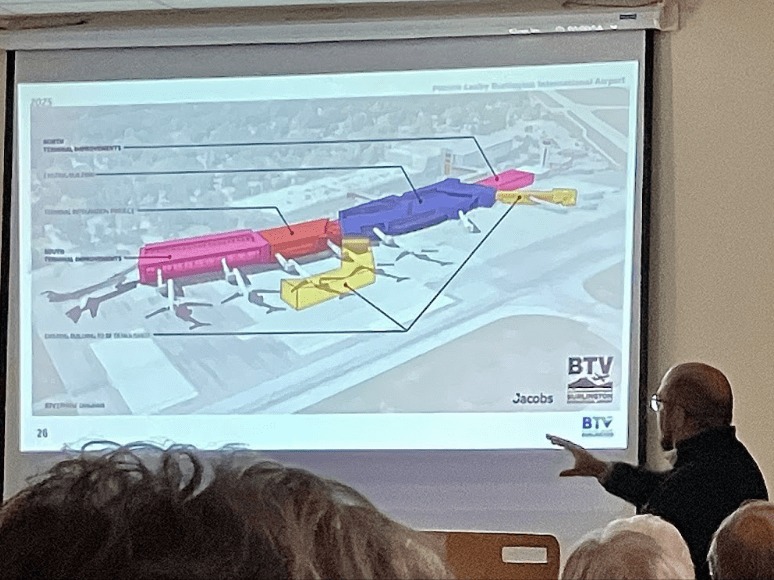
Longo then provided an overview of the ongoing construction at the airport, known as the North Expansion Terminal project, which aims to increase the airport’s capacity while keeping it as eco-friendly as possible.
The new 25,000 square-foot terminal will be almost entirely constructed of timber as opposed to the typical steel. Studies have shown timber to be an environmentally friendly construction material, due to its nature as a carbon sink and the low emissions created in its production, according to the Environmental and Energy Study Institute.
“Geothermal is going to heat this building, and then of course we’re gonna add solar to the rooftop,” said Longo of other planned environmental initiatives in the new terminal.
“Regardless of what happens to the industry … we’re ready,” said Longo. “Part of that is to make sure we’re sustainable, too.”

The talk also included a discussion of airport finances and partnerships, notably with the Vermont Air National Guard based at the airport, and with Beta Technologies, a designer and manufacturer of electric-powered aircraft.
Partnerships provide important revenue to operate the airport, Longo said. “Our costs are so low. We manage things very, very closely.”
Not all of these partners are welcomed with open arms by the entire community, however. Noise from the National Guard’s F-35 jet fighter squadron at BTV is a source of major controversy.
“I’ve clocked them at 115 to 117 decibels,” said Ben Bosher, a resident of Burlington’s Lakeside area, who said he hears F-35s flying over his house. “I’d argue that they should not be doing these kind of maneuvers over populated areas.”
This level of sound is slightly above the official figure provided by the Vermont Department of Health review, which estimates that F-35s have a maximum sound level of 115 decibels. The review also details mixed or inconclusive results in the study of chronic exposure effects of this sound level in terms of hearing loss, cardiovascular effects and more.
Other concerns were raised by community members during the open Q&A forum at the end of the lecture, including questions about the return of JetBlue service, which ceased on January 5, 2024. This left many people with significant amounts of accumulated points and miles through JetBlue that cannot currently be used at BTV.
Immigration and Customs Enforcement activity at the airport also generated questions.
One pressing question concerned the safety and staffing of Burlington International amid reports of no-shows during the government shutdown, which requires air traffic controllers and Transportation Security Administration employees to continue working without pay.
Any decrease in staffing would put the airport in a tight situation. BTV operates with a relatively small staff, given the airport’s value to the region, Longo said. “If you think about the $1 billion asset we manage, we [only] have about 55 employees.”
But, he continued, operations are going forward as normal during the shutdown.
“It is still safe to fly,” Longo reassured.
The presentation was a part of a lecture series offered biannually by local organization Education & Enrichment for Everyone, which hosts Friday lectures every fall and spring. The talks are free to EEE members, with an $8 walk-in fee for nonmembers.
EEE has been in operation since 1990, starting as Elder Enrichment Education, a brainchild of Jim Jackson, director of continuing education of St. Michael’s College at the time. The idea was for an institution to foster opportunities for learning among retirees and soon-to-be retirees.
Although the official mission has broadened since in accordance with the name change, the principal audience has remained the same. “Most attendees are retired or close,” said Linda Sparks, one of the event organizers, who also reported the organization to have “around 165 members.”
The lectures cover a diverse range of topics and speakers that pertain to a Vermont-based interest, with this fall’s series including talks on Canada-U.S. relations, the Howard Center (a Burlington-based mental health & crisis center), documentary filmmaking and more.
Each lecture hopes to be unique and fresh. “We try and rotate,” said Sparks. “[We] might have the same speaker every few years, but new topics.”
