


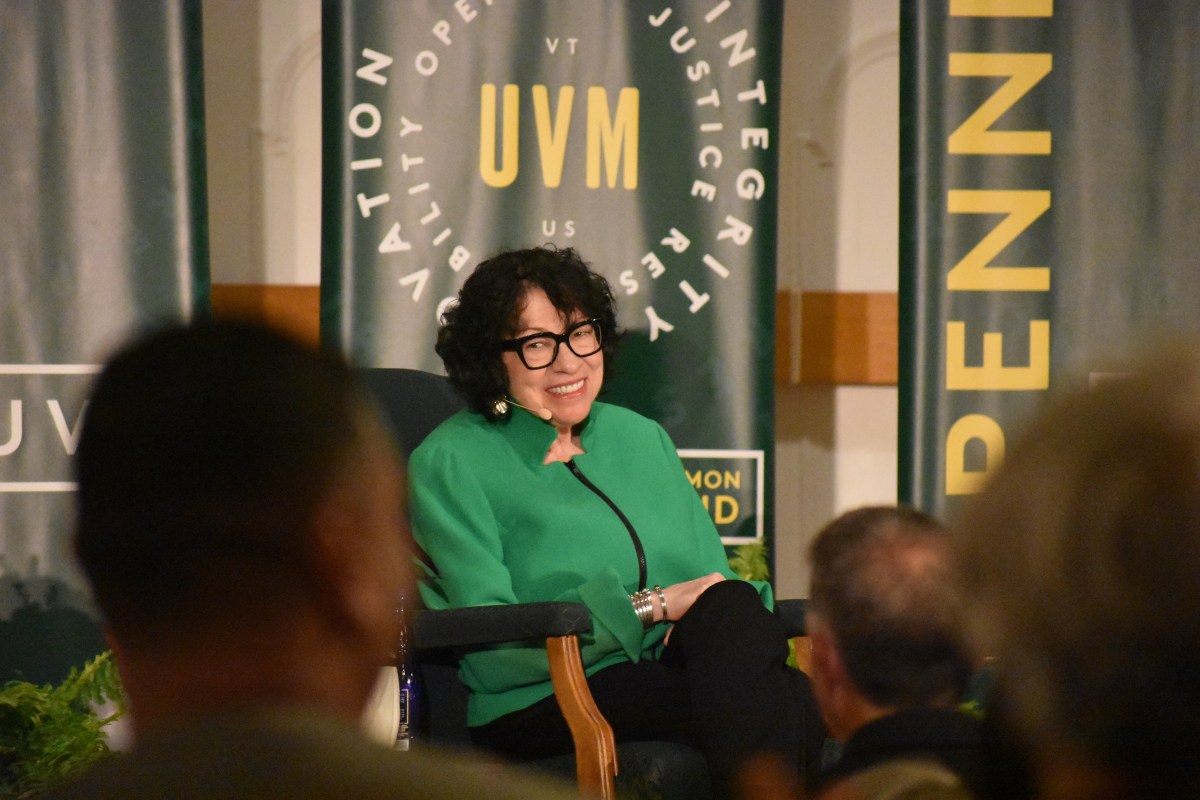
U.S. Supreme Court Justice Sonia Sotomayor spoke to a packed house at the University of Vermont’s Ira Allen Chapel on Monday night about her life, the role of lawyers and the power of dissent.
The justice, in conversation with UVM President Marlene Tromp, talked about her life and career, offered advice for young students in attendance and, briefly, addressed the state of politics in the country. Her appearance was part of the university’s second annual Leahy Public Policy Forum series.
“We are in a difficult part of American history, and we have great risk right now of our republic government changing in some fundamental ways,” she said. “I’m not going to tell you to not be worried. You have and should be worried. But what you shouldn’t do is walk away from the fight.”
She later said that if America “loses the value of understanding that America was built on the backs of immigrants,” and that the country continues to thrive from the children of immigrants, “then we’ll stop being great, because that’s how we got to where we are.”
Sotomayor, 71, has been a liberal stalwart on the court since her appointment by former President Barack Obama in 2009. She is one of three justices typically associated with the court’s liberal bloc, along with justices Elena Kagan and Ketanji Brown Jackson.
She is the first Latina to sit on the nation’s highest court, and was the third woman to be confirmed.
Sotomayor’s talk comes several weeks into a Supreme Court term with much at stake. The court has heard, or is scheduled to hear, arguments in a number of high-profile cases centered around transgender high school athletes’ participation in sports, the 1965 Voting Rights Act, and immigrants’ right to asylum.
Sotomayor spent the first part of her day on Monday speaking with elementary students in Burlington, Winooski and Charlotte — reading from her children’s book, “Just Shine! How to Be a Better You.” She later answered questions from a group of UVM students and alumni before the event.
Tickets for Monday’s event sold out as soon as they went live earlier this month, university officials said. The justice was welcomed with remarks by Republican Gov. Phil Scott, U.S. Sen. Peter Welch, D-Vt, and former senator Patrick Leahy, who was not in attendance but addressed the crowd in a recorded video message.
Sotomayor, during the Monday night event, spoke about her childhood growing up in the Bronx, and her mother’s influence on her life. Asked by Tromp whether she had received any advice that held special value with her, Sotomayor said she’s “never been afraid to ask a question,” and that she’s never been afraid to say, “I don’t know.”
“Too many people are afraid of being embarrassed by saying, ‘I don’t know,'” she said.
She encouraged students in the audience to be bold and press on through adversity. Asked about what motivated her early in her career, Sotomayor said people have to “be a little stupid.”
“Sometimes you just have to jump — be a little stupid,” she said. “Do what you think is something different or exciting. And if you get it wrong, change course, do something else.”
Sotomayor graduated from Princeton University in 1976 and received her law degree from Yale Law School. She later worked as an assistant district attorney in New York.
While in New York, she worked with the Puerto Rican Legal Defense and Education Fund, an experience she said introduced her to a “wider world than I would have ever known.”
From there, she rose through the federal court system. She was nominated by President George H. W. Bush to the U.S. District Court for the Southern District Court of New York in 1991. Five years later, President Bill Clinton nominated her to the U.S. Court of Appeals for the Second Circuit, also based in Manhattan.
Sotomayor, who has been lauded for her impassioned legal dissents, was asked by Tromp what dissent means to her “and what it should mean to us.”
The justice said the law is often perceived as “black and white” and said there is a “gray area” in the interpretation of the law. Dissenting, she said, “illuminates that gray area” for the public.
“Whether that view has or has not convinced my colleagues” on the Supreme Court, “they’re not my only audience,” she said. Her legal opinions are meant to speak to the broader public, she said, and sometimes to Congress to say “do your job and fix it.”
“That’s been a little more difficult” recently, she said, but “that hasn’t always been the case.”
Sotomayor later gave advice for students choosing to study law. Lawyers, she said, are there “to fight for the lost causes — to help people who are in need of a voice because they feel the system is stacked against them.”
Part of the job of a lawyer is accepting there will be cases you will lose, she said, especially if you are involved “in civil rights cases.”
But “we lose the war when you walk away,” she said. “So long as people and lawyers and young people are still fighting to create a better America … we still have hope in the world.”
