

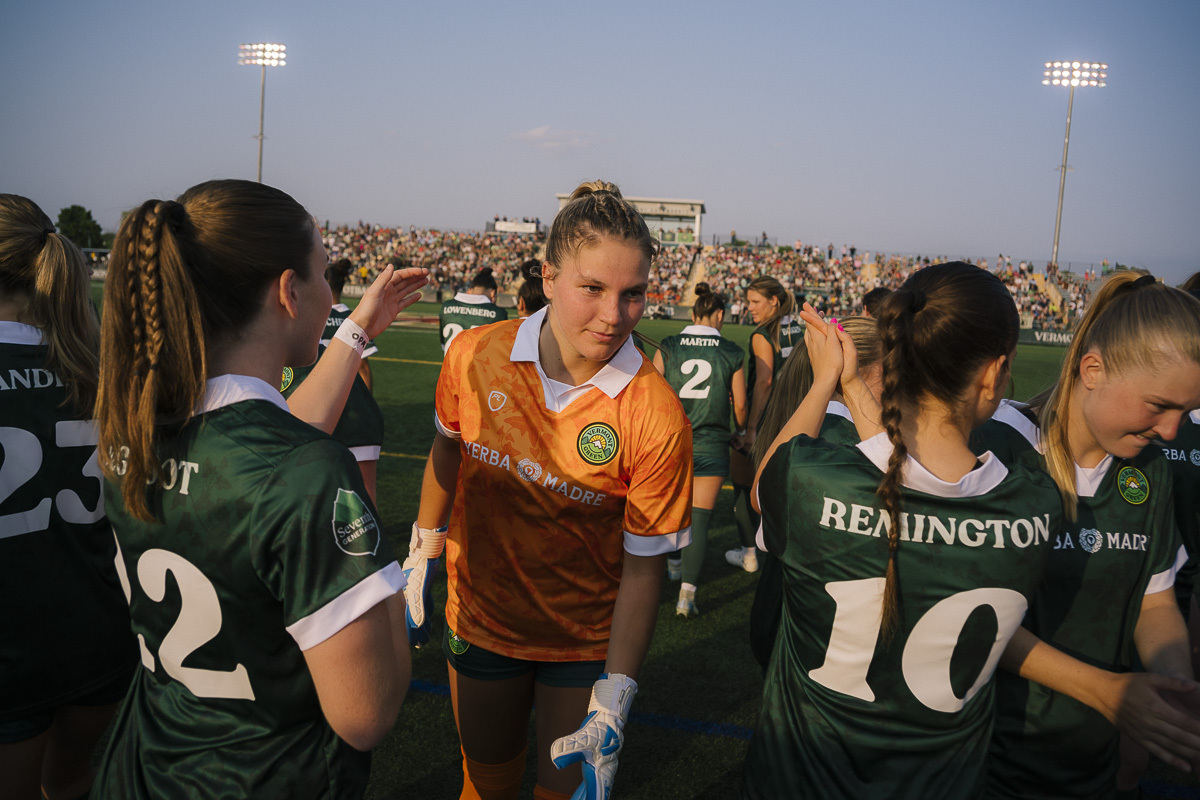
Vermont Green FC, the semi-professional soccer club in Burlington whose men’s team won a national championship in August, plans to field a women’s team for a first-ever full season in 2026, its owners announced Tuesday.
The Green’s men’s side has played four summertime seasons — and found runaway success — since its founding in 2022. Over the last two years, the club has also fielded a women’s team for several exhibition matches, all of which Vermont has won. Those games weren’t part of any formal league or tournament, though, and instead meant to test the waters for a more permanent women’s team at some point in the future.
Now, the club is set to join United Soccer League’s USL W, a nationwide summer competition made up largely of collegiate women’s players who often aim to get recruited to play professionally. It’s a parallel of the semi-professional men’s league — United Soccer League 2 — that the Vermont Green men’s team plays in.

The club said its women’s team plans are contingent on two other clubs joining what would be a new, five-team “Northeast Division” within the national USL W league. In addition to Vermont, two teams based in Connecticut have agreed to join so far.
In its 2025 season, which ended in July, USL W had 93 teams across 15 regional divisions. Vermont Green is confident that two more Northeast teams will come on board in time for the 2026 season, Patrick Infurna, one of the club’s co-founders, said Tuesday.
“We’re just incredibly excited to continue growing soccer in Vermont,” he said.
Infurna said local hype around Vermont Green’s women’s exhibition games has made developing a permanent side a matter of when, not if. Those three games all drew sold-out crowds to the team’s home turf on the University of Vermont campus.
The team has also gotten a boost from a big name.

Ahead of its first exhibition match in 2024, it recruited Sam Mewis, who won the 2019 World Cup with the U.S. women’s national soccer team, to coach and help train its players. Mewis moved to Vermont last year after retiring from her professional soccer career in the U.S. and the U.K.
Infurna said he expects Mewis to stay involved with the club when it fields a permanent women’s squad in 2026, though he isn’t sure yet what her role will be.
“We’ve seen amazing enthusiasm over the last two summers, not only from the fans, but also from some of the nation’s top players in their desire to play here in Vermont,” Mewis said in a club press release Tuesday.
Currently, there are no active professional or semi-professional women’s soccer teams in the state, according to Infurna. Vermont Fusion, a soccer club in Manchester, has fielded a team in the semi-pro national Women’s Premier Soccer League — which is separate from USL W — in the past, though didn’t do so this year or in 2024.
Meanwhile, he pointed to how the state has a likely little-known piece of women’s soccer history: Vermont State University Castleton, in the 1960s, was one of the first colleges in the country to give women an opportunity to play competitive soccer against other schools, predating the implementation of Title IX rules requiring equal athletic opportunities.
With its women’s team, Vermont Green is “following up on an already well-established and well-supported soccer community in Vermont,” Infurna said. “But, you know, we’re trying to take it to another level.”
Vermont Green said in the release that information about tickets and game schedules for the women’s team would be available early next year. The club expects to sell separate season tickets for its men’s and women’s teams, it said.
