

This story by Marion Umpleby was first published in the Valley News on Oct. 1, 2025.
WHITE RIVER JUNCTION — When collaborators Michelle Ollie and James Sturm set out to start a school for cartooning in the early 2000s, they were met with incredulity.
Cartooning was still considered a lightweight art form, at least in the eyes of the general public, and a school devoted to the craft, in rural Vermont no less, seemed like a far-fetched endeavor.
“People were like, ‘Oh, you’re making a clown college?’” Sturm said in a recent interview. “It was such a reach for the public imagination.”
But despite the raised eyebrows, the Center for Cartoon Studies, now in its 20th year, has grown into a hub for burgeoning talent and seasoned cartoonists alike. School alumni include Tillie Walden, whose autobiographical graphic novel “Spinning” earned her a Will Eisner Award, and drag queen Sasha Velour, whose art has appeared on the cover of The New Yorker.
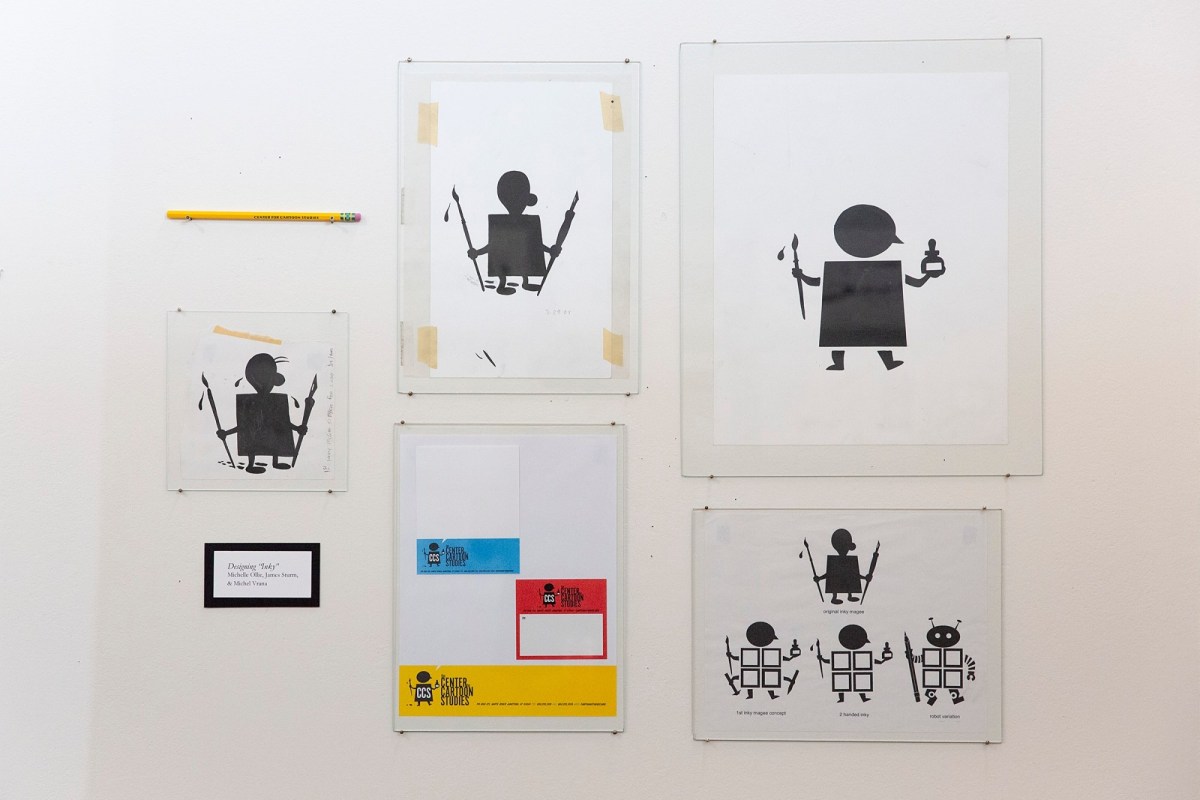
In honor of the milestone, an exhibition is opening in the school’s Colodny building that features cartoons and mock-ups from the center’s early days. The show’s opening reception is set for the end of this week as part of White River Junction’s First Friday festivities.


As CCS has continued to advance over the years, so has the state of cartooning. Back in the early 2000s, notions of what cartooning could look like were still evolving, and Sturm felt like he could “wrap my head around” their place in the zeitgeist.
Now bookstore shelves are lined with comic books whose subject matter range from cookbooks to personal memoirs to political manifestos.
The digital age has also given rise to a culture that communicates through the rapid exchange of symbols and visual imagery, be it with emojis, memes or Instagram posts.
“Cartoons have been doing that forever,” said Sturm, who turns 60 this month.
Cartooning has also gotten a lot more queer, and so has CCS. In the school’s early days, classes were mainly male, now CCS has so many women and non-binary students that Sturm said he’s surprised “we don’t have a target on our back from the Trump administration.”
Over the years, the center’s faculty has also grown, too. The school currently has around eight faculty members, many of whom are alumni at the school, in addition to dozens of visiting cartoonists who teach classes over the course of the year.
“I used to wear 50 hats, now I wear about four,” Sturm said.
One of those hats is director of the school’s Applied Cartooning Lab, which works with national organizations to create educational cartoons about topics such as health care, civic engagement and mental health. A couple years ago, the Lab published “Health and Wealth,” a comic book in which an eclectic cast of animals break down the complexities of the U.S. health care system. The guide, which was a collaboration with students at Harvard College, was distributed to all 535 members of the U.S. Congress.

While CCS has continued to develop work with some of the industry’s most notable cartoonists, with only three facilities concentrated in downtown White River Junction and about two dozen students in the full-time programs, in many ways it remains a humble operation.
“We punch way above our weight class,” Sturm said.
In addition to the MFA program, CCS also offers one-year and two-year certificates as well as fellowships and summer courses. Tuition for the MFA program for this academic year is $29,750 before scholarships and aid.
CCS’ small scale works for Sturm and Ollie. For one, it makes it easier to enact administrative and curricular changes quickly, but it also helps foster a tight-knit community among students and staff.
The school’s small operation also feels fitting given that cartooning, by nature, is a medium that can pack a punch even in the tiny margins of a sheet of notebook paper or the back of a napkin.
CCS is currently in the process of further consolidating the campus. In November, the school plans to start renovations on the town’s historic telegraph building to accommodate classrooms, a production lab, archives and offices.
The completion of the project, slated for next fall, would mean bidding goodbye to the Colodny building on South Main Street, which the school has used since it opened. A historic building that was once a department store, the Colodny’s basement flooded five years ago and as the school turns 20, it’s time to make a change.
