

This story by Cheryl Casey was first published in The Waterbury Roundabout on Sept. 19, 2025.
Move over, therapy dogs. There’s a new king of emotional well-being in town.
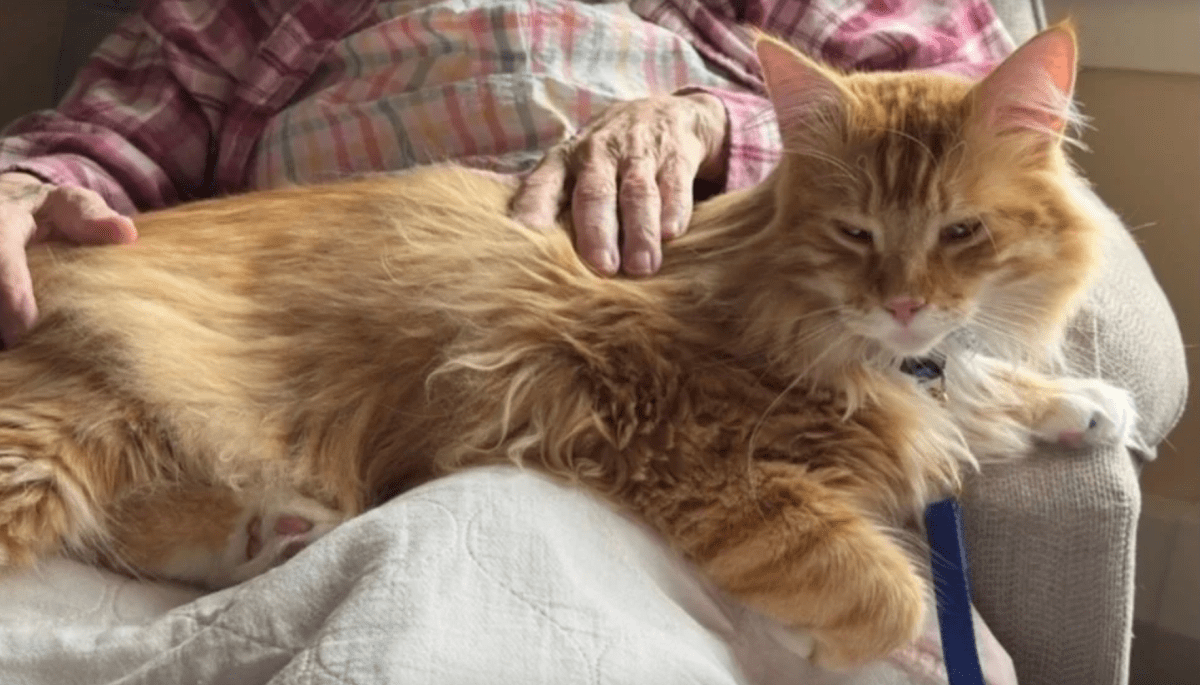
Meet Toby, a 16-month-old Maine Coon of Waterbury Center, the first nationally certified therapy cat in Vermont.
Toby and his human partner, Lisa Lovelette, have been bringing comfort and smiles to residents and staff at Woodridge Rehabilitation and Nursing in Berlin for nearly a year and along the way, Toby has refined his support skills and gained certification.
Lovelette recalled how she began to consider Toby in this new role after realizing that her dog Teddy, also a certified support animal, wasn’t really fitting in with the residents at Woodridge. “Teddy wasn’t really working out. It was a mismatch of energy,” she explained.
That’s when Lovelette decided to pursue her aspiration of training a therapy cat and found Toby the kitten at Cedar Rock Maine Coon Cattery in Northern Vermont.
“They did an excellent job of socializing him as a kitten,” Lovelette said. Toby went home with her at 10 weeks old instead of the typical 14 weeks that adopters wait. In those early weeks, Lovelette said she brought Toby everywhere with her — often in her backpack — to expose him to as many kinds of experiences, people, and other stimuli as possible.
Toby’s first visit took place when Lovelette stopped by to visit a friend at the facility. “He came here as a baby,” recalled Kathi Tynan, who works as Life Enrichment Coordinator at Woodridge.
From day one at Woodridge, Toby was “absolutely a dream,” admitted Lovelette, describing how Toby would sit next to people or on their laps with complete patience while they stroked and patted him.
“He’s a real gift to the elders,” Lovelette said, adding that Toby “never once tried to jump off of a lap.”
Administrators from Central Vermont Medical Center, which manages Woodridge, were skeptical of Toby’s suitability as a therapy animal, citing concerns about allergies and their own lack of a clear policy about therapy animals besides dogs. Toby couldn’t gain official certification as a therapy cat until this spring when he turned 1 year old, so Lovelette and Toby spent much of last winter wondering if that plan would be derailed by red tape.
Certification required 10 hours of supervised visits under the observation of an approved evaluator; Lovelette intended for these in-training visits to take place at Woodridge.
Fortunately, the pair had cheerleaders at Woodridge, especially Tynan, who Lovelette said persistently and effectively advocated to administrators for Toby’s visits to continue.
“The response has been very touching. It’s been very enriching to the residents, improving their quality of life,” Tynan said. “It was kind of a no-brainer because the response was so completely positive – there was no way we could go back!”
After several months, Tynan prevailed and administrators relented with the understanding that Toby and Lovelette would meet certain conditions – most of which were already part of the certification requirements, including claw caps, vaccinations, a control evaluation by a vet, and use of a leash. They also were to coordinate their visits with the nurses’ schedules, ensuring they would not come on a day when the one nurse with a cat allergy was working.
Getting credentials
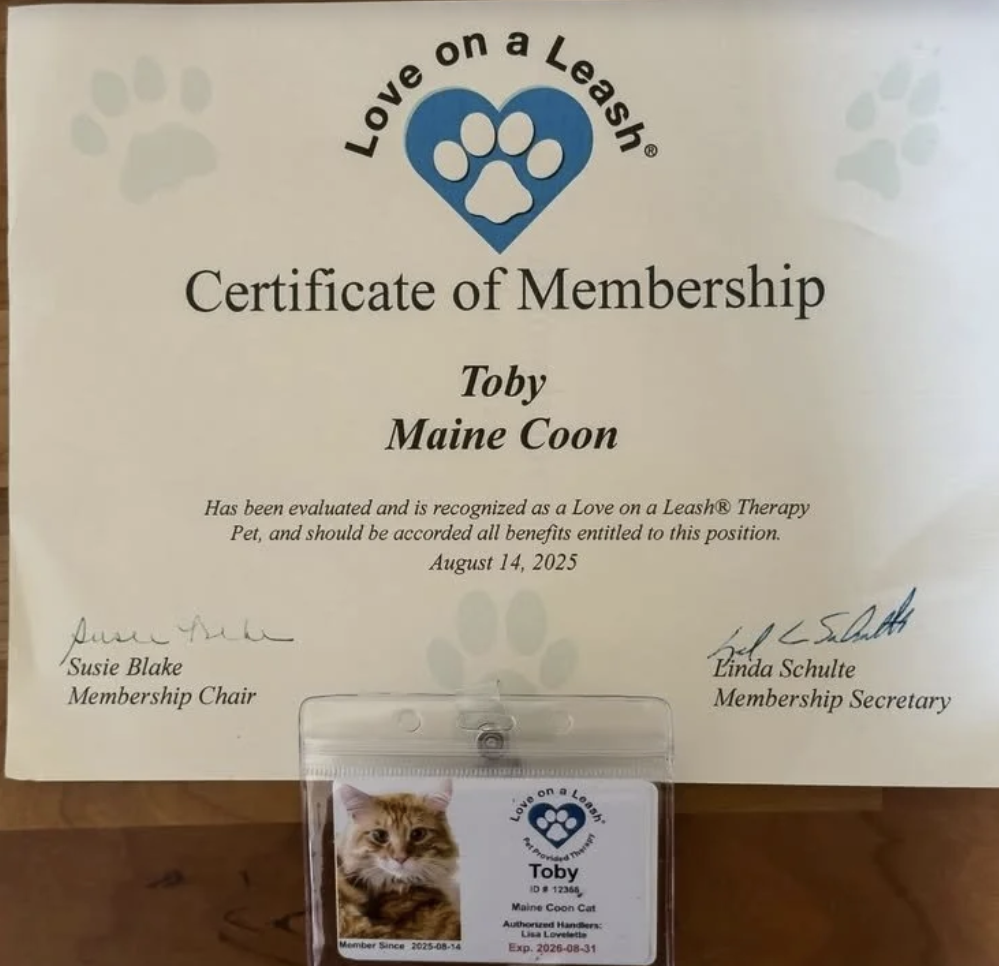
The next task was to undergo the formal certification process. There are only two national organizations that certify therapy cats, Pet Partners based in Bellevue, Washington, and Love on a Leash in Oceanside, California. Lovelette chose the latter, saying Love on a Leash’s process allowed her “to learn and grow” so she can “be that guide for anyone who is even remotely interested” in training a therapy cat.
According to the IAABC Foundation, a charitable sister organization to the International Association of Animal Behavior Consultants, only about 2% of the therapy animal teams certified by the two national organizations involve cats.
Lovelette said that cats are underrepresented as therapy animals because “they aren’t known to be trainable.”
A former teacher and principal, she noted that working with Toby was a lot more like working with kids than dogs. “Dogs require this step-by-step process of learning different commands, but training cats is more holistic,” she said. For cats, it’s about “giving them the experiences to acquire attributes of confidence and calm.”
It also sometimes just comes down to the cat. According to a study by Washington State University professor Patricia Pendry and her research colleagues in Belgium, some cats naturally possess the personality traits that are ideal for a therapy animal, like sociability, willingness to engage with people, and tolerance of being handled.
“There’s the perception that cats just aren’t suitable for this kind of work, but our study shows that some cats may thrive in these settings,” Pendry said in a press release from the university. The study still leaves questions about whether the desired traits can be developed through experience or if they must be innate and then encouraged. It still points to the promise of expanding the pet-therapy options for people who simply might not like dogs.
For such people, therapy cats remain a largely elusive option, a situation Lovelette is determined to change. But first, she and Toby had to become a certified team themselves.
Once again, Tynan played a key role. She worked with Love on a Leash to be trained as a formal observer so that Toby and Lovelette could achieve their 10 hours of in-training evaluation.
“It really was not hard,” Tynan said. “Toby would come for an hour a week and I’d observe the reactions to Toby and what Toby’s reactions were. He would just relax.”
Tynan confirmed Lovelette’s assertion that Toby hasn’t yet jumped off a lap. “He is definitely impressive. Not all cats are like that,” she said.
It’s his easygoing, friendly nature that makes Toby a natural for this role and the reactions from the Woodridge residents prove that. “Their faces would light up and they’d just snuggle up with him – even when there was a vacuum cleaner around,” she said.
Tynan agreed that the addition of Toby has expanded everyone’s idea of therapy animals, noting that before the furry Maine coon cat came on the scene, Woodridge’s experience with therapy animals was just with dogs. For the residents, not everyone is a dog person, Tynan said, and cats have their own unique way of engaging with people. “Toby gets right up to the residents and snuggles with them,” she said. “He’s just full of love.”
‘A glimmer of light’
The therapy team of Toby and Lovelette officially earned their certification in August. Lovelette called this achievement “the greatest accomplishment of my life because there’s no recipe to figuring it out or experts to fall back on.”
She and Toby continue to spend about two hours every Tuesday afternoon at Woodridge, where she knows Toby is making a real difference in residents’ lives. Spending time at an elder care facility has been “eye-opening” for Lovelette. “It’s a wonderful staff, and they give good care, but residents otherwise have so little actual interaction with others, especially with touch,” she noted.
Staff often give Lovelette tips on who might need Toby most on visiting day, such as a new resident or a resident whose spouse recently passed away. “We try to give everybody 10 or 15 minutes at minimum” if they want it, Lovelette explained. She also observed how staff members’ faces light up when Toby arrives. “He’s a glimmer of light in a very hard job,” she remarked.
Toby’s weekly visits now are a highlight at the facility for staff and residents alike, Tynan said. She shared various comments from the residents that she collected in making the case supporting Lovelette and Toby’s continued appearances. “I remember one saying something like, ‘Today’s a day for living because Toby is coming.’ Or, ‘I wait all week to see Toby,’” she recalled. “Whether they have dementia or not – they know Toby is coming.”
Hoping to inspire
Now that Lovelette herself has gone through this process and is certified, she said she’s in a position to support other potential therapy-cat teams in the region. “I want this to be the beginning, not the end,” Lovelette insisted, adding resolutely, “If I can get just one person.”
Lovelette said she’s confident that anyone who thinks their cat has a suitable temperament and personality can follow in her and Toby’s footsteps. “The majority of the [approximate] 250 therapy cats in our country were mature shelter cats when they started working, so it does not take a special breed to do this work,” she said.
The cost to obtain certification through the Love on a Leash organization that Lovelette worked with is mainly the time spent to meet the requirements. According to the group’s website, its membership fee is $80 in addition to any veterinary fees for a required evaluation. Once certified, the therapy teams work on an entirely volunteer basis, a requirement for the LoaL program.
Lovelette said she hopes her and Toby’s story will be an inspiration, and they’re ready to mentor other prospective therapy cats and their humans. “I hope it generates interest to the point where just one person decides to take the journey,” she said. “I am keeping my expectations low and hope I am surprised.”
