

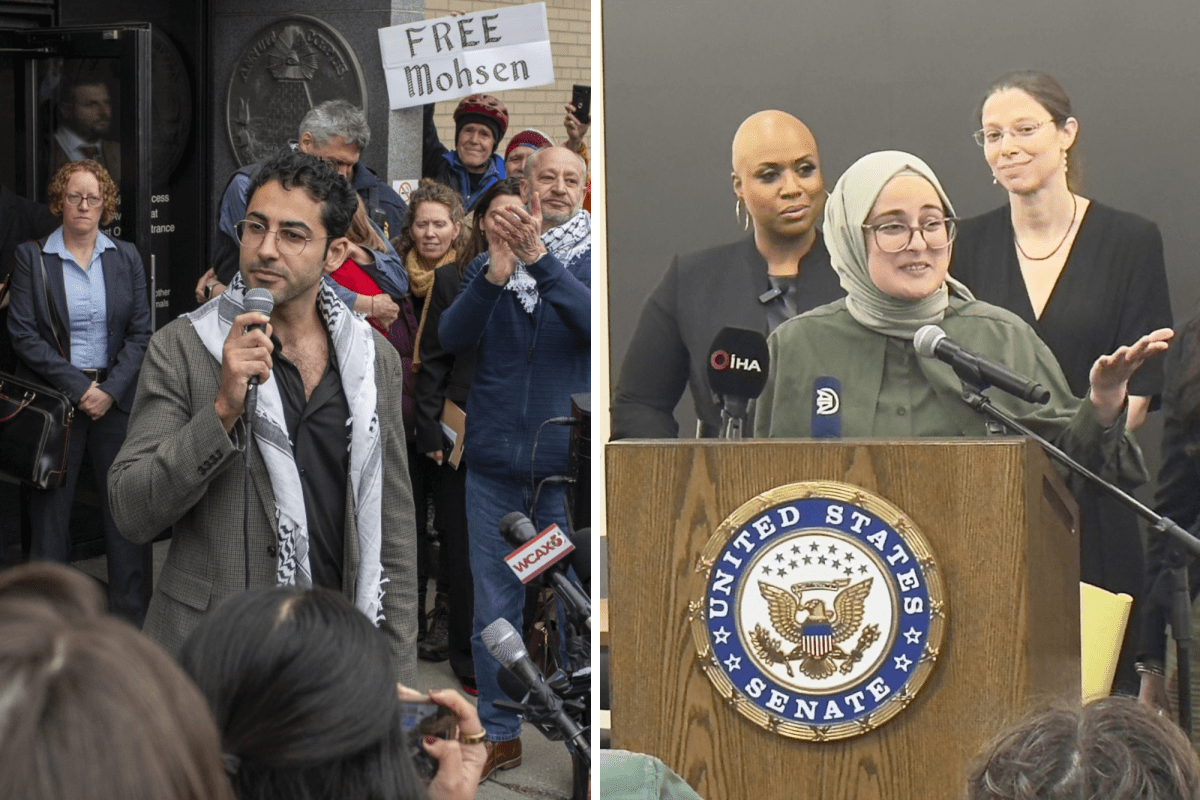
A panel of federal judges heard arguments Tuesday in the ongoing court cases of two international students who were detained in Vermont earlier this year as part of President Donald Trump’s crackdown on pro-Palestinian campus activism.
Mohsen Mahdawi, who is Palestinian, and Rümeysa Öztürk, who is Turkish, have been free from custody for months after judges in the U.S. District Court for Vermont ordered their release. Mahdawi was arrested by federal agents in Colchester in April and was held in federal custody in a state prison. Öztürk was held overnight in a U.S. Immigration and Customs Enforcement office in St. Albans after agents arrested her in Massachusetts. ICE then took her from Vermont to a detention center in Louisiana.
Now, the Trump administration is in the process of appealing aspects of the Vermont District Court’s rulings. The challenges were heard one after the other Tuesday in the U.S. Court of Appeals for the 2nd Circuit, which is located in New York City.
In both cases, the three-judge panel is considering questions with potentially national implications about the balance between the government’s power to enforce immigration laws and the protections of individual rights enshrined in the U.S. Constitution.
The appeals panel did not issue a decision Tuesday. Attorneys for Mahdawi and Öztürk said after the hearing that while they did not know when that ruling would come, it could be relatively soon because the judges were operating on an “expedited” timeline.
In both cases, the government is arguing that federal immigration law prevents district courts, such as the one in Vermont, from taking up certain cases in which those bringing a suit are challenging their detention by federal immigration authorities.
In Mahdawi’s case, specifically, the government is appealing Vermont Judge Geoffrey Crawford’s decision to release the Columbia University student on bail while courts consider his challenge to his arrest. In Öztürk’s case, the government is appealing Judge William Sessions’ order that would have transferred the Tufts University student back to Vermont from an ICE detention center in Louisiana. But that order was essentially superseded by Sessions’ decision to then order her release on bail.
In addition to the proceedings this week, both students are also challenging the Trump administration’s ongoing efforts to deport them in proceedings in the federal immigration court system. That court system is part of the U.S. Department of Justice and separate from federal district courts, like Vermont’s. The students’ immigration challenges are both being heard in Massachusetts, their attorneys said.
In court Tuesday, Tyler Becker, an attorney in Trump’s Justice Department, said the students should have been required to exhaust their options within the immigration system before seeking relief from the U.S. District Court judges in Vermont.
Becker argued that even if the students lose their immigration court challenges, meaning they would be facing deportation, that system allows opportunities for appeals, including to the same level of court — the federal appeals circuit — as Tuesday’s hearing. He said the Vermont judges were wrong to take up the two cases.
But attorneys for the students contended that those immigration proceedings could take months or even years. It’s unlikely the students’ immigration cases would get the same expedited treatment as their cases in Vermont’s district court, they said, because the students are no longer behind bars. That potentially long timeframe, the students’ attorneys said, would not give the students the immediate relief they needed to cure what the attorneys say were clear violations of their rights to free speech.
Both students appear to have been targeted for speaking out about Israel’s war in Gaza. Mahdawi was a prominent leader of pro-Palestinian campus protests at Columbia, while Öztürk wrote an op-ed criticizing Tufts’ response to the war.
Moreover, the attorneys said, stripping the students of the ability to challenge their detention in the place where they were being held, at least for a time — Vermont — would violate the clause of the Constitution meant to guarantee individuals’ protection from unlawful government detention, known as the writ of habeas corpus.
Potential conflict between the immigration system and other courts, which the Trump administration is raising as a key concern in the students’ cases, is “just the price of our constitutional design,” said Michael Tan, an attorney at the American Civil Liberties Union representing Mahdawi, during Tuesday’s arguments.
In Mahdawi’s case, Becker also argued Tuesday that a roughly decade-old Windsor Police Department report describing statements Mahdawi allegedly made to an Upper Valley gun store owner was not properly considered in the Vermont judge’s ruling.
The report led an FBI agent to speak to Mahdawi, and the case was soon ended, lawyers for both parties have said. Crawford, the judge, said earlier this year he believed that the “shocking” allegations in the filings were “in large part fabricated.”
One of the judges on Tuesday’s panel, William Nardini — who is one of two Trump appointees hearing the students’ cases — was sharply critical of Crawford’s assessment of the fact the FBI did not pursue charges in the case, saying Crawford made “dramatically flawed” inferences about Mahdawi’s character based on that fact.
Tuesday’s hearing came on the same day, meanwhile, that a federal judge in Boston ruled in a separate case that the Trump administration has violated the Constitution in targeting non-U.S. citizens for deportation solely for supporting Palestinians and criticizing Israel. The ruling said Trump and his policies threatened free speech.
Attorneys for Mahdawi and Öztürk said Tuesday they weren’t immediately sure how that case could impact the students’ proceedings. But in comments to reporters, Mahdawi himself quoted the Boston judge’s ruling and urged people to consider its words.
“He says: ‘Alone, I have nothing but my sense of duty. Together, we the people of the United States — you and me — have our magnificent Constitution,’” Mahdawi said.
