

Madelyn Nonni is a VTSU Castleton student, currently serving as a Rutland Herald intern. This story is via the University of Vermont’s Community News Service.
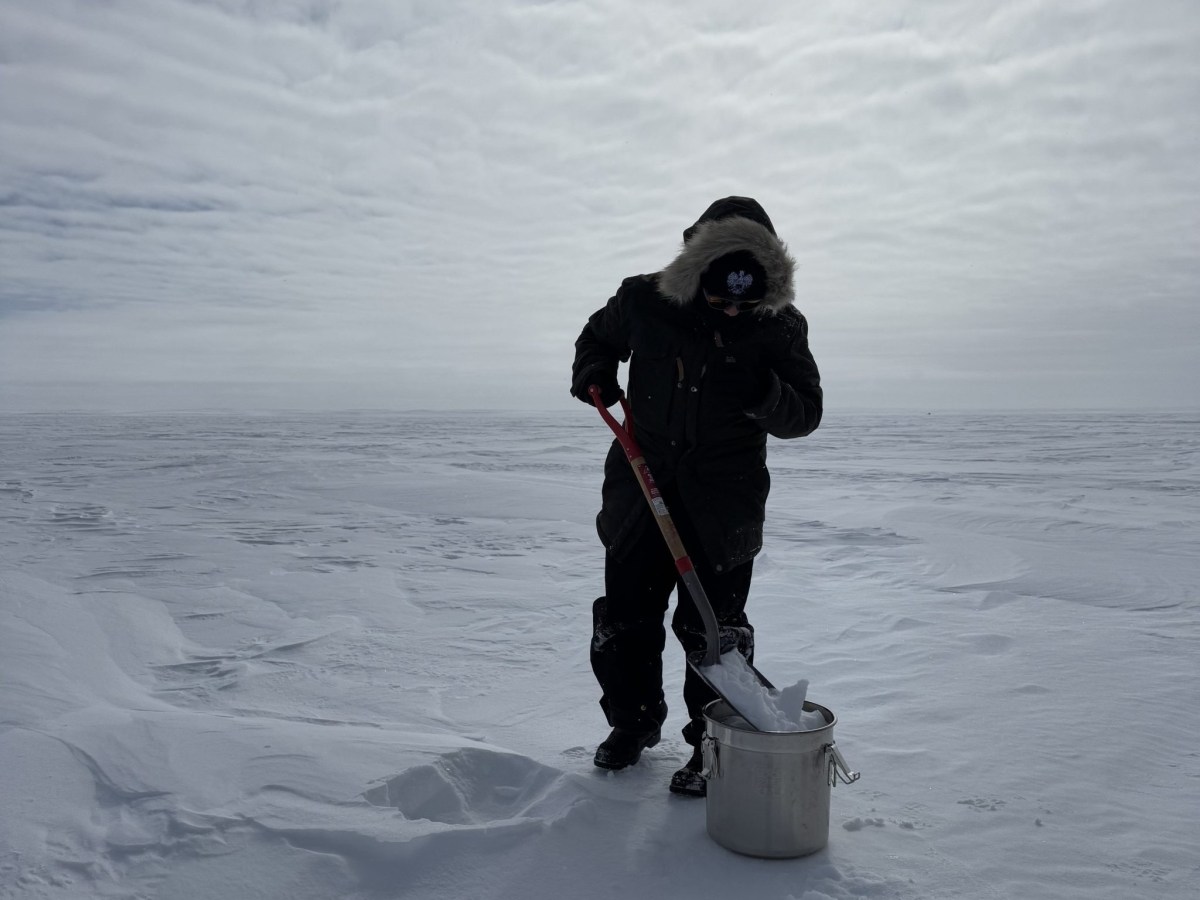
Picture flat white snow as far as the horizon. No trees, no rolling mountains. Just an endless scene of ice and frozen earth underneath an illuminated sky with the sun high in the air, regardless of the time of day.
This is what Castleton junior Environmental Science major Olivia Rutkowski saw as she stepped off the snowmobile in Cambridge Bay, Canada, this past May.
For two weeks, Rutkowski and five others lived and worked in the Arctic, collecting cores of snow, sea ice and permafrost to uncover more about the microbes hidden beneath the surface.
The research effort is in collaboration with the Dynamic Research of Arctic Cryospheric Organisms team, or DRACO. It’s a group of professors and students researching polar environments down to the nanoscale. The project is led by associate professors Ross Lieblappen and Michelle Sama of Vermont State University Randolph.
Joining them were environmental science and chemistry professor from Castleton Andrew Vermilyea and VTSU Randolph student researchers Elizabeth Goodell and Dominic Mazzilli.
“I’ve done field work around Castleton and Poultney, but this was my first time going out of the country to do it. It was definitely a new experience,” Rutkowski said.
The first week of the trip was spent snowmobiling over seven feet of ice to locations 15 to 45 minutes away to get samples of snow by ice drilling. The group would get as many samples as the day allowed to have thorough data pulled.
Before the day could end, the group would head back to the lab to process the samples.
“For my samples, it was putting them in a bucket, putting them in an incubator, melting them down, filtering all that water, assigning it a code so that I know which site it’s from,” Rutkowski said.
Rutkowski and Vermilyea are a part of a slightly different research effort.
“We’re looking at microplastics in pristine environments like the Arctic. The ocean, when we pull sea ice samples, our global oceans are connected. As plastics just degrade, they can be transported there, and you can see them in ice and water up there. They also can end up in the atmosphere, microplastics. From burning and processing of plastic and all kinds of reasons, and then can hang around up there for a long time and be deposited with rain and snow,” Vermilyea said.
Much of the work done in the field also transfers to further research after returning home.
Vermilyea adds that looking ahead for Rutkowski and her studies, the time she is putting in back in Castleton will be focused on developing more methods to research microplastics in soils, and accurately quantify them.
“Two weeks of field work creates two years of work,” Vermilyea said.

The second week of research consisted of collecting permafrost cores, which can be compared to solid cores of frozen soil. These extracted cores are gathered by drilling down using a corer, and on some occasions it can take multiple hours, if the corer were to stop spinning and freeze to the ground.
“Sure enough, we got the core barrels frozen in the ground, about a foot down. It’s frozen ground. You can’t yank that out, no matter how strong you are. Rather than going home for dinner, now we’re at it for four hours, chipping away at it. One person had like a pickax, one person had a chisel with a hammer, and we just took turns. We had a little bit of movement. So, one person was holding the core barrel, trying to keep it moving as much as possible to not freeze it more,” Lieblappen said.
After being awarded funding in 2023 by the US Army Corps of Engineers’ Engineer Research and Development Center (or ERDC), Lieblappen and his team invested in a state-of-the-art nano-CT scanner located on the Randolph campus to capture images of permafrost, snow, and sea ice down to the micron level.
The trip to Cambridge Bay was DRACO’s fourth research fieldwork trip. June 2024 brought them to Fairbanks, Alaska, and a month later, in July, they were in Kangerlussuaq, Greenland. Earlier this year, between February and March, the group was in Utqiagvik, Alaska.
Their goal is to fully characterize terrain from different geographical locations, like collecting permafrost from regions that are far apart from each other.
“The idea being that these biomes that have microbes there could potentially be very distinct. So, we want to kind of have a wide sampling of regions of the Arctic that we’re grouping,” Lieblappen said.

But the work doesn’t end after the cores and samples are collected and brought back to the lab in heavily insulated core boxes full of heavy-duty ice packs or a cryoshipper, basically a freezer. These shipping containers can keep the samples frozen and cold for about 48 hours, and are constantly being temperature-watched and tracked during travel.
“If the samples thaw out on the way home, it’s all for nothing. That’s the most worrying part when you’re traveling home and you’re waiting for baggage claim,” Vermilyea said.
These fieldwork trips offer students valuable hands-on skills, professors said.
“They do everything. The students do literally everything. It’s hands-on learning at its core. Olivia was driving the snowmobile with gear. She was running the corer with a big auger engine head on it. She was in the lab processing and filtering samples, taking notes. It’s just such a learning experience, but they’re not just hanging around and observing,” Vermilyea said.
For undergraduates, having this level of responsibility is rare. Lieblappen emphasized how unique these opportunities are for students, especially at VTSU.
“Undergraduate students are the ones being able to use state-of-the-art equipment, making these discoveries, doing all the work themselves, which is something that’s really unique for a place like VTSU. I think there’s a lot of opportunity both in terms of the personal manner aspect, but also in terms of the professional development that they get, and the opportunities that they have, and the confidence that they can do groundbreaking science. They can be out there, being the ones that make these discoveries,” Lieblappen said.
Looking ahead for DRACO, a summer 2026 trip is in the early planning phases. In an effort to remain far from Cambridge Bay, the team is brainstorming locations like Ellesmere Island, Canada, or northern Greenland.
The hands-on nature of the Arctic fieldwork, combined with exposure to cutting-edge equipment, gives students like Rutkowski confidence and a tangible foundation for future research.
“It sets up a path for my career. I’ve always wanted to do cold-weather research. Having this experience puts a foot in the door to more Arctic or Antarctic experiences, more opportunities for cold-weather research. It was an amazing experience for sure,” Rutkowski said.
Lieblappen said the work was funded by the Broad Agency Announcement Program of the U.S. Army Research and Development Center and that “opinions, findings and conclusions or recommendations” from it don’t necessarily reflect the views of the sponsoring agencies.
