

This story by Carla Occaso was first published in The Montpelier Bridge on Sept. 16, 2025.
Montpelier’s City Council agreed to pay Christ Episcopal Church $600 per month, for three months, to defray the costs of allowing an encampment on their property. This unexpected quick decision happened during the Sept. 10 council meeting. It came following a presentation of the homelessness situation continuing to develop in downtown Montpelier from the perspective of a local church.
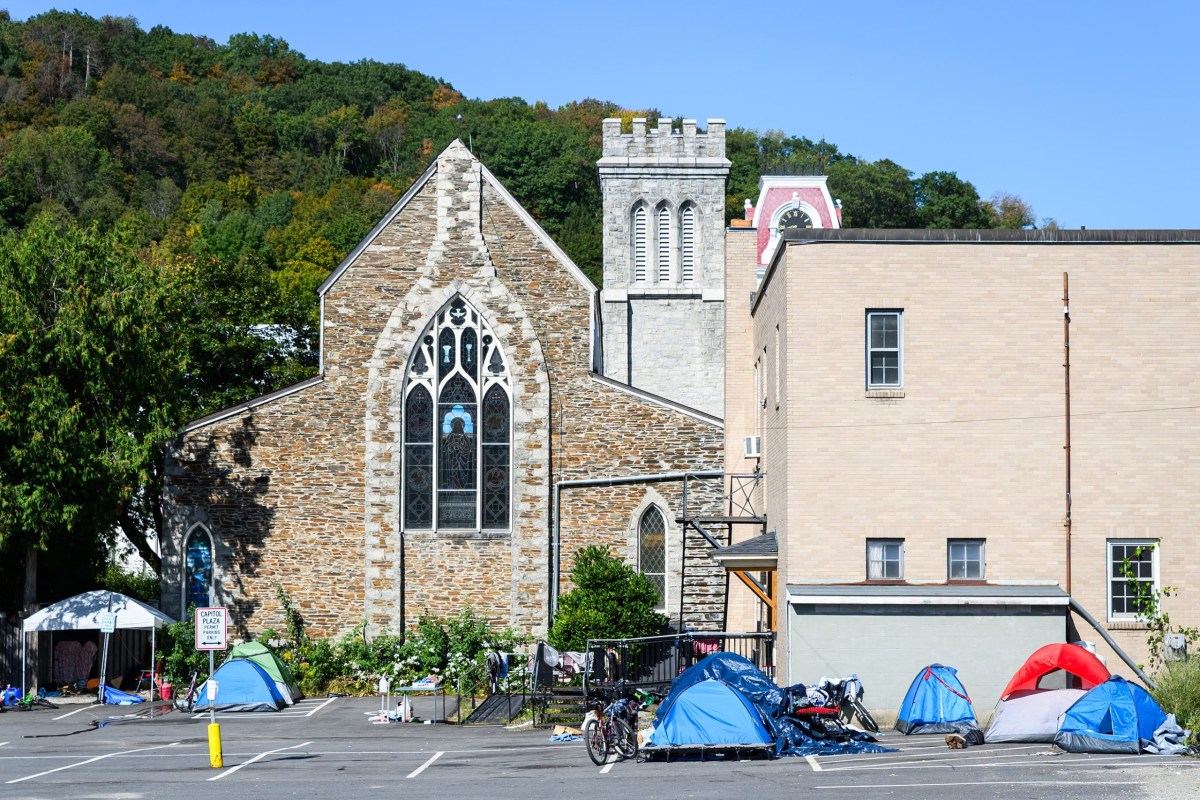
A small grouping of tents covered with tarps is currently gathered on the parking lot surrounding Christ Church’s back door, visible from the bike path and the Capitol Plaza hotel. When The Bridge visited recently, clothes were hanging to dry on nearby outdoor railings and people were sitting together. This encampment has cropped up at its present location just a few hundred yards from the nearby park where, in August, it was dismantled and evacuated by Montpelier city staff. Rev. Dr. Walter Brownridge, Christ Church’s transitional priest, said the number of campers has been fluctuating between 12 and 20.
The church gave permission for people to camp there temporarily, at least until November, Brownridge said. Some people have been permanently “exited” as well, according to Elizabeth Parker, the church’s senior warden, who said seven people who have acted inappropriately have been asked to leave and to stay away.
However, the arrangement has associated costs, including trash removal and bottled water provisioning among others. Additionally, Brownridge said he would like to give laundry vouchers so people can clean their clothes. Those monitoring and attending to the encampment dwellers are volunteers, and include Parker and Zack Hughes, a member of the congregation and co-chair of the Homelessness Task Force.

Brownridge, along with Parker and Hughes, requested $600 per month for three months to cover the cost of trash bags and trash removal, cleaning supplies, laundry vouchers, bottled water and the rental of a portable toilet.
“These are all not luxuries, but simple things that, for people living outside in tents, we might need,” Brownridge said. He also said some members of the congregation are uncomfortable with the situation while others support it. He pointed out that there is nowhere else for the people living in the encampment to go.
“And when I am told — or scolded — that this is too big of a problem, ‘You can’t save everybody,’ and that is true. I can’t. But I can save the person in front of me for at least two or three months, and that is what we are trying to do: Save or help those who are a very vulnerable population,” he said.
Brownridge described the situation as “most critical” and highlighted the need for a collaborative, urgent response. Councilor Jim Sheridan praised the church for “stepping up more than anybody else.” He asserted he would support the funding on the spot considering the urgency. Other city councilors weren’t as quick to agree. Councilors Ben Doyle and Pelin Kohn expressed concern about setting a precedent for similar requests and the lack of a formal application process. Doyle worried aloud that anyone could walk in the door and request funding if a precedent is set in such a manner.
Sheridan argued that although this does set a precedent, it is in response to an unprecedented situation. “I mean, precedents are done all the time because if no precedent is ever set we would still be in the Stone Age,” Sheridan said. “You (set) precedents when you have something that is brand new that you have never had to face before.” He then made the motion to grant the requested $1,800. Councilor Adrienne Gil pointed out that the last encampment cleanup cost $4,000, and that she would support releasing the funds on the spot “because it will save us potential future cleanup costs.”
Parker said measures taken to manage the encampment safely included posting signs to discourage unwanted visitors, working with the Montpelier Police Department, and installing security cameras. She noted that the police have assisted in removing individuals for inappropriate behavior.
And while the funding request was for a short-term need, there was a broader discussion about the city’s lack of long-term homelessness planning. Residents Steve Whitaker and Peter Kelman criticized the city council for neglecting the issue for years and failing to act on previous reports. The church is also exploring options for a winter day shelter and a more permanent, long-term solution.
In the end, everyone decided to support the request.
