

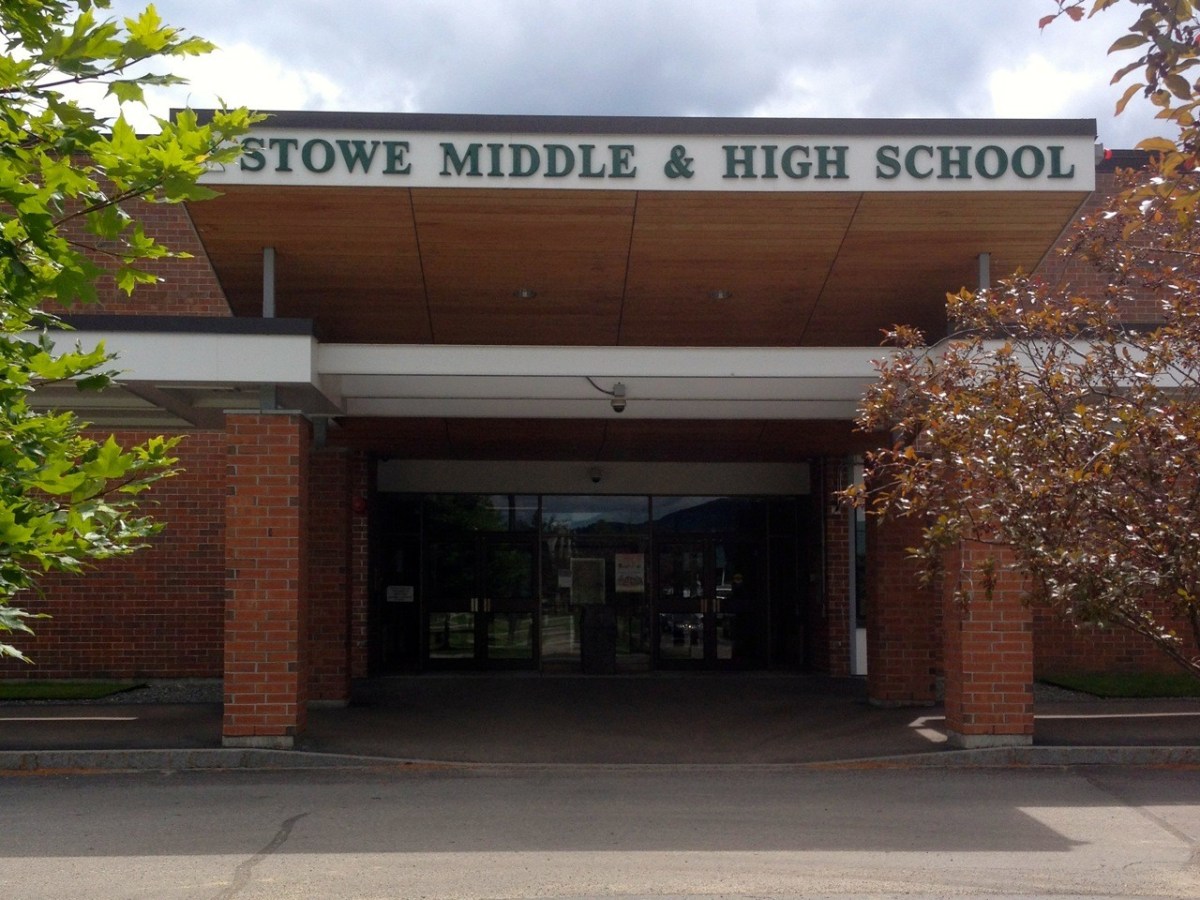
This story by Patrick Bilow was first published in News & Citizen on Sept. 11, 2025.
Seven years after their state-arranged marriage and four years after the voter-approved divorce, the Stowe and Elmore-Morristown school boards have unanimously passed resolutions recommending another merger.
After school board meetings on Monday and Tuesday, Lamoille South Supervisory Union Superintendent Ryan Heraty, who oversees schools in Stowe, Morristown and Elmore, submitted the resolutions to the Vermont Legislature’s School District Redistricting Task Force, which has been tasked with drafting new school district boundaries under H.454, a bill that tees up sweeping education reform for the state.

“If the redistricting task force requires a merger of the Stowe School District, we support a joint district with the Elmore-Morristown Unified Union School District (EMUU),” reads the resolution.
School officials from Stowe and Morristown said a merger is the best possible scenario for what they called a likelihood of district consolidation under H.454. While they’d prefer keeping individual districts, the officials said a lack of representation on the redistricting task force might lead to a greater consolidation of the greater Lamoille County school system, which includes three supervisory unions with more than 20 schools spread out over roughly 400 square miles. According to Heraty, that would be disastrous.
H.454, which passed in June, established a new student-weighted formula for state education funding and a process for drawing larger school districts across Vermont. The initiatives go together, according to Heraty, a PhD candidate in education leadership and policy who has been outspoken about the bill’s potentially negative effects on rural schools.
“They need to draw new districts to make their formula work,” Heraty said.
The redistricting task force has until December to draft new districts, at which point it will present them to the Legislature. The group met on Wednesday in Waterbury, after press deadline, and discussed two potential models for district consolidation, one based on counties and another based on regional technical education centers, according to agenda items. In this case, Green Mountain Technology and Career Center also serves schools in the Lamoille North and Orleans Southwest supervisory unions.
At this week’s meetings, Stowe and Morristown-Elmore school board members and Heraty spoke against those types of districts. Under the state’s proposed funding formula, Stowe and Morristown-Elmore work well together, they said, but folding them into a bigger district will have a negative impact on students, teachers, administration and taxpayers.
‘It’s like when you get married’
The Stowe and Elmore-Morristown districts are well-positioned for a merger, Heraty said. The boards and administration have already navigated one before and many of the same players are still around, and the schools, which are relatively connected geographically, share sports teams and transportation routes. But most importantly for some school officials, Stowe and Elmore-Morristown are solvent, and they don’t want to incur new debt.
“Nobody is talking about debt right now, but it’s a huge factor,” Heraty said,
It’s not like the schools in Stowe and Morristown don’t need work — Stowe voters rejected a $39 million bond in 2023. Instead of bond votes, the districts have opted to chip away at capital projects with smaller investments from the reserve fund year after year, Heraty said.
The Lamoille North Supervisory Union has taken a different approach. Over the past decade or so, the district has taken on five bonds totaling more $18 million for school projects, including $10 million for Hyde Park Elementary School. The oldest bond retires in June 2027 and the youngest June 2048.
“It’s a puzzle lawmakers haven’t solved,” Heraty said. “As soon as they start saying to taxpayers, ‘You’re going to have to encumber debt you didn’t vote for,’ people are going to revolt.”
Rep. Rebecca Holcombe, D-Norwich, a redistricting task force member and former Vermont Secretary of Education, said the debt implications vary based on how the districts shape up.
“It’s like when you get married, you marry someone with all their blessings and faults,” Holcombe said. “Everybody brings something to the table.”
According to the resolutions, the combined district would also balance under the state’s new student-weighted funding formula. For example, Stowe alone would lose millions, Heraty said, but combining with Morristown-Elmore — and creating a district with a demographically diverse population and a relatively large student body and property grand list — would generate enough funding to cover expenses.
Jed Lipsky, I-Stowe, who voted against H.454, said the proposed merger is the best possible scenario, given the legislation coming down the pike.
“There’s going to be a lot of change statewide,” Lipsky said. “Hopefully ours will be minimal, but it would be a great first step to have Lamoille South restructured as it had been.”
Déjà vu?
On Tuesday night, the Elmore-Morristown school board passed the resolution unanimously after a four-minute conversation, but the Stowe vote was drawn out over two meetings.
During the initial conversation for Stowe last week, the proposed resolution took board member Andrew Kohn by surprise, and he requested more time to review it. Board member Ryan Bennett was also absent from that meeting.
“I’m afraid of the public’s view of this,” Kohn said. “I’d be very uncomfortable reversing a 3-2 majority vote from two years ago that separated the districts without having public input on whether they want to join again.”
In 2018, the Stowe and Elmore-Morristown school districts were forced to merge under Act 46, which passed three years earlier, but local representatives and school leaders fought tooth and nail to overturn the merger. The effort was reaffirmed by a 1,068-464 vote to separate in 2021.
To some voters, this week’s recommendation to merge again may represent a flip-flop from 2021, but Stowe school board chair Tiffany Donza said the board is merely responding to the state’s changing education policies over the last two and a half decades.
Donza supported the separation in 2021. At the time, Stowe was pursuing a $39 million bond for renovations to the middle and high school, and she didn’t feel it was fair to burden Morristown-Elmore taxpayers with that expense. Had Donza known the bond would fail, she said she might have felt differently about the separation. She noted that Stowe’s property tax rate shot up after the separation due to Act 127, which landed around the same time.
Unlike with Act 46, Donza said the fight with H.454 isn’t exclusive to maintaining individual districts. Act 60 in 1997 was about funding, Act 46 was about a governance structure and H.454 is about both, she said.
“That’s the biggest part people need to understand,” Donza said. “The new funding formula is going to get overlaid on districts, and if they left us alone it will be a form of punishment, intentional punishment, because we won’t have the money to operate our schools.”
