



The entire state of Vermont and three of its cities are listed on a new Department of Homeland Security list identifying so-called sanctuary jurisdictions across the United States — but Vermont officials say their policies adhere to federal immigration laws and help build trust with and reassure immigrants.
Released Thursday night, the list of more than 500 cities and states identified as sanctuary cities, schools or states are seen by the Trump administration as “defying federal immigration law,” according to a Department of Homeland Security press release.
“Sanctuary cities protect dangerous criminal illegal aliens from facing consequences and put law enforcement in grave danger,” and the department is “committed to exposing these lawless jurisdictions to the public and making them accountable for not respecting the rule of law,” the release stated.
The list was compiled in response to President Donald Trump’s April 28 executive order directing federal authorities to identify so-called sanctuary jurisdictions nationwide that are “deliberately obstructing the enforcement of federal immigration laws and endangering American citizens.” The Trump administration has threatened to suspend or end federal funds to those schools, cities or states.
While Vermont has not declared itself as a sanctuary state, it “maintains full compliance with federal law while protecting the Constitutional rights of citizens and the State,” Amanda Wheeler, Gov. Phil Scott’s spokesperson, wrote in a Friday email.
“This means, Vermont doesn’t stand in the way of the federal government carrying out federal immigration laws in Vermont,” she wrote.
After considerable delays and pressure from immigrant advocacy groups, the state last year updated its fair and impartial policing policy that aims to reduce bias based on citizenship status.

The governor in 2017, however, signed legislation days after then-U.S. Attorney General Jeff Sessions threatened to revoke law enforcement funding from sanctuary cities and states that block police from telling federal authorities about unauthorized immigrants in their custody.
The 2017 guidelines provide an outline for municipalities to consider when adopting policies on municipal law enforcement interactions with federal immigration officials. A fact sheet put out by Scott further stresses “Vermont’s response does not put federal dollars at risk because it does not establish Vermont as a ‘sanctuary jurisdiction.’”
After families and staff in Vermont’s most diverse school district strongly advocated for the measure, the Winooski School District in February became the first in Vermont to pass a sanctuary school policy that remains active and compliant with existing law, according to Superintendent Wilmer Chavarria.
Winooski “continues to abide by its policy to affirmatively protect the rights of students and families regardless of their immigration status and to take proactive measures to educate our community of those rights,” he wrote in an email Friday.
“Our policies and procedures are respectful of the law and while we monitor ‘demands’ from the Trump administration, we will be ready to comply only when those demands have a sufficient legal basis. As of this moment, our policy remains within the law,” Chavarria added.
The Department of Homeland Security release contained no details, but local authorities believe the administration will target policies that restrict federal immigration authorities from accessing property and information. This could apply to existing sanctuary city or school guidelines as well as fair and impartial policing guidelines in Vermont.
Montpelier and Burlington have both in place.
Burlington Mayor Emma Mulvaney-Stanak said Friday the city’s fair and impartial policing policy, aimed at preventing discrimination in law enforcement and preventing officers from enforcing civil immigration law, does not violate federal law and is needed “to keep our community safe.”

“Burlington, like other communities identified as sanctuary jurisdictions, has a proud history of welcoming immigrants and refugees,” she said in a press release issued Friday afternoon. “We will not back down from ensuring the safety of all who live, work and visit our community.”
Such policies help build trust between immigrant communities and police departments and ensure “people can call for help without fear of discrimination based on immigration status,” Mulvaney-Stanak added.
The Burlington School District has not declared itself a sanctuary school, but it did issue guidelines regarding federal immigration efforts to staff in January and partnered with local agencies to educate new American families about their rights.
Superintendent Tom Flanagan said he is concerned about the Homeland Security directive. He is not sharing details about the agencies the district has partnered with to help immigrant families in order to protect them.
“Thankfully, no deportations have occurred in schools or on school grounds. We continue to work closely with families and community partners to make sure they feel safe and understand their rights,” he said in an emailed statement Friday. “Families and staff understand that we cannot keep anyone 100% safe from illegal deportation and they have told us they are grateful for the steps we have and continue to take.”
“We also believe we continue to do what is morally right and that we are operating in a way that complies with federal and state law,” he wrote.
Montpelier adopted its sanctuary city resolution in 2016 affirming that local law enforcement will
not enforce federal immigration policy at the request of the federal government.
The capital has also adopted a fair and impartial policing policy modeled after the state policy that makes clear “enforcement of civil immigration law is a federal responsibility, and establishes that the Montpelier Police Department (MPD) shall not engage in such enforcement,” City Manager Bill Fraser said in a Friday press release.
The Homeland Security release claiming sanctuary jurisdictions “protect violent criminal illegal aliens” comes a day after the second large-scale immigration enforcement incident in Vermont in just two months.
Immigration and Customs Enforcement officials detained 10 people in the town of Newport Thursday after they finished work at a construction site nearby. Some were carrying proof of their immigration status and are being scheduled for release. The status of the other detainees is not yet clear.
Last month, ICE detained nine migrant workers at a dairy farm in Berkshire, four of whom have already been deported to Mexico. Three others were released Friday, according to a press release from Migrant Justice.

Molly Gray, executive director of the Burlington-based nonprofit Afghan Alliance, wrote in an email that the sanctuary list is intended to “intimidate Vermonters through fear and coercion.”
“This administration may be comfortable with violating due process, and unlawfully targeting immigrants and refugees but Vermonters are not and won’t have any part in it. This Administration might abandon its promise and responsibility to Afghan Allies, but Vermonters will not,” she wrote.
The Homeland Security release is “another attempt from the federal government to force private and public institutions into “voluntarily” changing their conduct, policies, or practices—even when institutions’ rights and responsibilities, and the law, have not actually changed,” Falko Schilling, advocacy director of the ACLU of Vermont, said in an emailed statement.
Presidential executive orders cannot change laws, Schilling said. He said the Trump administration is “trying to use its executive power to pressure institutions into pre-emptive compliance with its policy goals in an end run around not only Congress, but the autonomy of individual states.”
Some states and advocacy groups across the country have been challenging presidential orders, arguing they are unconstitutional, particularly around immigration as the Trump administration carries out a promise to ramp up mass deportations.
A federal court in Vermont has played a central role, most recently helping to free detained Palestinian student Mohsen Mahdawi and pause the transfer of detained student Rümeysa Öztürk.
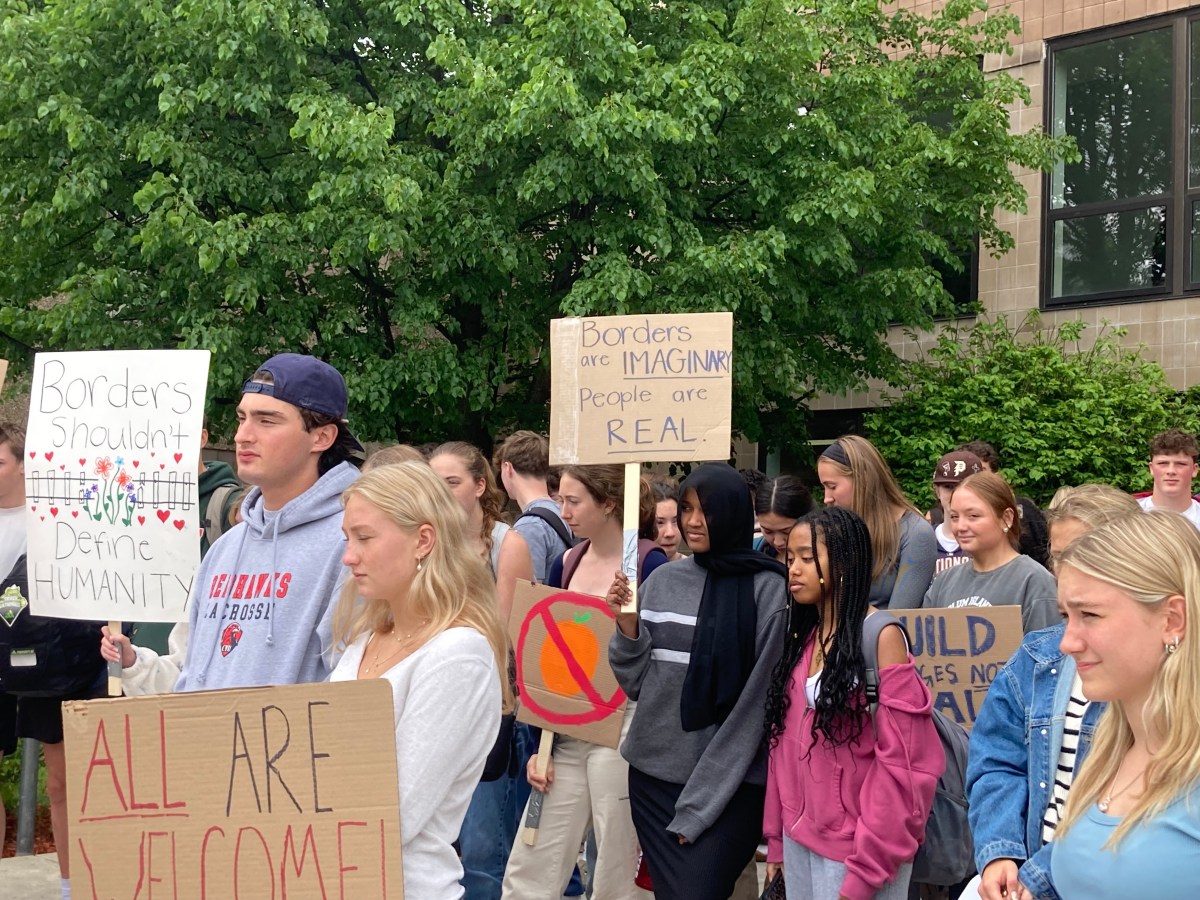
Students at Champlain Valley Union High School last week staged a “hands off” walkout in protest of the impact of the federal government’s immigration enforcement policies. An early suspension of a parole program for Cubans, Haitians, Nicaraguans and Venezuelans led two Nicaraguan students to leave the country by the end of April.
“We’ve heard from students, educators, and community members, students can’t learn if they don’t feel safe. No student should have to fear for their friends, family, or their own safety in the presence of immigration officials, especially in a place of learning. Sanctuary school policies make schools safer for all students,” said Kayla Loving, a coordinator at the Education Justice Coalition of Vermont that helped draft a K-12 sanctuary school policy used by Winooski.
This is not the first time Vermont communities have faced federal threats over their sanctuary status. In 2018, the U.S Department of Justice sent letters to 28 cities and states, including the state of Vermont and city of Burlington, warning they may not be in compliance with federal immigration law.
None of the communities named in the Department of Homeland Security list had received letters as of Friday.

Vermont Attorney General Charity Clark, who continues to join other states in a growing list of legal actions challenging Trump administration actions, said this list is no surprise. She said her office is prepared and will continue to fight for the rule of law and the rights of Vermonters.
“Any Vermont official who receives a notice as a result of this list should continue to follow state laws and policies, which are in compliance with federal law and designed to build the trust necessary to protect public safety,” Clark said in an emailed statement. “It’s the federal government’s responsibility to enforce immigration laws, and state and local law enforcement should remain focused on public safety in our communities.”
The crackdown on immigration has many immigrant families nervous and on edge, according to Shabnam Nolan, executive director of the King Street Center, a community center that serves youth in Burlington.
“We continue to hear worry, even from those with legal status, about their safety amid recent federal statements. When any statement or action — whether from institutions or individuals — casts doubt on belonging, children feel it first. We hear their questions. We see their fear. And we hold space for their hope,” Nolan said Friday.
The center’s role, she said, is to provide stability and connection to every child and caregiver.
“And no matter what, we will continue to play this role,” Nolan said. “We remain committed to listening deeply, responding thoughtfully, and standing alongside our families through uncertainty and beyond.”
