


You couldn’t walk 10 steps under the golden dome Friday without someone asking if we were getting out of here today. Legislative lawyers are under-rested and over-extended. Lawmakers have skipped too many meals. And everyone has a pet theory — so-and-so wants a delay, someone has a secret proposal they’re waiting to unveil.
But it’s not looking good, folks, thanks to the ed bill. Here’s how it was going down (so far).
After a stalled morning, the H.454 conferees gathered for a brief meeting after 11. Despite an air of pessimism preceding the discussion, both sides expressed willingness to compromise on key issues that threatened to delay the day.
The surprise came later. I’ll get to that.
House members, for their part, signaled a willingness to consider allowing districts to spend less than the amount a foundation formula would provide in full. Senate members suggested they would consider the House’s version of a property tax credit, which would significantly expand eligibility and relief over the existing system but cost more overall.
Reaching agreement looked much less likely hours later.
When the group returned at 2:45 with the Senate’s latest draft, there were some new ideas. Quite a few.
For example, a potential expansion of school choice. Components of a foundation formula pulled from a couple of weeks ago. And if districts can’t pass a budget by a certain date, they get 90% of a foundation formula rather than the full thing — unless they’re a fully non-operating district, in which case they don’t have to vote and get 100% of the foundation formula.
As the surprises arrived, both conferees and spectators struggled to control their shock. Eyebrows raised, one lobbyist leaned to the next and mouthed, “this is wild.”
The new language proliferated throughout the Senate’s proposal — but was not in the chamber’s original bill, the House’s version or the governor’s recommendations. With frustration palpable, Rep. Peter Conlon, D-Cornwall, chair of the House Education Committee, called for a recess.
When the group reconvened at 5 p.m., the Senators first appeared to pull their large changes off the table, before clarifying that most of it was still in play.
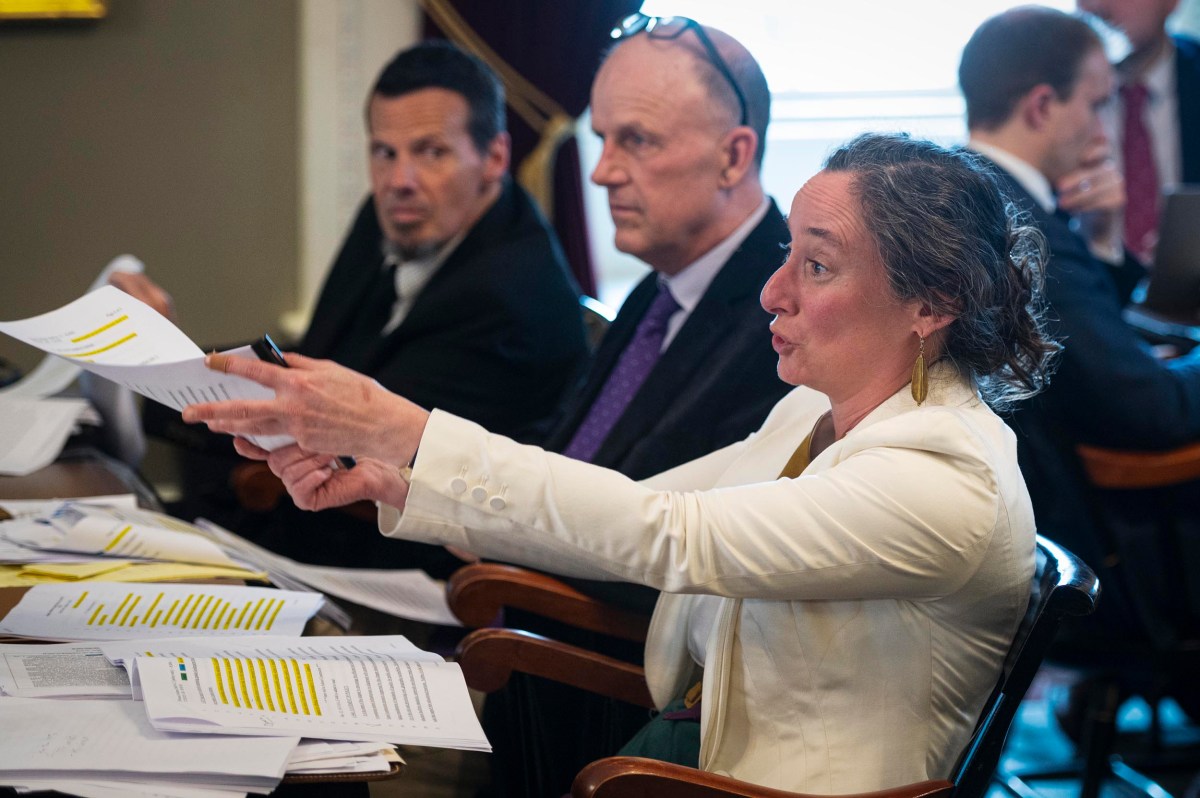
“Do you believe passing this tonight is the right answer?” Conlon asked the Senate members, holding up the afternoon surprise.
Sen. Seth Bongartz, D-Bennington, appeared to nod. But Sen. Ann Cummings, D-Washington, was less sure.
“I don’t know if that is the right answer. That was 15-minute at lunch’s attempt to come up with an answer,” she said.
Sen. Scott Beck, R-Caledonia, spoke up.
“We had a bill that was one caucus all the way through, and now we’ve got to square it up with both caucasus and a Republican governor. So I guess, let’s dig in.”
— Ethan Weinstein
On the move
After several days of acrimonious debate, the House and Senate reached a deal on this year’s housing bill, S.127, on Friday afternoon. Scott administration officials indicated that the Republican governor will support it. The chambers each accepted the compromise and passed the bill by early evening.
The bulk of the disagreement between the two chambers centered around a new infrastructure financing program for housing development, which would leverage the increased tax revenue from new construction to pay back loans for infrastructure like water lines, roads and sidewalks.
The House had added a host of guardrails to the initiative in an effort to protect foregone property tax revenue from the Education Fund. The Senate — and the Scott administration — had pushed for fewer rules, arguing that a more flexible version of the initiative would help add more homes to the grand list and spread out the burden of rising education costs.
Tensions ran high during a conference committee this week as the two sides sparred, leaving observers to wonder whether lawmakers might walk away from the negotiating table. But by Friday afternoon, they settled their differences on a few key points: they agreed to significantly raise a cap on the amount of tax-increment a state council can approve for new projects each year, and they scrapped a previously-added sunset to Vermont’s existing, larger-scale tax increment financing program.
The crowded room erupted in applause when House members agreed to Senate members’ last offer.
“Thank you for this step – for really creating a new tool for housing creation,” said Sen. Alison Clarkson, D-Windsor.
— Carly Berlin
The House on Friday morning approved a Senate proposal to push back the effective date of a proposed cap on the cost of outpatient pharmaceutical drugs. The measure, included in H.266, was originally proposed by the House with a transitional cap beginning July 1. But the Senate nixed that initial cap, settling only on a slightly lower cap that would take effect next January.
Supporters have said a cap on outpatient pharmaceuticals could provide the most immediate relief to health care insurance costs of any measure lawmakers have considered this year. The bill now heads to Gov. Phil Scott for his consideration.
— Shaun Robinson
A bill that would overhaul Vermont’s response to homelessness is also headed to Gov. Scott’s desk, after a largely party-line vote in the House on Thursday evening. Scott and members of his administration have remained mum about whether they support its final iteration.
If Scott vetoes the bill, H.91, he could effectively kill it. Without a Democratic supermajority, lawmakers are unlikely to have the votes to override.
Read more about the uncertainty facing the proposal here.
— Carly Berlin
Visit our 2025 bill tracker for the latest updates on major legislation we are following.
Heavyweight
It’s well known around the Statehouse that Rep. Alice Emmons, D-Springfield, is the House’s longest-tenured current member. For that distinction, she is called the chamber’s “dean.” But lest anyone forget, the 40-plus-year representative now has a shiny accessory to prove it.
This week, members of Emmons’ House Corrections and Institutions Committee gave her a wrestling championship-style belt that bears a large, silver plaque declaring she is the “GOAT,” short for “greatest of all time,” along with her name and honorific “Dean of the House” title.
The words are surrounded by images of goats, one of which is clad in sunglasses. Never having won a wrestling bout myself, Emmons graciously let me try the thing on — and I can confirm, it’s quite the substantial piece of hardware.
— Shaun Robinson

