


If Ethan and Ira Allen had their way, Canada would have been America’s 14th colony.
The Allen brothers were hardly alone in pushing to have Canada join the United States. In 1774, delegates to the First Continental Congress, including Benjamin Franklin and John Adams, published an open letter to the Province of Quebec, urging Canadians to join their struggle against the British government. All they heard back was crickets.
So the following year, the Allens joined more than 3,000 other colonists to try a different approach with Canada — invasion. The belief was that if the colonists made a show of force, then French Canadians, who represented a majority of European settlers in the region, would rise up against their British overlords. This Canadian-American alliance would deprive Britain of a staging area for invading the United Colonies. (This was so early in the war that the name “United States of America” hadn’t yet been coined.) It would also significantly expand the landmass and population of the Colonies. The invasion, however, would turn disastrous for the colonists, and Ethan in particular.
Ethan was full of confidence in 1775 — when was he ever lacking in confidence? — because in May he had led troops in America’s first offensive victory of the war by capturing Fort Ticonderoga on the New York shore of Lake Champlain. Actually, he jointly led forces that night — working beside Benedict Arnold, who was perhaps America’s most effective officer before turning traitor. Also, the fort was crumbling and only lightly defended by British troops who had no warning an attack might come. Still, this was an important American success and made the 37-year-old Ethan Allen a household name.
After capturing the fort, Arnold acted on news that a British sloop was anchored at the north end of the lake near Saint-Jean (St. Johns), Quebec. He hoped to seize it before news of Ticonderoga’s fall spread. Boarding a schooner stolen from a prominent Tory, Arnold and his crew captured the sloop without firing a shot. For good measure, they burned several smaller boats and raided supplies from the fort at Saint-Jean. Arnold declared, “At present, we are Masters of the Lake.” As the main route between British Canada and the Colonies, the lake was strategically invaluable.
Sailing south with their prize, Arnold’s force encountered a group of four boats paddling north. The 100 weary men aboard the boats had been hurriedly organized by Ethan, so hastily, in fact, that they lacked sufficient rations. Nevertheless, Ethan seemed eager to outdo Arnold, announcing that his motley crew would take the town of Saint-Jean. Arnold tried to talk Ethan out of this rash plan. He failed.
“100 mad fellows are going to take possession of St. John’s,” Arnold later wrote in his journal. “… A wild, impractical expensive Scheme. Of no Consequence.”
And little chance of success. Ethan’s flotilla reached Saint-Jean after dark. The exhausted men secured their boats and promptly fell asleep on the riverbank. By then, 200 British soldiers had reinforced the town. At dawn, Ethan’s men were jolted awake by the sound of cannons firing from the opposite shore. Clearly outnumbered and outgunned, Ethan and his men retreated, hastily. Leaping into their boats and paddling out of range, they abandoned three of their compatriots, one of whom was captured. The other two walked the 100 miles south to Ticonderoga.
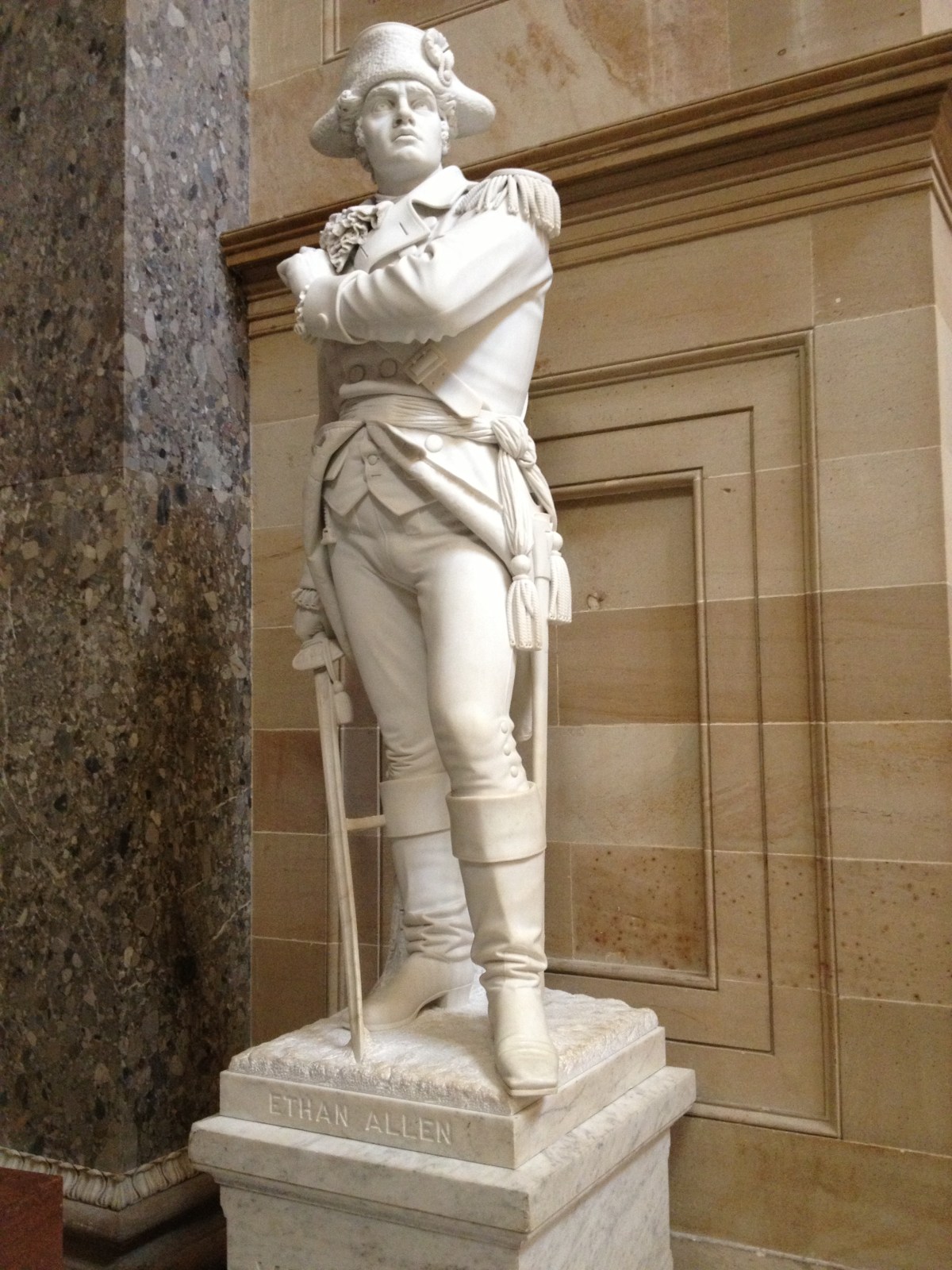
That summer Ethan returned to Canada, this time as a scout for the American army. His Green Mountain Boys had transformed into the Green Mountain Rangers, a regiment in the Continental Army. As part of the reorganization, troops elected the level-headed Seth Warner to lead them. Perhaps fearing Ethan’s recklessness, they opted not to give him a leadership role. His brothers Ira and Heman, however, were named as officers.
Ethan proved effective as a scout, moving freely behind enemy lines, recruiting French-Canadians and members of the native population to fight the British during the coming American offensive.
“I … have two hundred and fifty Canadians under arms; as I march, they gather fast,” Ethan reported to invasion commander Gen. Richard Montgomery. He sent most of the men to Montgomery, but still had nearly 100 with him when he decided to improvise — he would lead the capture of Montreal. Working with Major John Brown, who had about 200 recruits of his own, Ethan devised a plan to use their forces to simultaneously attack Montreal from opposite directions, even though Montgomery had given no such orders. In fact, the general thought Saint-Jean a more valuable target.
The assault was a fiasco. On Sept. 25, Ethan’s force descended on Montreal from the north, but the signal from Brown indicating that his men were in position to the south never came. Gen. Guy Carleton, the governor of the province of Quebec, rallied a force of Canadian, British and native fighters and advanced on the invaders. Ethan and 38 of his men were captured. He would spend the next two and a half years a prisoner of war. “I thought to have enrolled my name in the list of illustrious American heroes,” Ethan later wrote of that day, “but was nipped in the bud.”
Earlier that month, Ira Allen attained a position of trust, when Gen. Montgomery selected him to serve as a lieutenant on his staff. Ira was only 24 years old.
At the time, Montgomery was beginning a siege on Fort Saint-Jean. Critical to the operation’s success was keeping Carleton’s forces trapped in Montreal, a task that fell partly to the Green Mountain Rangers. The commander of Fort Saint-Jean, realizing that reinforcements from Montreal would never arrive, surrendered on Nov. 3.
The Americans quickly moved on to their next target, Montreal. Believing the town undefendable against this larger force, Carleton withdrew his troops and headed to Quebec City and its imposing citadel, located some 150 miles to the northeast. This time, the Americans took Montreal without a fight. Next, they would seize Quebec City.
Ira traveled with the Continental Army to Quebec City along the St. Lawrence River. There Montgomery planned to rendezvous with Benedict Arnold and 1,100 Continental Army troops who were trekking to Quebec through the woods of what is now northern Maine.
When Montgomery’s troops reached Quebec City on Dec. 1, a shocking sight awaited them. Having marched, rowed and portaged all the way from Boston, Arnold’s force was a shadow of its former self. Desertion, disease and death had thinned its ranks to about 600. Those remaining were ragged, hungry and desperately short of supplies. Anticipating that Arnold’s men would need resupplying, though perhaps not to this extent, Montgomery had brought winter clothing and provisions.
Despite the poor condition of the troops and having only about 1,200 men to the Quebec citadel’s 1,800 defenders, Montgomery and Arnold stuck with the plan. When Carleton rejected a call to surrender, the Americans bombarded the town with the few mortars and cannons they possessed. Montgomery knew he couldn’t mount a successful siege; he lacked sufficient artillery and the frozen ground made it impossible for his men to dig trenches. So he planned an assault.

The Americans wanted to attack on a snowy night to conceal their approach. But the weather refused to cooperate. Finally, on the night of Dec. 27, it began to snow. As the Americans assembled for the assault, however, the sky cleared and the moon lit up the night. Montgomery postponed the attack, but he had only days to act. Arnold’s troops’ enlistments were due to expire at midnight on Dec. 31, leaving the men free to return home and effectively cutting the American force in half.
It must have seemed a good omen when it began to snow on the afternoon of Dec. 30. At 2 a.m. on Dec. 31, the Americans gathered for the assault. By this point, however, the snowstorm had become a blizzard, with snow drifting to two and three feet.
Ira Allen was one of two officers leading an attack on Cape Diamond, the southern corner of the town’s wall perched atop a steep bluff. But this was just a diversion. When his unit began its attack, Ira lit rockets to cue the main strike force, led by Montgomery, to launch its attack on fortifications in the Lower Town.
After helping carpenters cut through a wooden palisade fence, Montgomery led his men forward, breaking into a run with his sword drawn. As the group rounded a turn in the street, the town’s defenders fired a cannon loaded with grapeshot at the attackers. A dozen men were killed by the hail of small iron balls, including Montgomery. One of the few members of the storming party to survive was Capt. Aaron Burr.
With their leader dead, the Americans fell into disarray and retreated. The battle was a rout. Against the 19 British and Canadian casualties, the Americans had 60 men killed or wounded and more than 400 captured.
The Americans hunkered down outside Quebec’s walls and waited through the bitter Canadian winter in hopes that the Colonies were sending reinforcements. Ira Allen remained in the American army camp until February. Then, seeing the futility of the situation, he began the trek home.
Reinforcements arrived in May, but they were British troops. Their arrival persuaded the remaining American soldiers it was time to head home. They carried with them memories of a scarring defeat and a raging epidemic of smallpox that had erupted in the camp. The effort to make Canada the 14th colony had proved a failure. Although it was never a colony, Vermont, not Canada, would become the 14th state.
Gen. Richard Montgomery’s death made him an international hero. Congress commissioned a memorial in his honor, pamphleteer Thomas Paine and poet Anna Eliza Bleecker wrote of him, and members of the British Parliament even praised his valour. In Vermont, Ira Allen honored him by successfully lobbying for a town to be named after him.
