


Democrats in the Vermont House put forward another key piece of their education reform proposal, their alternative to the wide-ranging plan unveiled earlier this year by Republican Gov. Phil Scott.
The new portion of the bill approved Tuesday by the chamber’s Ways and Means Committee proposes myriad changes to Vermont’s education finance and property tax systems.
The House’s finance-related work is the latest in the Legislature’s ongoing education system reform efforts. Both chambers, like Scott and his team, have made education reform the year’s key issue in response to last year’s double-digit average property tax increases.
The House is expected to vote later this week on the Ways and Means Committee’s proposal, packaged with the House Education Committee’s work on school district governance. Like the governance proposal, many of the finance-related changes wouldn’t take effect for years, meaning lawmakers will need to fiddle with the details in sessions to come.
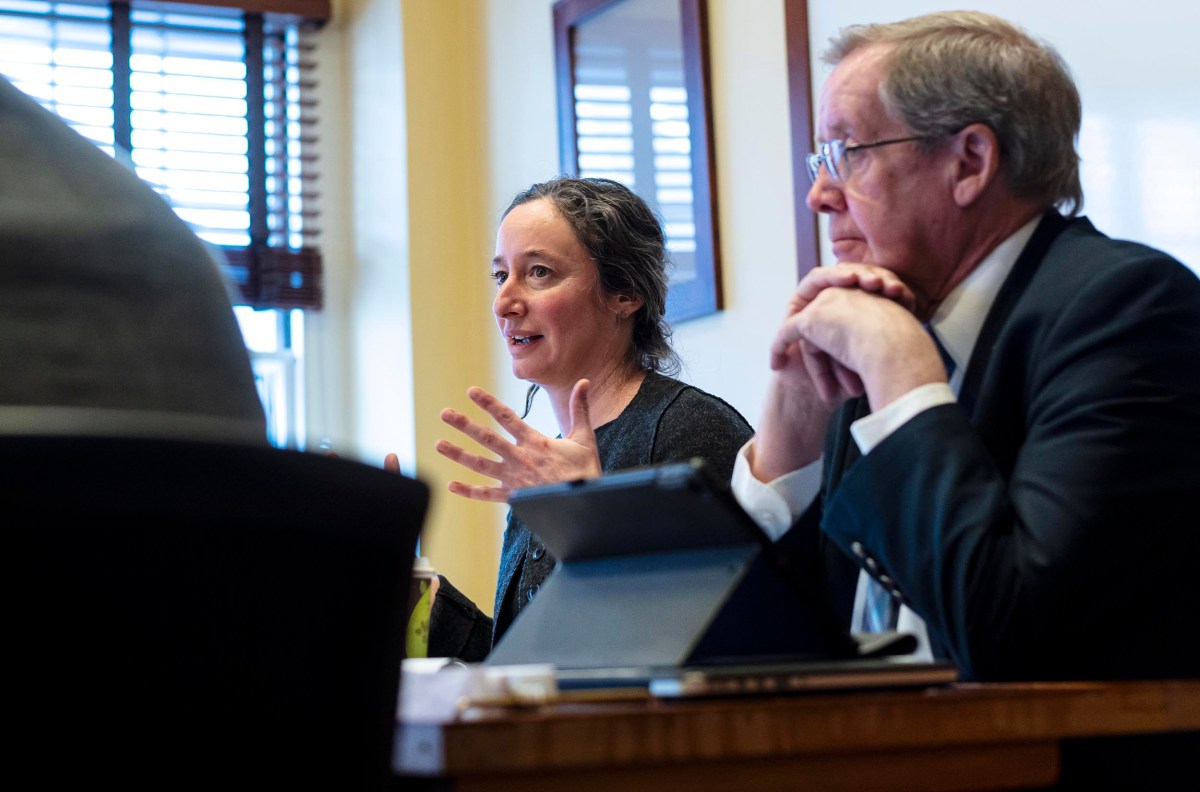
“I don’t want to downplay the importance of the decisions we’re making here; they’re really important decisions,” Rep. Emilie Kornheiser, D-Brattleboro, the committee’s chair, said in a hearing last week. But she added that the committee will “have to do this entire thing again next year regardless of what we decide right now.”
While Democrats borrowed a few concepts from the Scott administration, GOP representatives on the committee voted against the finance changes. And in a Tuesday press conference, House Republicans panned the entire plan — both the governance and finance pieces — for its drawn-out timeline and higher expense compared to Scott’s proposal.
“The longer we push off any kind of change, school districts are left uncertain, and they’re already making cuts,” Rep. Casey Toof, R-St. Albans Town, the House assistant minority leader, said in an interview, questioning Democrats’ willingness to work quickly. “We have to make the tough decisions. We were elected to do that.”

Foundation formula
The bill, H.454, proposes shifting the state to a new education funding formula in 2029, two years later than Scott’s plan would, and takes a different approach than the formula proposed by Scott and Education Secretary Zoie Saunders.
A foundation formula is the most common type of education funding system in other states. Generally, a foundation formula provides districts money based on the number of students in each district and how expensive those students are to teach. The formulas Vermont is considering provide additional funding for students from economically disadvantaged households and who are English language learners, among other factors research has shown increase education spending.
But the formula proposed by lawmakers uses a different method than the Scott administration. Scott’s plan primarily relies on an “evidence-based” model, which adapts national norms to estimate the price to operate a cost-effective and high-performing education system, but not one that necessarily resembles Vermont’s current state.
Democratic legislative leadership, including Kornheiser, have suggested Scott’s model may work when and if school districts consolidate, but for now, the result would not provide enough money to districts.
“Significant costs had been left out” of the administration’s foundation formula, Kornheiser told House colleagues in a briefing on the finance portions of the bill Tuesday morning.
Lawmakers’ approach, in contrast, relies on modeling that determines what efficient spending and positive outcomes already look like within Vermont’s existing public school system.
Legislators only received the specifics on their preferred formula Thursday, presented by University of Vermont professor Tammy Kolbe. Kolbe and her colleague’s work relies on modeling she completed for the state in recent years.
The two proposals have different price tags. Preliminary estimates for both indicate if districts were to spend only the amount provided by the formula, Scott’s approach would provide about $200 million less than lawmakers’, a difference of roughly 10%. The same estimates indicate Democrats’ formula provides slightly more money than districts are already spending.
The legislation does pave the way for moving to a foundation formula more like the Scott administration’s once the bill’s education reforms start to bear fruit.
The cost differences between the systems, as well as the limited time spent examining Democrats’ preferred formula, led the committee’s Republican members to question the more expensive approach.
“I am just very uncomfortable with voting for a set of numbers that I don’t know where they came from,” Rep. Marty Feltus, R-Lyndon, said in committee. “It looks like we would be spending even more than we are right now.”
The plan that passed out of Ways and Means on a party-line vote would allow districts to spend up to 10% more than the formula provides.
New property classifications
One proposal, which has drawn the ire of both the Vermont Department of Taxes and the business lobby, would create new classes of property, expanding on Vermont’s two current classifications: homestead, defined as owner-occupied residences and their immediately surrounding land, and nonhomestead.
In recent years, lawmakers have considered proposals to tax second homes more than other nonhomestead properties. But because all nonhomestead properties — businesses, apartments, camps, second homes etc. — are all currently classified the same for tax purposes, singling out a certain type of property is challenging.
Creating new classifications is one way lawmakers could separate out second homes, allowing them to be taxed at a different rate.
But organizations representing businesses, including the Lake Champlain Chamber and Vermont Association of Realtors, panned the proposal as discriminatory and against economic best practices.
Fewer rather than more classifications would promote “simplicity, transparency, and economic neutrality,” Austin Davis, a lobbyist for the Lake Champlain Chamber, told lawmakers last week. “And I worry that, you know, this system would create a future where it’s easier to violate the principles of economic and tax neutrality.”
Vermont’s Tax Department argued the new system would be a bane to implement.
“We can’t administer this successfully. I’m very confident about that,” Rebecca Sameroff, the department’s deputy commissioner, told lawmakers in the House tax committee last week.
Despite the vocal opposition, some lawmakers argued second homes strain Vermont’s public education system and should be taxed accordingly.
“If it’s cheaper to carry (a property) as a second home than it is for the person with three kids trying to live at the same place that has to pay a rate that’s 50 cents higher” per $100 in property value, Rep. Rebecca Holcombe, D-Norwich, said in committee last week, “we’re actually incentivizing the removal of families with kids from our school system which in turn drives up our per pupil cost.”
Ultimately, the committee reduced the number of categories it was considering from nine to four, ending up with homestead, nonhomestead apartment, nonhomestead nonresidential, and nonhomestead residential.
The nonhomestead residential category would include second homes and short-term rentals, and could include properties under renovation, according to Kirby Keeton, an attorney for the Legislature.
The proposed legislation does not indicate how different property types would be taxed differently. Kornheiser told lawmakers she didn’t expect to create different rates for at least a couple of years, but the legislation allows for those decisions to be made eventually if legislators so choose.
Committee members approved the new property classification language in a party-line straw poll.
Rep. Mark Higley, R-Lowell, who opposed the language, said the variety of property tax changes shouldn’t be tacked onto the foundation formula: “It doesn’t belong there.”
New property tax discount system
For years, lawmakers and state officials have bemoaned Vermont’s complicated property tax credit system. H.454 creates an alternative.
Called a homestead exemption, the new tax break idea for eligible homeowners would exempt a portion of a housesite’s value from a person’s property taxes. A household’s income would limit the amount of property tax discount a family could receive, with households with incomes up to $115,000 eligible for a partial exemption.
The proposal resembles an idea put forward by the Scott administration, but the governor’s team suggested placing a limit on the amount of home value eligible for an exemption. Lawmakers’ proposal does not cap the amount of house value eligible for a partial exemption.
The new discount system would cost about $45 million more than the current credit, according to preliminary analysis by the Legislative Joint Fiscal Office. Like the existing credit system, the reductions from the homestead exemption would mean shifting some of the tax burden to other property taxpayers.
Both lawmakers and the Tax Department have advocated for an exemption system due to its relative simplicity compared with Vermont’s current, convoluted property tax credit mechanism.
Among other property tax tweaks, the bill paves the way for Vermont to shift to 12 regional reappraisal districts in 2030, rather than reappraising on a town-by-town basis.
Ultimately, the committee backed H.454 on a party-line vote.
“We might agree with the concept here,” Rep. Bill Canfield, R-Fair Haven, the committee’s vice chair, said during testimony, “but we might not agree with the whole bill.”
