


Vermont House Democrats nominated their leaders at a caucus meeting Saturday morning, but not without debate over who should hold the body’s most powerful position.
A move to nominate Rep. Laura Sibilia, I-Dover, for speaker of the House was met by sharp opposition. The caucus ultimately voted 60-18 to allow only Democrats to be nominated by the party for leadership positions.
The dustup comes weeks after Sibilia announced a rare challenge to Speaker Jill Krowinski, D-Burlington. Sibilia was not in attendance Saturday, but several Democratic members voiced their support for her outsider bid. A vote between the two speaker candidates, and perhaps others, is expected to take place on the first day of the next legislative session, on Jan. 8.
“This is not the time for back to the old drawing board,” Rep. John O’Brien, D-Tunbridge, said in his speech attempting to nominate Sibilia. “We’ve just come off an election where 19 of the best and brightest among us have lost their seats. Why? Because, as one losing Democrat told me, we had nothing to run on.”
Democrats in the House and Senate lost seats to Republicans across Vermont in November, ending supermajorities in both chambers. Sibilia’s speakership announcement, which preceded the latest election, appeared prescient after Democrats struggled particularly in rural parts of the state, outside the blue bastion of Chittenden County.
On Saturday, though, Democrats by and large rallied around their leader, Krowinski, who they said was best suited to shepherd the party through the tumultuous session to come.
“I’ve served under three speakers, so I have some basis of comparison through my experiences for what I’m about to say,” Rep. Theresa Wood, D-Waterbury, said, nominating Krowinski for speaker. “With the thoughtful, deliberate, calm and compassionate leadership we have in Rep. Jill Krowinski, Vermont will be a better place when we all adjourn in May.”
But the few who spoke up to oppose Krowinski said that, under her leadership, Democrats were losing the support of voters.
In his nominating speech, O’Brien told Democrats that Sibilia was tough enough to combat the messaging of Republican Gov. Phil Scott, who O’Brien said was responsible for attack ads against their colleagues.
“We’ve become the party that raised property taxes 14%. We’ve become the party that’s synonymous with unaffordability,” said O’Brien.
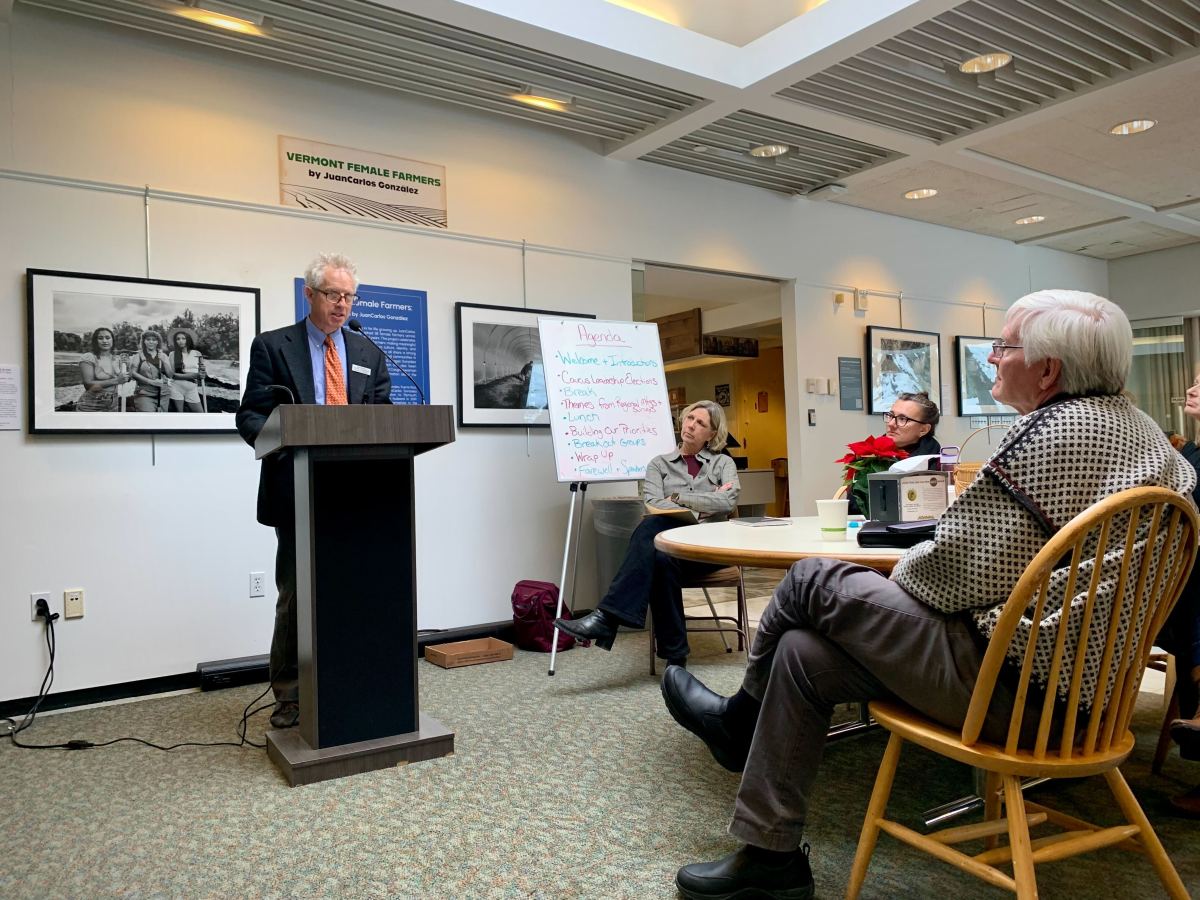
After Sibilia’s attempted nomination, which was seconded by Rep. Lucy Boyden, D-Cambridge, the question was raised whether the caucus was allowed to nominate a non-member. Rep. Emily Long, D-Newfane, who facilitated the elections, said that the move would defy precedent, though the caucus’ rules do not exist in writing. As a result, she said, the caucus would need to vote in order to allow non-members to receive nominations.
“I understand we’re here to serve Vermonters, but I’m here today as a Democrat, as part of the Democratic caucus,” Rep. Mike Mrowicki, D-Putney, said, “and my understanding is we’re coming here to nominate a Democrat.”
Mrowicki was briefly interrupted by Rep. Jay Hooper, D-Randolph, an outspoken supporter of Sibilia, causing a stir.
Some of those who spoke in support of Krowinski nonetheless praised the morning’s vigorous debate as part of a healthy democratic process and spoke in favor of allowing the vote to play out.
“We can determine this right now,” Rep. Conor Casey, D-Montpelier, said, advocating to allow the vote between Sibilia and Krowinski on Saturday. “I don’t see the value in waiting.”
The question was settled by a paper ballot vote of 60-18, and Krowinski was afterward unanimously nominated by the caucus.
Sibilia framed the vote as a sign of growing support. In a statement Saturday, she said, “The effort to nominate me from members of the Democratic Caucus illustrates that there is a desire for change and collaboration to better serve Vermonters.”
For her part, Krowinski, in accepting the nomination, nodded to the difficulties to come.
“I acknowledge and own the challenges that we face, communications being at the top of the list,” she told her colleagues. “It’s clear that we need to change our approach.”
Chittenden County consolidates power
Chittenden County Democrats rose to fill two of the party’s other prominent positions.
Rep. Lori Houghton, D-Essex Junction, ran unopposed for majority leader, replacing Rep. Long, a Windham County Democrat.
And Rep. Karen Dolan, D-Essex Junction, also ran unopposed for Democratic whip, taking over from Rep. Kathleen James, D-Manchester.
The changes further consolidate Democratic legislative power in Chittenden County. Last month, Senate Democrats ousted Sen. Alison Clarkson, D-Windsor, as majority leader, replacing her with Sen. Kesha Ram Hinsdale, D/P-Chittenden Southeast.
Houghton, the newly elected House majority leader, acknowledged the concentration of power in Vermont’s population hub during her acceptance speech.
“I have heard the concern that leadership power is being concentrated in Chittenden County,” she said. “I know I need to demonstrate through my actions that my commitment is to the entire state, all 14 counties.”
Echoing Krowinski’s claim that the party faces a communications crisis, the caucus elected not one but two assistant majority leaders focused on messaging. Rep. Heather Surprenant, D-Barnard, will focus on internal communications, and Rep. Mary-Katherine Stone, D/P-Burlington, will focus on external communications.
