


Uncontested in his own gubernatorial primary race, Republican Gov. Phil Scott opted to spend his political capital on Election Day on two Democratic candidates challenging incumbent legislators down-ballot.
“It’s election day, and if you’re voting in the Dem. primary, I hope you consider Elizabeth Brown for State Rep.,” read a text message sent to voters in Washington-Chittenden’s two-seat House district. “We will not always agree, but Elizabeth will put her constituents ahead of politics.”
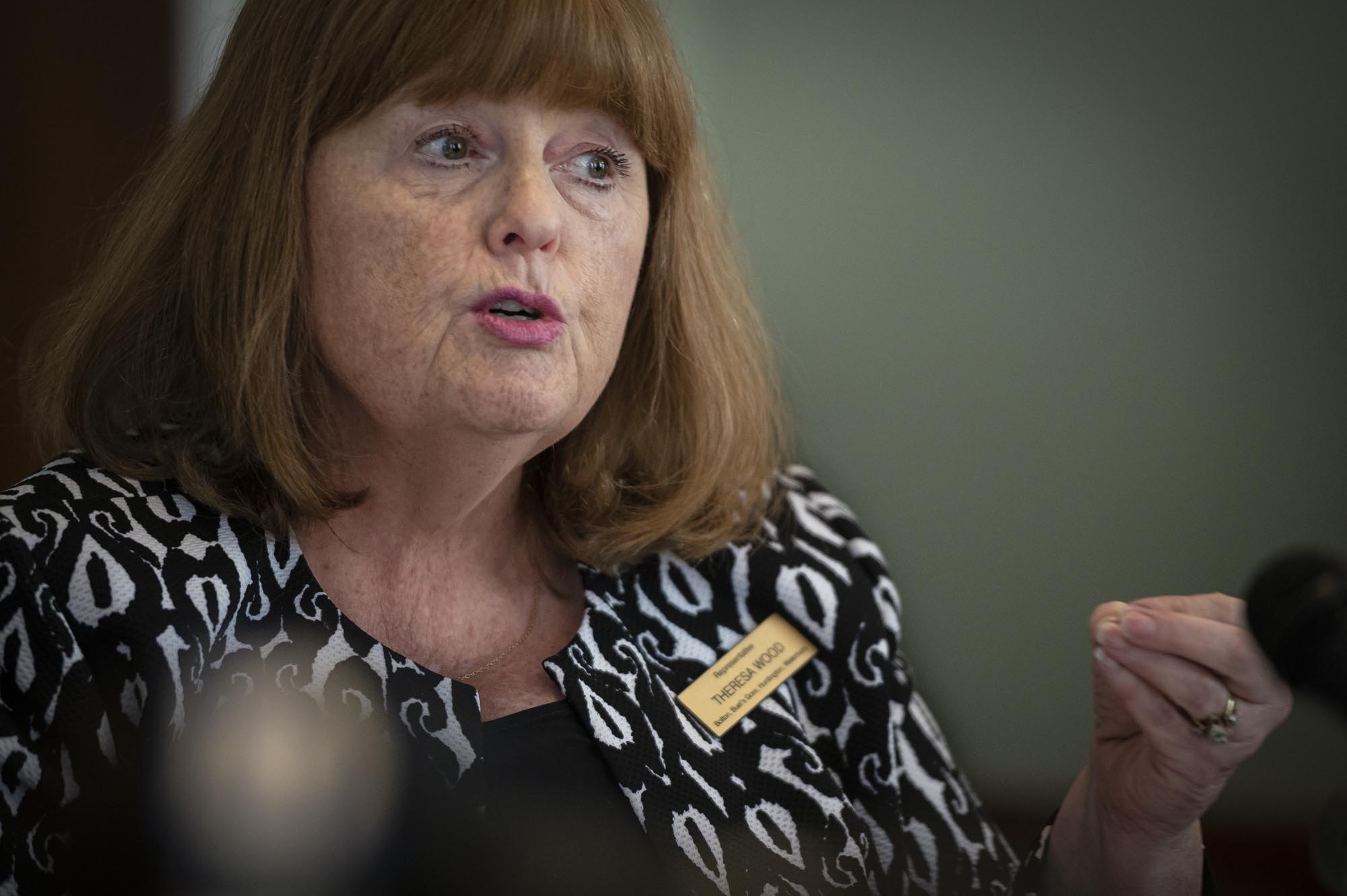
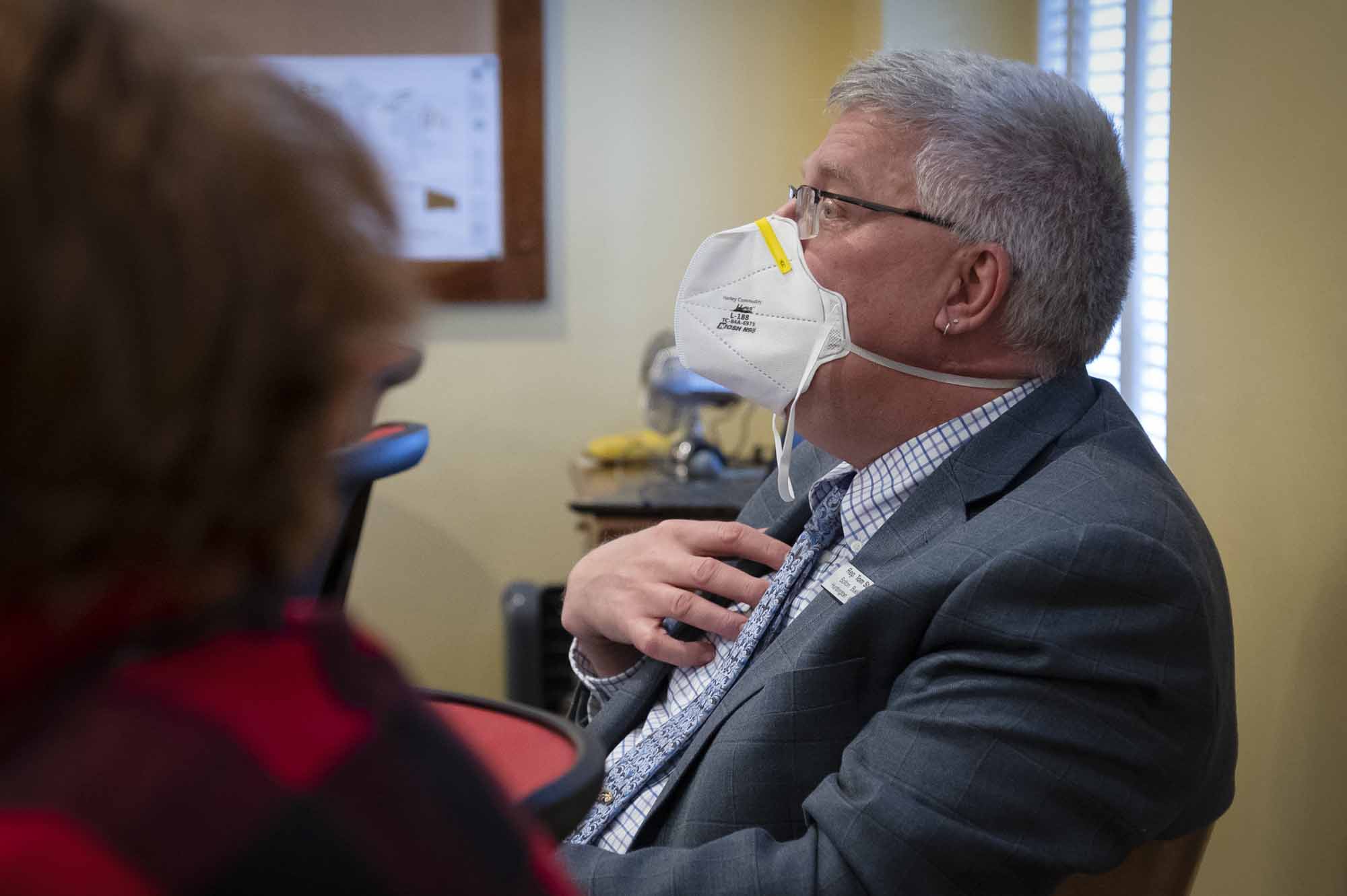
Brown, a financial consultant from Waterbury, had clearly positioned herself on the political spectrum to the right of the two incumbents she was challenging, Rep. Theresa Wood, D-Waterbury, and Rep. Tom Stevens, D-Waterbury, who both lead House committees. Central to her campaign messaging was sharp criticism of the Legislature’s recent handling of statewide education funding, and resulting ballooning property tax bills throughout Vermont.
The Tuesday text message sent on Brown’s behalf closed with the disclaimer: “Paid for by Phil Scott for VT.”
A nearly identical message was sent to voters in Vermont’s Chittenden-Central state Senate district, in support of veteran broadcaster Stewart Ledbetter. Ledbetter challenged three incumbents — Sens. Martine Gulick and Tanya Vyhovsky and Senate President Pro Tempore Phil Baruth — for a Democratic nomination to the three-seat district.
Scott’s messages came after the governor has, for months, told reporters that he planned to spend this election cycle supporting moderate down-ballot candidates for the state Legislature, in hopes of chipping away at Democrats’ theoretically veto-proof supermajority. Scott has said that he will extend support to Democrats, too — if they’re like-minded enough.
The text blast was a move that Jim Dandeneau, executive director of the Vermont Democratic Party, called “conscience-free meddling in Democratic primaries” on Scott’s part.
Scott’s campaign manager, Jason Maulucci, on the other hand, told VTDigger on Wednesday that the texts were sent in an effort to gin up voter turnout in those two races. Scott’s camp had observed noticeably low voter turnout this primary, based on early absentee ballot returns.
By Wednesday afternoon, preliminary election results from the Vermont Secretary of State’s Office indicated a total voter turnout of roughly 15% statewide — a number that, Scott told reporters at an unrelated press conference Wednesday, was “not something to be proud of.”
Maulucci said that the low turnout “makes some sense, given there weren’t as many competitive, high profile races. There wasn’t a congressional primary. There wasn’t an open gubernatorial seat.”
“So we wanted to send a message to folks who we identified as those who were more in the middle, mostly reminding them that there was an election yesterday,” he added.
It wasn’t just Brown and Ledbetter’s primary contests in which the governor got involved. He also piped up in two Republican primary contests, backing former state senator (and former Democrat) John Rodgers in his bid for lieutenant governor, and state Rep. Scott Beck, R-St. Johnsbury, in his bid for Caledonia County’s open Senate seat. Both Rodgers and Beck prevailed in their primary races Tuesday night.
But in the cases of Brown and Ledbetter, the governor’s pleas were not enough to secure a win for his chosen candidates — though they came close. Brown finished third in her race, fewer than 100 votes behind Stevens, who came in second behind Wood. Ledbetter finished in fourth, coming within two percentage points of Vyhovsky, who finished third.
At an election night celebration Tuesday night in Burlington’s New North End, Baruth told VTDigger that he, Gulick and Vyhovsky were “feeling wonderful.”
“It was an extremely low turnout race, so every vote really mattered,” Baruth said, before hypothesizing that Scott’s last-minute endorsement of Ledbetter may have backfired with voters in the deep blue Chittenden-Central Senate district.
“The knock on Stewart was that maybe he wasn’t a Democrat,” Baruth said.
Asked about Ledbetter and Brown’s election outcomes at Wednesday’s press conference, Scott also pointed to low turnout as the culprit — as well as the dynamics of a primary election.
“When you have a primary … it really attracts the party faithful — those extremes of any party, the ones who are most interested to show up to vote,” Scott said Wednesday. “You get more polarization, in some respects. You don’t get the middle, because the middle doesn’t seem to come out and vote at those times.”
Vermont Republican Party Chair Paul Dame struck a similar chord — albeit, in stronger terms — in a Tuesday night statement, in which he declared that the primary results showed “that the Democratic Party is no place for moderates any more.”
“The Democratic primary rewarded the most extreme and far-left candidates in several races, passing over sensible moderates,” Dame said.
Dame pointed specifically to Vyhovsky, who recently spearheaded a lawsuit against Scott for his reappointment of Interim Education Secretary Zoie Saunders after the Senate voted overwhelmingly to reject her initial appointment.
“Democrats are electing adversaries, not allies for Governor Scott,” Dame concluded.
Dandeneau drew a vastly different conclusion from Tuesday’s primary results. Low voter turnout “makes things more unpredictable,” he said, but doesn’t explain Brown and Ledbetter’s losses wholesale. Instead, Dandeneau said he thinks Scott’s and his allies’ main campaign talking point — railing against education spending and property taxes — isn’t resonating.
“The same people who have been pushing the idea that there is some silent majority tax revolt brewing since the Tea Party in 2010 have been wrong every single time,” Dandeneau said. “There are certainly issues around (education) finance that need to be addressed next year. But I think a big lesson here is, you should be careful who you listen to when you’re thinking about meta narratives in the campaign.”
Maulucci countered Dandeneau, saying, “If anyone who’s making that claim can find one voter who was happy about their property tax bill, I would be shocked.”
“Any poll you run right now, voters will say their top issue is cost of living — across the partisan divide,” Maulucci continued. “You know, Democrats pay taxes too, and they’re frustrated. … Many people want to fund government services. They want to pay their fair share, but there comes a point where it’s just no longer sustainable.”
And to back that theory, Maulucci pointed to Scott’s consistently sky-high election margins and favorability ratings among voters. In November 2022, Scott won reelection to his fourth two-year term in office by his largest margin yet.
Now, the fate of the governor’s agenda largely depends on the political leanings of next year’s Legislature. Scott has, during his nearly eight years in office, issued a record number of vetoes. And in the past two legislative sessions, House and Senate Democrats — holding greater majorities than ever — have retorted with a historic number of veto overrides.
From now until November, Maulucci pledged: “We’re going to pound the pavement.”
“We’re going to be reaching out to candidates and offering whatever support we can provide. We’re going to get the message out to voters that, again, the governor can’t do it alone,” he said. “It’s not enough to just vote for the governor, as many, many, many Democratic voters will do. You need to send him some reinforcements.”
Theo Wells-Spackman contributed to this report.
