



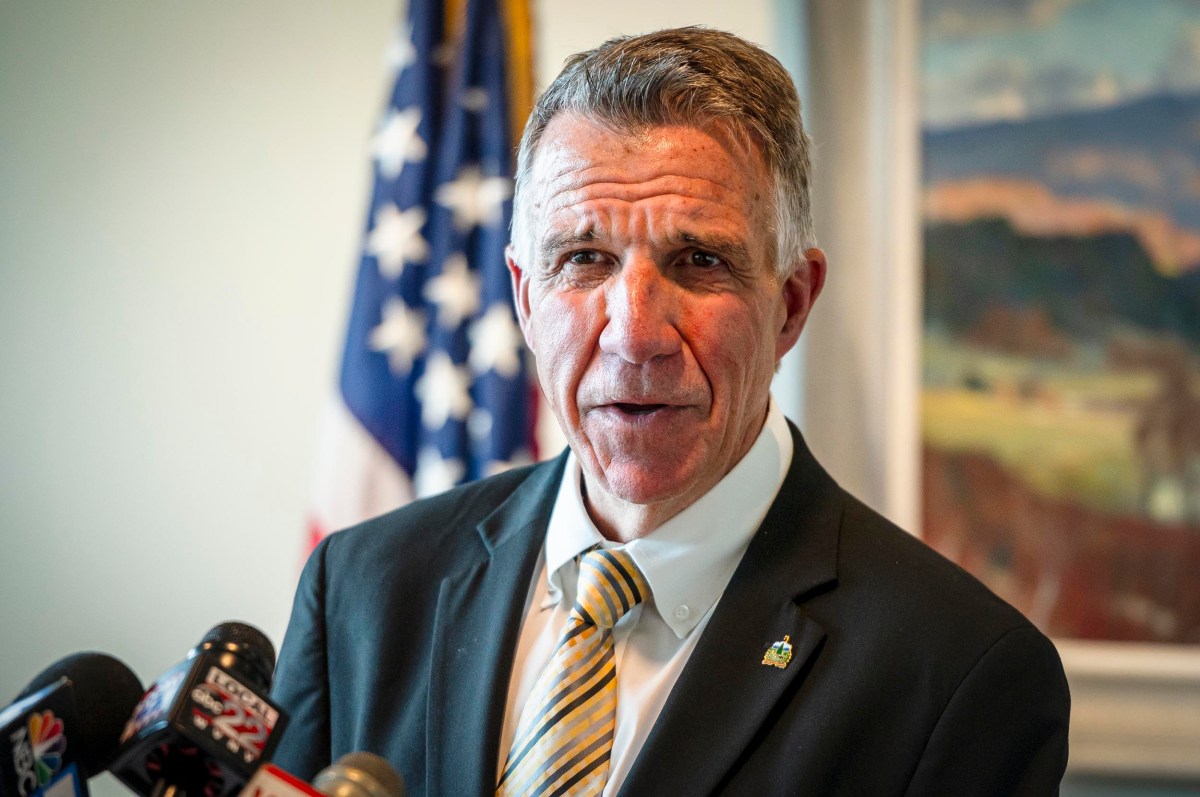
One day after a panel of high-ranking state officials approved the release of millions in state emergency flood recovery money, Gov. Phil Scott’s administration celebrated the decision.
On Thursday, Vermont’s Emergency Board — composed of the Republican governor and the four Democratic chairs of the legislative committees charged with writing the state’s annual budget — greenlit a combined $14 million to help Vermonters whose manufactured homes or businesses were flooded this summer. Officials approved the funds after two destructive storm systems moved through the state in July, and just ahead of the arrival of the remnants of Tropical Storm Debby in Vermont.
The first program, to be overseen by the state’s Agency of Commerce and Community Development, will dedicate $7 million to siting new manufactured houses outside of flood-prone areas for Vermonters whose homes were destroyed in recent floods. Secretary of Commerce Lindsay Kurrle said at a Friday morning press conference that the program is designed “to make it easier for Vermonters to buy an affordable home” quickly.
“As you’ve heard us say countless times, Vermont is in the throes of a housing crisis that is decades in the making,” Kurrle said Friday. “Losing units to flooding and other natural disasters makes the problem even more acute. The Rapid Response Mobile Home Infill Program will address the urgent need for affordable housing exacerbated by natural disasters.”
Kurrle said that as part of the program, the state will identify manufactured home site lots and subsidize their improvement in order to reduce the cost burden on buyers. The state will also encourage manufactured home production and offer support services to prospective low-income buyers.
The program is not designed to provide emergency, temporary manufactured home placements while Vermonters wait for permanent housing, like the Federal Emergency Management Agency sometimes provides to disaster-stricken areas (and almost did last year in Vermont). Kurrle told reporters Friday that this program is meant to get Vermonters into permanent housing.
The agency is aiming to help place 30 manufactured homes by the end of 2024, and 250 new homes in five years, Kurrle said. Scott told reporters that the homes will be located throughout the state, but the program will prioritize placing homes in communities hardest hit by the floods.
Manufactured homes were not the only houses hard-hit by the floods last summer and this past year. Scott told reporters on Friday that, in 2023, the Federal Emergency Management Agency identified 16 homes in Vermont as destroyed. Forty-four manufactured homes were condemned that same year.
This year, by comparison, preliminary data shows that this summer’s floods destroyed 26 homes, and dealt major damage to 121. With housing stock already limited before the floods, Scott said that “it’s difficult to find a place for these families to go.”
The Emergency Board also on Thursday greenlit another $7 million in state funds to Vermont’s Business Emergency Gap Assistance Program, or BEGAP, for short. Created in the wake of the floods of July 2023, the program offers grants from the state to business owners and farmers whose establishments were flooded, or who lost revenue due to the floods.
Business owners are not eligible for FEMA disaster relief dollars, which are tailored to homeowners, renters and state and local governments. Instead, for federal assistance, business owners impacted by natural disasters must resort to emergency loans from the Small Business Administration — which carry interest that many businesses cannot afford.
And the White House must issue a federal disaster declaration to an area for a business to even qualify for such a loan from the SBA in the first place. While President Joe Biden on Friday approved a disaster declaration to Vermont in anticipation of Tropical Storm Debby, he has not yet issued similar declarations for two bouts of flooding that hit the state on July 10 and July 29.
Last year, in the wake of Vermont’s Great Flood of 2023, the state dedicated $20 million to BEGAP. Scott on Friday said this year’s lower sum was proportional to the damage caused by this summer’s storms.
“It wasn’t enough, to be honest with you. $20 million wasn’t enough. $7 million is not going to be enough either,” Scott said Friday. “But it was to fill those gaps, help some of the smaller businesses get their doors back open.”
Kurrle said that business owners impacted by this July’s floods are still in the early stages of recovery. When they first report their damages to the state, she said, “they don’t necessarily, at that time, have a dollar value” estimated for the total cost of recovery. But based on preliminary assessments, she said, the state “tried to estimate, as best as we could” how much aid was required.
“Like the governor said, it’s not going to make anybody whole,” Kurrle said. “But we feel, compared to last year, based on what folks are recording, that at least right now, we’ve provided for folks to get a similar award, percentage wise, as we did a year ago.”
