


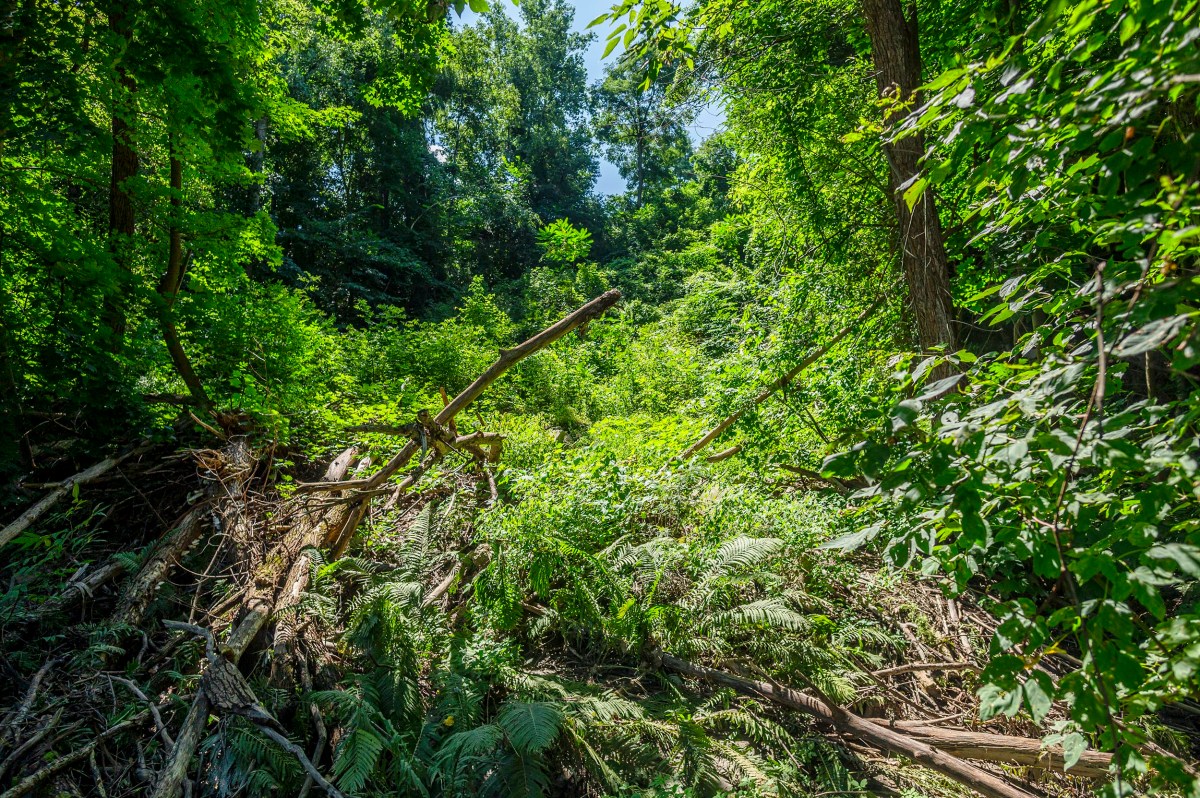
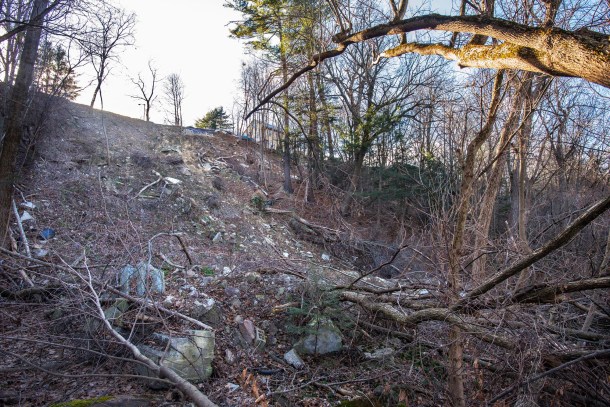
Paul Bierman first signaled his concern in 2019. During his walks home from work, he noticed cracks splitting the downward slope behind the homes and businesses on Burlington’s Riverside Avenue, cracks running just feet away from the precipice overlooking the Winooski River.
Along the wooded riverside trail below, he observed peculiar material protruding out from the hill’s slope — car engine blocks and other industrial materials. Bierman, a professor of geology at the University of Vermont, recognized the signs of unstable land, and started to sound the alarm to city and state officials.
On Halloween that year, a powerful rainstorm confirmed his fears. The storm dumped more than three inches on the city, causing part of the wooded slope to cascade down into the Winooski River.
It was the most recent warning sign of many, he said, that immediate action needs to be taken to remove structures from the area as soon as possible.
“People’s lives and livelihoods are at risk here,” Bierman said in an interview with VTDigger on Tuesday. “That’s a conversation we’ve been trying to start for five years.”
A new study published last week by Bierman and UVM PhD student Bella Bennett in the peer-reviewed academic journal, Quarterly Journal of Engineering Geology and Hydrogeology, has renewed their growing concerns that properties on Riverside Avenue’s slope are at imminent risk.
Using public records, old articles from the Burlington Free Press and other sources, Bennett and Bierman identified 20 landslides that have occurred on Riverside Avenue over the last 70 years. While the area is naturally prone to landslides, artificial material used to fill in the ground over the years has exacerbated the threat of landslides there, according to the study.
Photos taken in 1931 show the area was once a more heavily forested slope, providing more stability and making landslides a rarity, Bennett said. But a “massive” landslide in November 1955, across from where the Hillside Terrace Apartments are now located, took out much of the natural forestation.

“And the way that they filled in all of that suddenly empty space was by putting hundreds of junked cars into the hole and then kind of covering that with sand,” Bennett said. That made the land particularly prone to landslides, she said.
“This is a problem of people’s making right now,” Bierman said. “We brought this on ourselves by putting this fill in.”
With extreme weather becoming ever more prevalent in Vermont, Bierman and Bennett say it’s only a matter of time before heavy rain provokes another landslide.
“We’ve had two summers in a row of record rainfall, and these landslides are triggered by heavy rain. To me Riverside Avenue is ready to go,” Bierman said. “Three-and-a-half inches of rain on Halloween” caused a landslide, he said. “I suspect I will live long enough to see another one or two. … It’s a matter of public concern that raises a lot of fuss when we have (a landslide) and then seems to recede.”
A site evaluation, conducted by state geologist Ben DeJong, confirmed those findings in a report he delivered to the city this week, which said that the area was at imminent risk of failure within the next five years.
“This is an unstable site, and we should be using whatever opportunity we can to get some of the built infrastructure off of there,” he said in an interview. DeJong said he notified the city and said that the state would be in support of buyouts for the area.
‘We thought it was good for us’
Bierman and Bennett’s study, as well as an earlier report presented to the city of Burlington in 2021, identified six properties along Riverside Avenue that are at risk or need further testing done, including one apartment building. Two of those properties — 505 and 389 Riverside avenues — are considered at urgent risk.
Burlington has been pursuing a state grant program that utilizes Federal Emergency Management Agency funding to buyout the apartment building at 389 Riverside Ave.
That application was made several years ago, according to a memo published last month from the city’s director of public works, Chapin Spencer, and efforts to purchase the property, remove the structure and leave the property undeveloped “are advancing.”
Now, with the state’s site evaluation report, the city is moving forward with a buyout application for 505 Riverside Ave., which hosts Kismayo Kitchen. The deadline for the application is the end of the month, and city spokesperson Joe Magee said the city is “still doing some due diligence on our end” before submitting that application.
Four other properties, meanwhile, remain in limbo. Ed Couillard, who owns the Burlington Collision Center, is unsure about what to do with his property.
Couillard said he had previously tried to protect his property by using wood chips and logs to buttress the north side of this building, but he said the city issued a zoning violation for not having the correct permit for that work.
He later hired a geotechnical engineer that did a study on his property, and presented the city with a plan to reinforce the building, but that proposal got stalled. The city, he said, later came to him to see if he was interested in a buyout; they wanted to turn the area into green space.
“And they went out and tried to get funding and they couldn’t get funding, so then they rescinded their offer,” he said. “And that was like six, seven months ago.”

He said he’s willing to sell his property, but has not heard from the city since their initial discussions.
“I’m 72, I’m ready to retire,” he said. “I probably would be retired now except for this stupid zoning violation. Now that’s attached to my property and in order to sell I’d have to get that cleared up. I don’t know what the hell’s going on.”
Further up the road, Pranisha Pradhan, whose family has owned Namaste Kitchen in Shelburne for two years, said her family purchased the property at 471 Riverside Ave. to open a second location in a private sale just two weeks ago.
“We thought it was good for us — it has everything because it used to be a Nepali restaurant,” she said. But now she said she’s feeling “pretty nervous” about the location since they found out about the risk.
Pradhan and her family were never notified of the potential landslide risk, she said. In the city’s 2020 slope report, the property is listed as having evidence of “active slope movement,” and that further tests may need to be conducted to determine what further action should be taken.
She said she has not heard from the city about buyouts or about the landslide risk. “It’s making me feel like I made a bad decision about opening a second location there,” she said.
Magee, the city’s spokesperson, said the city has not yet engaged with other nearby property owners yet about potential buyouts.
The city and state, Bennett and Bierman said, should find resources to compensate people for the loss of their businesses, remove the buildings and pavement, and add more trees and vegetation to try and stabilize the land. But in the meantime, more precautions should be put in place for potential buyers or developers of the land.
“A real issue here is just to avoid situating vulnerable communities on this slope,” Bennett said. “Certainly another reason for proactive action here is to protect these communities who are already vulnerable. Folks are putting their heart and soul into a small business and unknowingly being situated in a really dangerous or precarious location.”
