


ST. JOHNSBURY/LYNDONVILLE — In a region hit with multiple bouts of flooding last month, workers at Northern Counties Health Care have struggled to reach vulnerable residents — from those who were marooned at home to those who couldn’t get their prescriptions or had to reschedule surgeries.
As hard-hit communities continue to dig out after the latest round of devastating floods last week, a variety of health care workers met with state and federal leaders Monday in St. Johnsbury to outline their ongoing plight.
Home health professionals continue to triage every day to prioritize who they can help from among the 400 patients they serve in the Northeast Kingdom, said Treny Burgess, director of home health and hospice at Northern Counties Health Care. To do so, they have to navigate longer routes to get to patients who can’t go out, which takes time and leads to a backlog of folks not receiving care, as well as worker fatigue.
Burgess and others addressed Admiral Rachel Levine, assistant secretary for health for the U.S. Department of Health and Human Services, who was visiting Vermont in the aftermath of the latest disaster.
On Monday evening, Levine joined U.S. Sen. Peter Welch, D-Vt., who requested Levine’s visit, and local leaders at Northern Express Care, a walk-in primary care clinic in St. Johnsbury, to discuss the impact of successive flooding events on health and wellbeing, especially mental health.
Experiencing multiple 100-year storm events within a couple of years is the result of climate change, Levine emphasized, and such events take a heavy toll on both residents and health care workers.
“We come to listen, do a tour and to hear from the community and then take it back to Washington to see how we can help,” Levine said.
As she travels throughout the country, Levine said, she meets with community leaders, organizations and residents to discuss steps her office is taking to address the effects of climate change and building resiliency within health systems.
Funding is available via the Inflation Reduction Act for hospitals and health systems to invest in infrastructure that supports resilience to the impacts of climate change, said Levine, a physician. She said she is hoping to leverage some help there for Vermont.
Northern Counties Health Care is one of the largest federally qualified health center systems in Vermont serving more than 20,000 people in Caledonia and Orleans Counties, as well as parts of Essex County. On Monday representatives from different medical centers outlined continued challenges to delivering care and the toll it takes on them.
Health care providers discussed the anxiety of patients before an impending storm, shared the story of a pregnant staff worker who lived in a house that was flooded with mold growing, talked about elderly residents marooned and unable to get their prescriptions and a health system struggling to respond to it all while some facilities are tapped to act as a hub for emergency services during unforeseen storms that have devastated large swaths of Vermont.
Hardwick’s one pharmacy, for example, was cut off in both directions from any hospitals and closed for two months after last year’s flood, said Jeri Wohlberg, a nurse practitioner with Northern Counties Health Care who works at a clinic in Hardwick. To top it off, 20 houses in Hardwick were recently deemed unlivable, compounding the housing crisis and the anxiety communities are battling post disaster.
“A lot of people are disadvantaged – they don’t have vehicles, they don’t have gas money – so we were actually sending nurses to the next town over 20 minutes away to pick up their prescriptions because they had no way to get them,” Wohlberg said.
All of this adds to the mental health crisis flood-affected communities are facing at a time when there is a severe shortage of mental health providers and crisis responders in the state, health care representatives stressed.
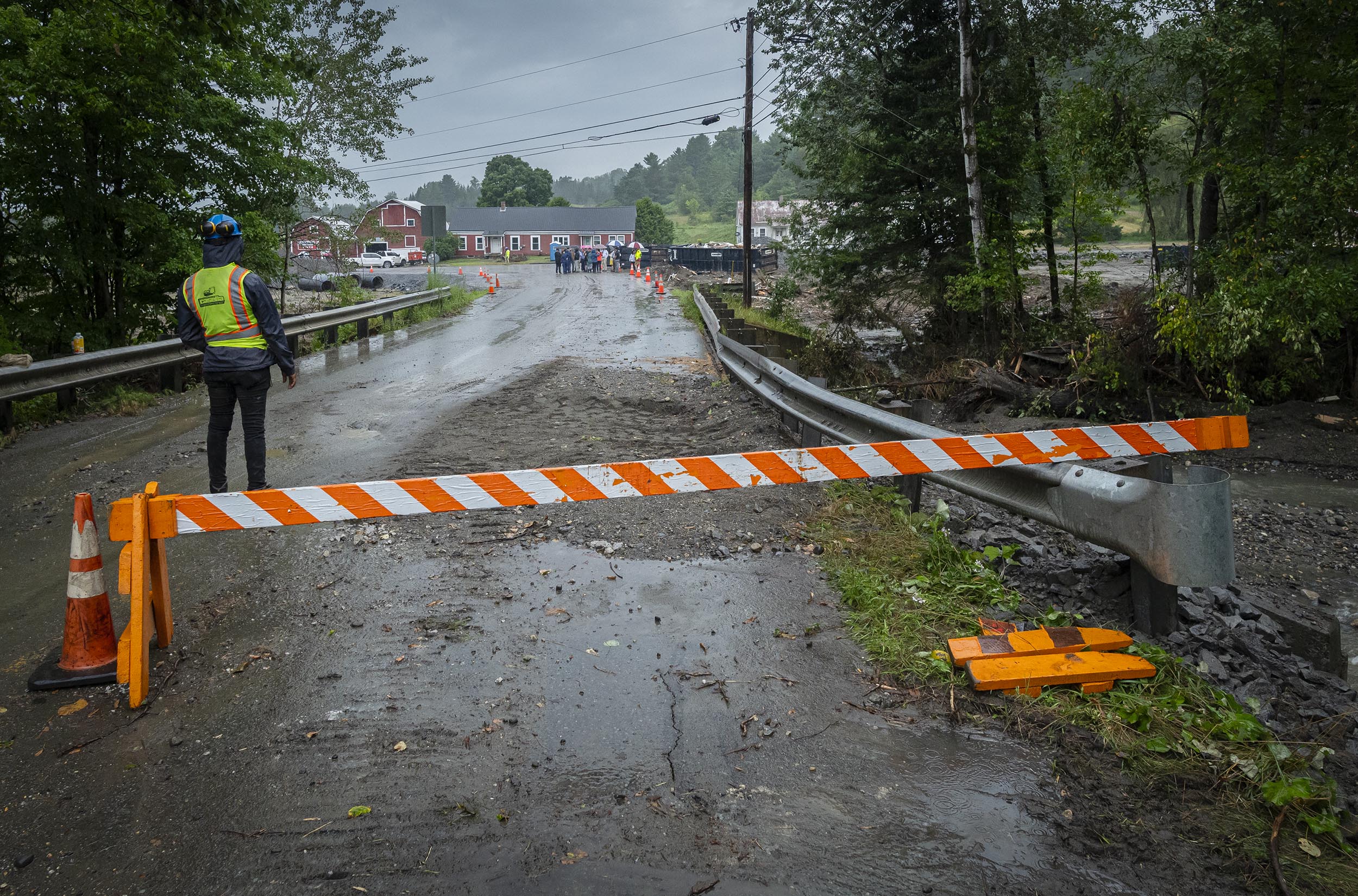
The team of federal officials then traveled to Lyndonville — among the worst-hit areas this July — to meet with residents and local officials.
Lisa and John Berry were the first to meet them outside their business Berry Tire, in pouring rain. Last week the overflowing Passumpsic River again swept in and around, carving out a 6-8 foot ditch in front, they told Jarrett Devine, regional deputy administrator at the Federal Emergency Management Agency (FEMA), who is working on a preliminary storm damage estimate this week.
While the red barn buildings are still standing, the Berrys have lost much of their machinery and equipment. “We don’t need bullshit. We need help,” John Berry said in an interview.
Further up the road, Brian Nichols of Speedwell Farms said he had to pour out 35,000 pounds of milk because the delivery trucks couldn’t get there. He also lost about 20 acres of hay fields and some corn in the flood. “It’s going to take a lot of work,” he said, for the community to recover.
Andre and Teresa Poginy said they lost their respective home-based businesses – Counters By Design and Teresa’s Touch Of Style.
As rain continued to fall, Jeremy Greer pointed out a dumpster that carried the remnants of his house, a fixer-upper he bought about 10 years ago.
Surveying a field of mud dotted by dumpsters carrying the debris of what used to be homes on Red Valley Road — what local officials are calling ground zero there, Levine said, “It’s really a crisis. This area has been devastated because of the rains and the floods.”
She said she wants to take back information from Vermont to Washington and Congress with the intention of supporting the mental and physical health outcomes of these disasters.
“It’s good to see people in their position come and support people here on Red Village Road and all around East Lyndon and Burke,” said Eric Berry, a resident related to the Berrys, whose driveway was washed away but whose house is safe as it is on higher ground.
“These people need the help and resources that hopefully Sen. Welch and Admiral Levine can provide.”
