

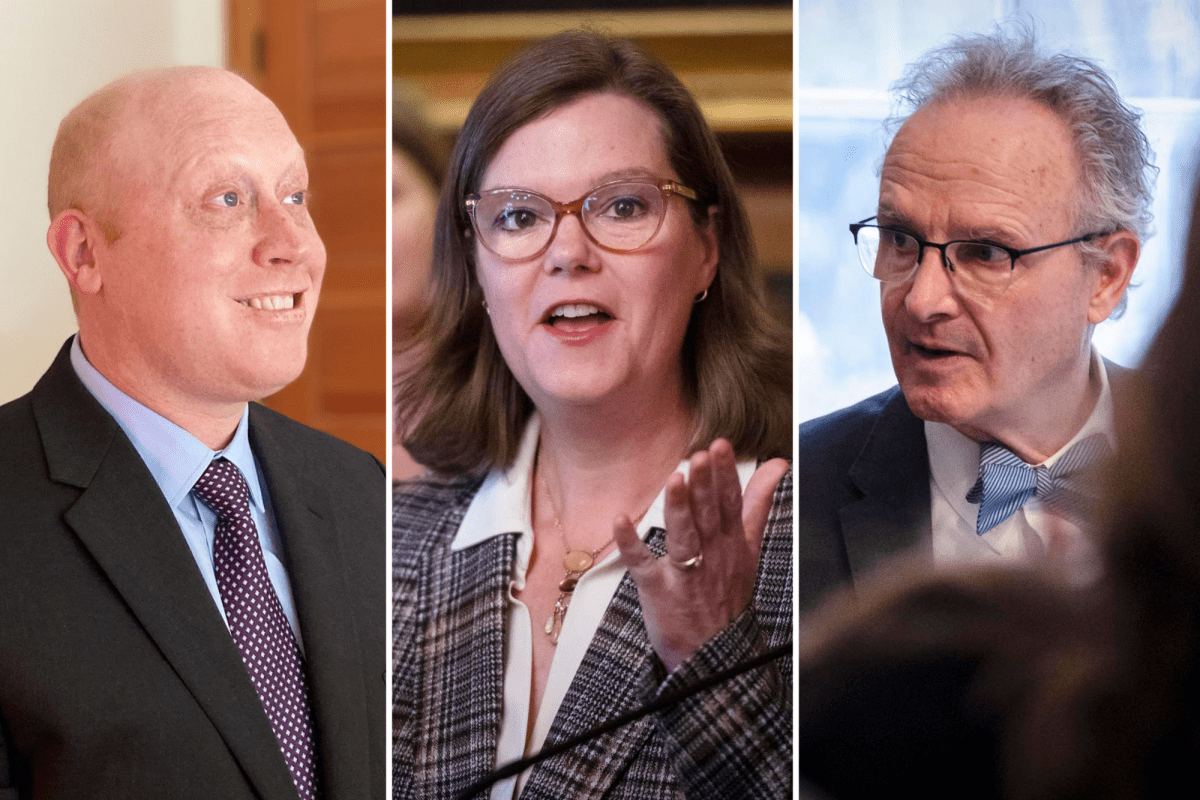
Addison district Democratic Sens. Ruth Hardy of East Middlebury and Chris Bray of Bristol have never faced a contested primary in their three and six prior Senate races respectively. Both incumbents chair important committees — Hardy, Government Operations and Bray, Natural Resources and Energy — and they both typically win their general elections by wide margins.
None of that has dissuaded Rep. Caleb Elder of Starksboro, who currently represents the Addison-4 district in the House, from putting his name down against them in this August’s primary.
“People say, well, I just wish the seats were open,” Elder said in an interview last week. “The seats are open every two years, per the Constitution. They’re open. Incumbency is not permanent.”
“If you want another 16 in the building, you got to win an election every now and then,” he continued, referencing the 12 years that Bray has spent in the Senate and four years in the House. Hardy and Elder each have served six years in their respective chambers.
The three candidates, vying for two seats, will appear on the ballot on Aug. 13 in Addison district, which encompasses Addison County as well as Buels Gore, Huntington and Rochester.
There are also three Republicans vying for their party’s nomination to the November general contest: Lesley J. Bienvenue of Leicester, Landel James Cochran of Huntington and Steven Heffernan of Bristol.
Elder said he is looking to make the leap to the upper chamber not so much because he wanted to unseat one of the incumbents as much as because he no longer thought he could be effective in the House.

“Leadership made it clear the doors were shut for me to participate there,” he said. “But I’m a stubborn person. And I, for the sake of my three- and five-year-old daughters and all kids in Vermont, have been determined to participate. And so I’m going to the Senate to see if I can have a seat at the table there.”
Elder said he butted heads with Democratic leaders in the House because he didn’t like how top-down the decision-making process in the chamber was. He recalled being told on several occasions to “jump on board or be thrown off the train.” He hopes for a more collaborative legislative process — and he believes he could be a part of that in the 30-member Senate better than he could in the 150-member House.
Elder said his top priority area is education, having served on several school boards in Addison County in the recent past. He said that the Legislature must respond to the 2022 Supreme Court decision in Carson v. Makin, which held that reserving private school tuition vouchers only for nonsectarian schools constituted religious discrimination. The upcoming session is a critical one for education and education finance policy, he said, especially after the Legislature drew public ire this year by passing a property tax hike to fund locally-approved school budgets, without addressing structural school funding reform.
“We have the property tax situation of this year, which is creating a serious mandate for change,” Elder said. “I’ve got a number of ideas in terms of what I want to do, how I think that we could stabilize our public education system in the long term.”
He shares the emphasis on education finance with Hardy, who said the number one thing she has been hearing from her constituents has been frustration with this year’s property tax hike.
“We cannot sustain another property tax increase like that,” she said. “We really need to figure out a better way of funding and supporting our public schools in Vermont.”

Hardy said her other top priorities are health care affordability, which she hopes to continue working on as part of the Senate Health and Welfare Committee, and financial resiliency for local governments.
“So many of our small towns in Vermont are run by volunteers,” Hardy said. “When things like a major flood hits, they don’t have the expertise or the capacity to do everything they need to do. And so we really need to be looking at local government and how it can build up the capacity to manage things.”
Bray, who has served as chair of the Natural Resources and Energy Committee for a decade, said most of his priorities are focused there, where he said he has unfinished business. He pointed to continuing work on the Affordable Heat Act, which he sponsored as a design and study process in 2023, as his top legislative priority. The resulting framework will return to the Legislature for a vote on implementation next session.
“This is a really crucial job, and I want to stick with it,” Bray said. “Since I wrote the predecessor, I’m in a good place to write the successor bill.”

The act would require fossil fuel sellers to offset the carbon footprint of their business by either instituting their own clean heat measures or paying a fee that the state would invest in solutions to transition gradually away from fossil fuels in heating and cooling systems. Though much of the conversation around the bill has revolved around the costs being passed down to households by the fuel companies, Bray said he believes that Vermonters would eventually save money by not being beholden to gas price volatility.
The advocacy group Americans for Prosperity, funded by the Koch brothers, recently launched a mailer and media campaign that Bray said exaggerates the estimated cost to households. He takes that effort only as further motivation.
“In a certain way, it’s a great compliment that what Vermont is working on is drawing the fire of a national group like that,’” Bray said. “We must be on the right track.”
Bray highlighted his experience in Senate leadership as his main strength in the race, and said he cultivates a collaborative, thorough working culture in committee.
Hardy, meanwhile, said that what sets her apart is her communication with constituents and communities, which she has prioritized not only on the campaign trail but in all her duties as a senator. She pointed to a legislative blog she has maintained since the pandemic as a way to keep people informed about what’s going on in Montpelier, and added that she has knocked on hundreds of doors around the district this summer.
“I’m the one that’s out there; I’m the one that regularly talks to people and provides information to voters,” she said. “I’m accessible. I pick up the phone, I answer emails. I provide my constituents with a lot of information and help. If they need help accessing services, I’m the one they call.”
As of the end of June, according to the Vermont Secretary of State’s campaign finance data, Hardy had raised just over half of her $7,447 so far through donations under $100. Small donations represent 13.3% of Bray’s $6,205 contribution total and 13.6% of Elder’s $7,630, according to the latest available data.
With regards to campaign expenditures, Bray has reported the most with $10,150, and Elder and Hardy have reported spending $8,203 and $6,209, respectively.
Correction: An earlier version of this story mischaracterized details of the 2023 Affordable Heat Act.
