


Latex gloves, alcohol wipes and needles are common tools for administering injections — even when the shots are for trees.
On Tuesday, the Catamount Community Forest became a doctor’s office for a unique set of patients: ash trees that are at risk of being infested with invasive beetles called emerald ash borers.
Experts from Arborjet — a company founded in 2000 that saves trees by injecting them with species-specific treatments — visited Williston to treat 11 ash trees with insecticide that will kill the beetles.
The emerald ash borer is an invasive species from Asia that has killed tens of millions of ash trees in North America over the past 20 years, according to the U.S. Department of Agriculture. The beetles lay eggs in trees’ bark, and larvae burrow into and feed on inner layers of bark once they hatch, destroying the tree from the inside out.
When Terry Marron, a member of Williston’s conservation commission and Catamount Community Forest committee, learned that the beetles could be “devastating” to Vermont’s forests, she said she knew she had to do something to help.
“My theory is: you gotta start somewhere,” Marron said. “You can’t stick your head in the sand and say it’s too far gone. There are always ways to take action.”
In 2022, Marron worked with town officials and the Vermont Land Trust to get the ash trees their first round of injections. Today, the trees received a second dose through a grant from Arborjet, which should further safeguard them against the beetles.
Arborjet employees — protected with safety goggles and gloves — drill small holes every few inches near the base of the tree, inserting plastic plugs into each opening, said Kevin Brewer, the northeast territory manager for Arborjet. The drilling is not harmful to the trees as long as it’s done correctly, he said, and company staff even clean drill bits with isopropyl alcohol to ensure no diseases or infections are spread between trees.
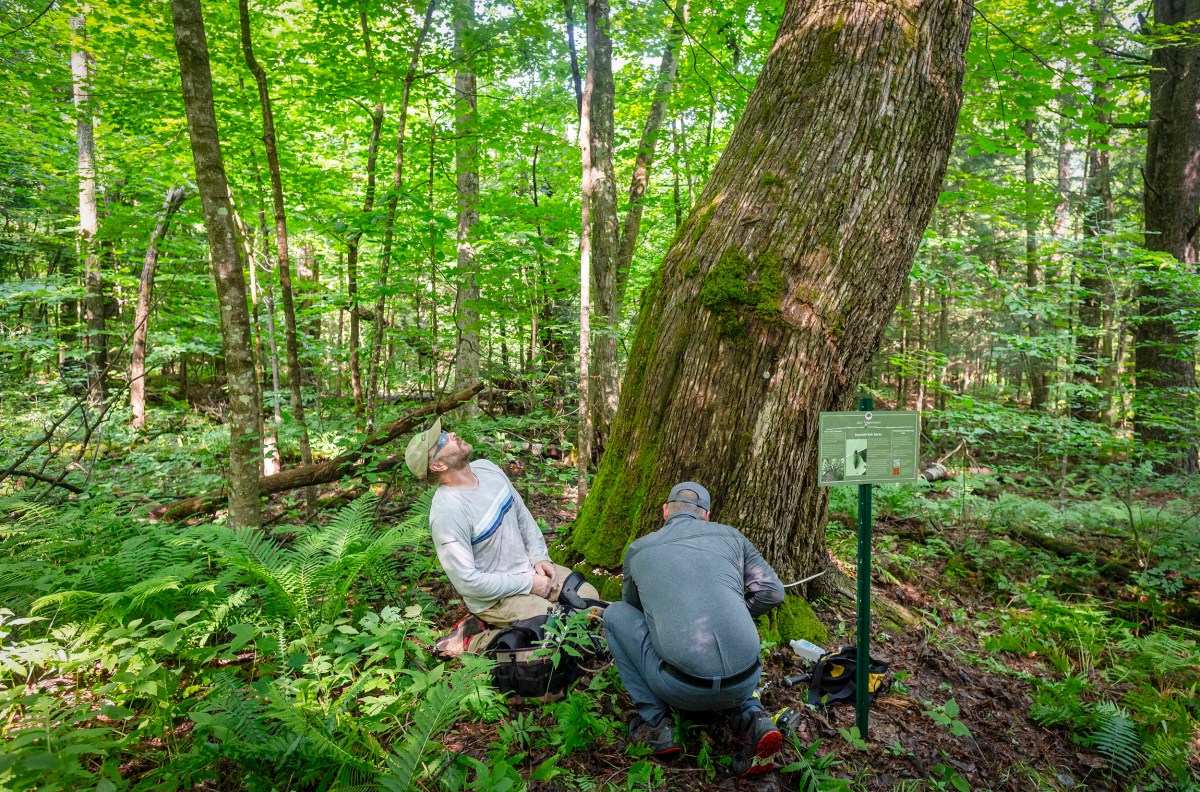
Once the insect control formula is injected into an opening, Brewer said, the plug seals the injected treatment inside the tree where it can be distributed throughout the trunk and branches along with water and minerals taken up by the roots. After a few days, the formula — named Tree-age R10 after the medical term “triage” — will reach the bark where emerald ash borer larvae feed and the leaves where the adult beetles feed.
The insecticide used in this treatment “just goes after boring insects,” Brewer said. It isn’t absorbed into a tree’s nuts or fruits, keeping wildlife that eat those products safe, he added.
The injections are different from other treatment methods, such as soil drenches that involve pouring insecticide on a tree’s roots, because the chemicals remain contained within the tree and can’t harm other plant and animal species through runoff, according to Brewer.
Just like shots that humans receive, Brewer said, a small injection can go a long way to help a tree become resistant to emerald ash borers. He said, on average, each tree receives about two milliliters of treatment per inch of trunk diameter, which is enough to protect the tree for two to three years.
The technology can work for trees that are already infested with beetles also, Brewer said, as long as no more than a third of the tree’s canopy has been destroyed. Once a tree has too many dead branches or cracks in its bark, it becomes harder to save.
Marron said the only downside to the technology is that “it’s not cheap.” The treatment for the 11 trees cost about $3,000, Brewer said, but it was all covered by Arborjet as part of its “Saving America’s Iconic Trees” initiative.
One of the Williston trees — called “Big Jim” by locals — fits the bill of “iconic,” Brewer said, because it is one of the largest ash trees he’s seen in the state. The tree is named after former state Rep. Jim McCullough, who preserved the 393-acre plot that is now Catamount Community Forest with his family. Farther down the trail sits “Lovely Lucy,” an ash tree named after McCullough’s wife, who helped to build and maintain the forest’s network of trails.
The forest wouldn’t be recognizable without its ash trees, Marron said.
“They’re just so prominent in our landscape,” she said. “Without them, it would look like a whole part of the forest is missing.”
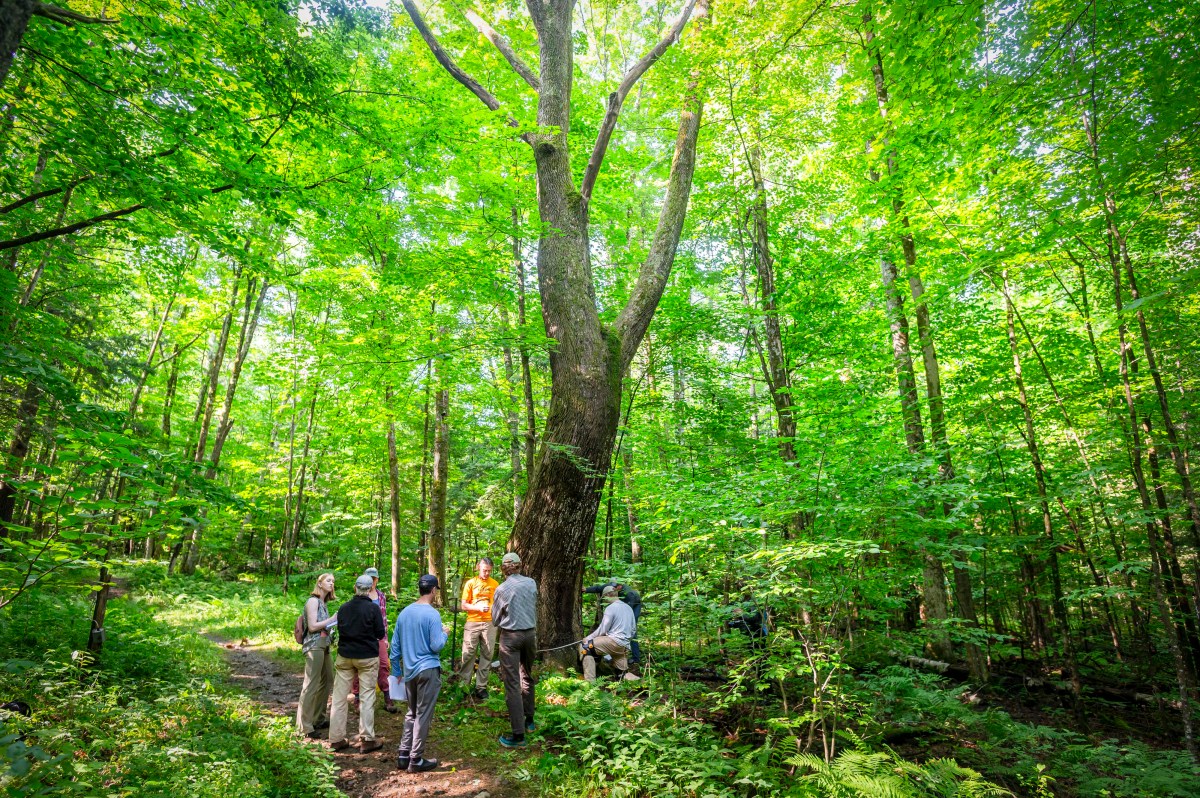
According to the USDA, the emerald ash borer has been reported in 36 states since it was first found in the United States in 2002, and is largely concentrated in the Northeast, Mid-Atlantic and Midwest regions. For many communities in New England, ash trees have “disappeared entirely,” Marron said.
And when ash trees go, “biodiversity goes with them,” Marron said. Ash trees provide habitat for birds and other wildlife species, food for caterpillars, strong bark for lichen to grow on, and late-falling leaves that improve soil quality — making them a “staple” for forest ecosystems, she said.
Protecting mature trees of any species is crucial to overall global climate health, according to the Arborjet website, because large trees sequester carbon, facilitate water infiltration into soil and support the biodiversity that Marron described.
Marron said the best thing locals can do to stop the spread of emerald ash borers is to not move firewood that could be infested from one place to another. Because once the beetles become prominent in an area, she said, options for ash trees’ future are limited.
Locals can choose to leave trees standing after they begin to die from infestation — dead trees are still crucial parts of forest ecosystems, according to a 2019 report from The Wildlife Society, because they provide habitat for many animal species. And, Marron said, some trees are naturally resistant to the bugs, so it’s important to give them the chance to fight before hastily cutting them down.
But she said leaving dying trees untouched can be dangerous in areas with public trails such as Catamount Community Forest. Once trees are infested, branches become brittle and often fall off, which could harm hikers. So, she said her only two options are to treat ash trees before they become heavily infested or cut them down if it’s too late.
Marron said she’ll continue to advocate for preventative measures so that the latter call never has to be made in the “Big Jim Grove” — which she calls the “core group” of ash trees in the Catamount Community Forest.
“The goal is that, when people walk these trails 50 years from now, all the trees will still be here,” Marron said. “And the real hope is that there will be some new trees, too.”
Clarification: This story was updated to more accurately describe the options for dealing with ash trees infested with emerald ash borers.
