


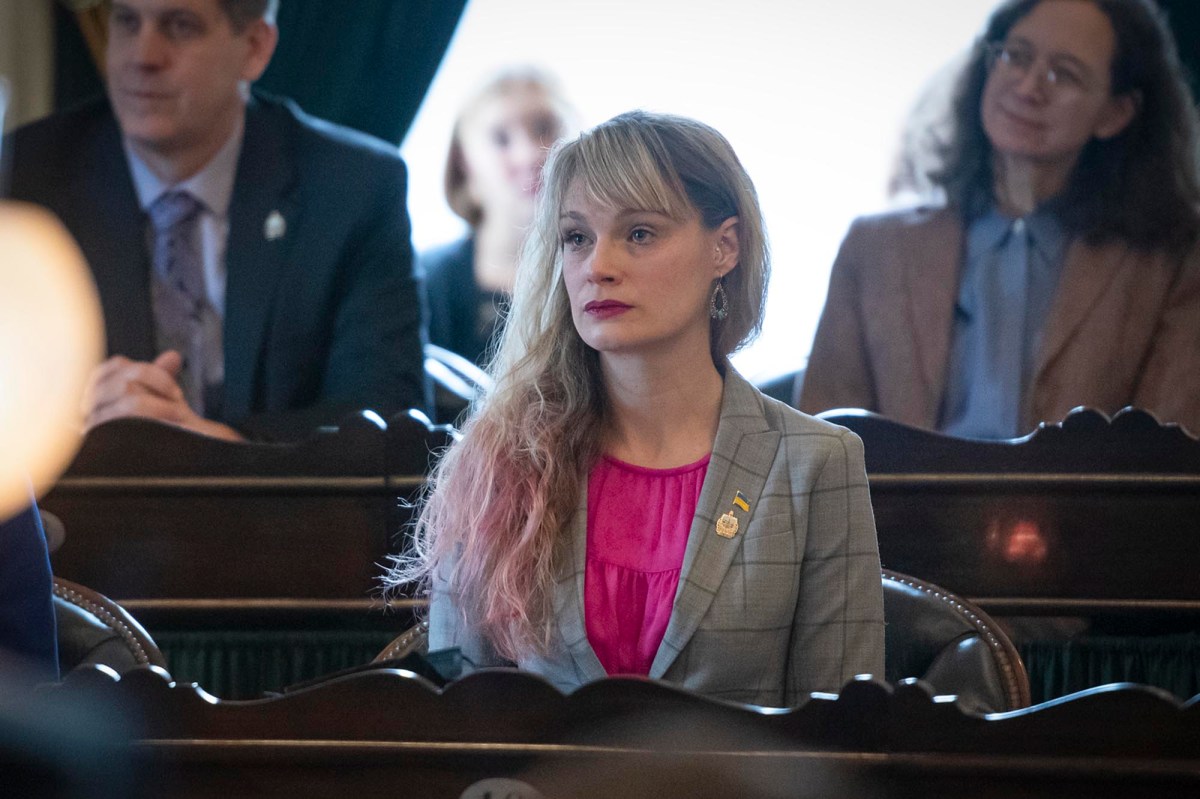
Last week, two state senators announced they were suing Gov. Phil Scott over his appointment of Interim Education Secretary Zoie Saunders.
In a Friday press conference, Sens. Tanya Vyhovsky, P/D-Chittenden Central, and Dick McCormack, D-Windsor, said they’d raised more than $11,000 to fund the lawsuit, which also names Saunders as a defendant, but they declined to release the donors’ names.
“These are private citizens, and they were making donations under the expectation that their names would not become public. I don’t want to share names,” Vyhovsky said in a subsequent interview.
The unusual practice of raising funds to support the lawmakers’ lawsuit against Scott — and the reluctance to identify the donors — is a murky area not addressed in the state’s campaign finance disclosure laws.
State law requires the disclosure of the name of campaign donors and limits the amount that can be donated by political action committees and individuals.
According to Lauren Hibbert, deputy secretary of state, Vermont doesn’t have campaign finance guidelines governing situations like Vyhovsky and McCormack’s lawsuit.
“It’s sort of a unique situation that we did not consider,” she said. “It’s an unprecedented question.”
A spokesperson for the Vermont Attorney General’s Office, which is representing Scott and Saunders in the case, declined to comment on the campaign finance considerations at play.
Donations ranged from $10 to $5,000, according to Vyhovsky, with an average donation of less than $200. Money went directly to the attorneys in the case, John Franco and Jared Carter, she said.
“They were not able to do the case pro bono, but they are doing it ‘low bono,’” Vyhovsky said. “They’re doing it at a reduced rate given, you know, what’s at stake.”
The two senators sued Scott, arguing he overstepped his constitutional authority when he appointed Saunders interim secretary after the Vermont Senate voted 9-19 not to confirm her as permanent secretary.
State law says secretarial appointments require the “advice and consent” of the Senate, and also grants the governor authority to use appointments to fill vacancies.
Vyhovsky, who spearheaded the suit, said she solicited donations informally through word of mouth and that some people reached out to her asking how they could contribute. Because donations went directly to the lawyers in the case, she acknowledged that there could be donors she was unaware of, but she was “not aware of lobbyists donating or people who employ lobbyists.”
The Progressive/Democratic senator described Carter, a professor at Vermont Law and Graduate School, as an appellate attorney and constitutional law expert. Carter wanted to work with Franco as co-counsel due to Franco’s extensive litigation experience, Vyhovsky said.
When planning to pursue the case, Vyhovsky said she considered working with the attorney general’s office, but because the executive branch and the Senate are both parts of state government the attorney general is elected to represent, she thought a conflict of interest could exist and decided against it.
The Office of Legislative Counsel, the attorneys who work for the Legislature, don’t specialize in litigation, and Vyhovsky said the Senate Rules Committee would have had to direct legislative counsel to take on a case like hers.
Ultimately, private attorneys proved the best option, she said.
Paul Burns is executive director of Vermont Public Interest Research Group, a nonprofit which advocates for government and corporate transparency.
He called the campaign finance considerations in the lawsuit “unusual.”
Lawmakers often raise money for their campaigns, and some fundraise for nonprofits or specific causes, but “this seems like something bordering on in-between,” Burns said. He noted that the case is a “pointed issue with political overtones,” potentially inseparable from the senators’ “interests.”
“Though they’d argue, I’m sure, that the substance goes beyond their self-interest.”
Burns also acknowledged that VPIRG hasn’t taken a stance on the senators’ case, which he described as addressing “quite a legitimate, legal, constitutional question.”
(VPIRG’s political action committee has previously donated to McCormack and Vyhovsky).
Asked about the money behind the suit, Amanda Wheeler, a spokesperson for the governor, said in an email she was unaware of any donors.
“I do know their lawsuit will have a cost to taxpayers because of the need to respond to and defend against the suit,” she added.
Disclosure: Jared Carter is providing pro bono legal assistance to VTDigger in an unrelated public records case.
Editor’s note: This story was updated to note that VPIRG has made political donations to Sens. Tanya Vyhovsky and Dick McCormack.
Correction: A previous version of this article misrepresented Vyhovsky’s reason for not seeking counsel from the attorney general’s office.
