


This story by Aaron Calvin was first published by the News & Citizen on May 9.
The day after last July’s catastrophic flooding inundated Foote Brook Farm in Johnson — ruining or damaging crops, barns, machinery, feed and fertilizer — Tony Lehouillier got up and went to work.
“I definitely learned how resilient Tony really can be,” Joie Lehouillier, his wife of 18 years, said. “He literally just got up the next day, basically put his shoes on and said, ‘I’m going to do whatever I have to do to make this work,’ and I was just blown away by his ability to just always keep going. There just doesn’t ever seem to be anything that will make him not want to try.”
“We were $80,000 into our line of credit when the flooding hit, so we had to take the next $20,000 knowing that we’d get no money,” Tony Lehouillier said. “My wife suggested sending everyone home and I said, ‘No, because if they go now then we’ll never get any of this done.’ We were going to be done. Done, done, done. Totally, never come back. We wouldn’t have any tractors and wouldn’t have worked through all that, even though it took two months of labor.”
Owners of a remarkably diverse farm set up across a flat plain of soil made rich by the very river that occasionally devastates it, the Lehouilliers grow food shipped wholesale through their Deep Root organic co-op and to select markets and sold directly from their farmstand operation.
They’re beholden to a cycle, familiar to most farmers, of taking on debt to keep their farm running and paying it down with the profits from the season’s yield.
After the catastrophic flood caused an estimated half million dollars in damage, they found themselves in a deep financial hole. With an estimated 75 percent of their crops lost, Lehouillier knew that to save the rest he’d have to purchase thousands of dollars’ worth of fertilizer to replace what had washed away.
He had to adhere to the strict requirements imposed by the U.S. Department of Agriculture when it came to salvaging what could be salvaged, retaining seasonal employees and getting extra help from volunteers to peel away sheaves of kale to ensure they eventually produced an uncontaminated crop, even though some of the leaves had barely touched the floodwaters.
Unlike monocrop farmers that mostly grow corn or soybeans, organic farmers don’t benefit from the same federal subsidies or generous crop insurance terms that save other farms during a devastating event. Foote Brook’s community network came to its aid with over $60,000 in donations, and it secured $200,000 in emergency grant funding, according to Farm Progress, but the farm was still left massively in debt.
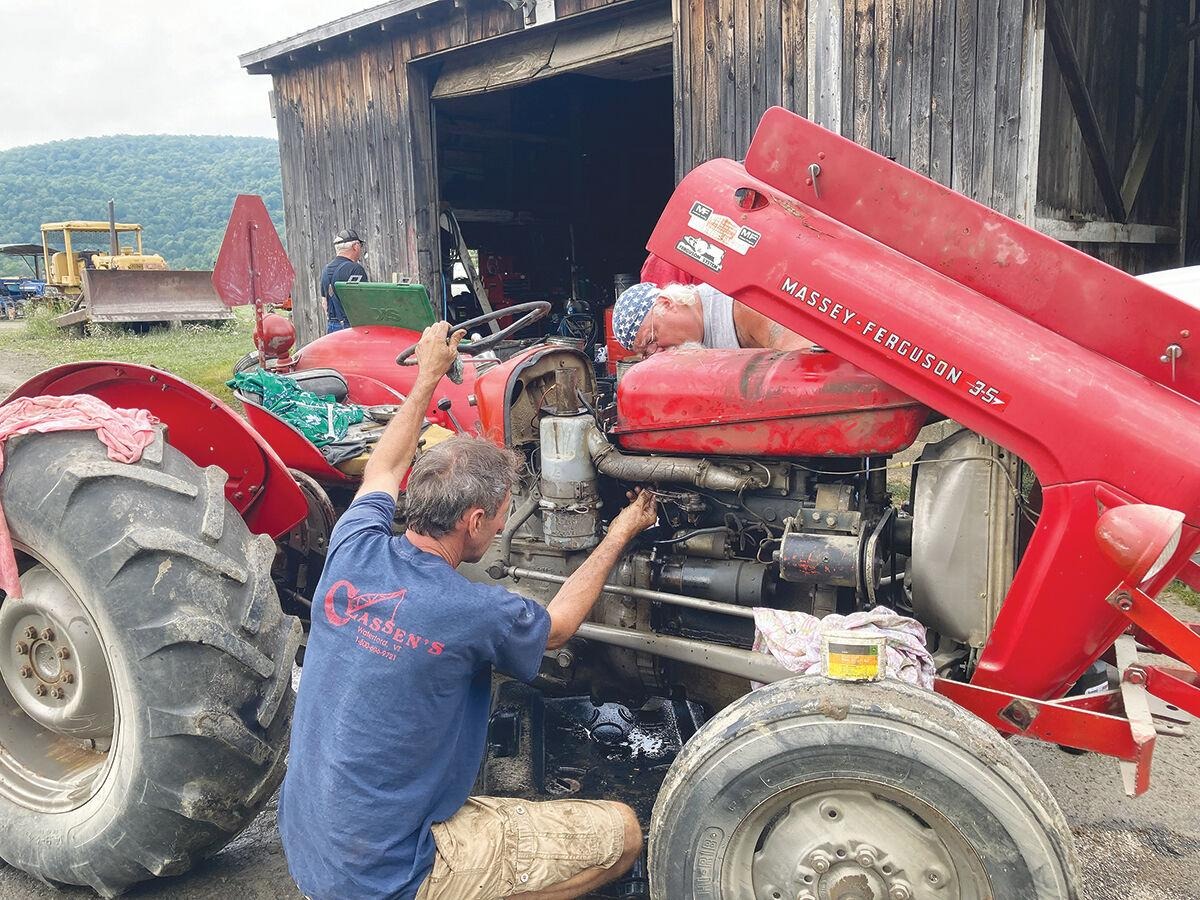
“We’re going to be catching up for the next 10 years at least,” Tony said. “We don’t know which piece of equipment is actually going to die next, but we know they’re all going to die. Hopefully, they won’t die right when we need them.”
This resilience is taking an increasingly unsustainable mental and physical toll on Tony, who, at 55, suffers from mangled fingers and worn-down knees, and there’s not a moment to rest.
“Your life is here, seven days a week,” Tony said. “Your wife wants to go on vacation for two days, too bad. It’s all those things that beat you down as a farmer, that kills farmers because they’re mentally not in the same place as most people.
“There’s no reason that I should even be fooling around with farming this way after what we just went through, but I really didn’t want the place to go down in flames like that in one year. I’m going to try again, and if we fail, we fail.”
Restorative efforts
Amid the anguish, there is still hope for the future of farming on the plot of land between the Lamoille River and the Foote Brook tributary.
Last Friday, a group of volunteers made up of friends of the Lehouilliers, members of the organic farming community and others who are simply passionate about sustainable agriculture, trekked across the farm to the edge of the river.
They were led by Karen Ganey, community director of Regeneration Corps, a regenerative farming implementation and education organization, and Mollie Wills, organizing director with Rural Vermont, a nonprofit that promotes healthy agrarian communities in Vermont.
This team of volunteers dedicated their Friday to planting a stand of nut trees and berry bushes — all donated by Elmore Roots Nursery — along the river. They planted 45 trees in total, along with 100 shrubs to form a riparian barrier in an area where the river, when it surges, most commonly bursts its banks.
They planted a collection of black walnut, shagbark hickory and butternut trees, and shrubs like aronia, highbush cranberry, nannyberry, hazelnut and dogwood. Not only will the vegetation help secure land next to the river from further erosion, but it will also eventually be productive and nourishing.
“This little mound that we’re standing on, it’s going to become a nutrient dense nut forest,” Ganey said. “So, you can imagine years from now, when we’re not even around, the people, the species that are going to be enjoying this beautiful bounty.”
Volunteers paired off, packing spindly twigs tightly into the earth in an act of belief in the future where the land could be both productive and healthy.
“We’re stepping outside of the capitalistic model to support our community, to support our food sovereignty and invest in our shared future,” Wills told the volunteers.
Tony dug into the dirt alongside his employees and volunteers. All his life he has paid close attention to the rhythms of the Lamoille River and has plenty of thoughts about how it’s currently being mismanaged by the state.
Ongoing development in the hills on either side of the river, looming over the farm and Johnson village — also devastated in last year’s flood — have eroded the streams and ponds that once held water in the hills, leaving it all to flow down into the Lamoille during high-precipitation events.
He believes that the river is now trapped in a feedback loop that causes further flooding and erosion. He pointed to a thin stand of trees on the banks near where the new planting was being done as a simple measure, enacted after the Flood of 1927 — the only flood to see waters rise higher than they did in Johnson last summer — as something that could have helped prevent this cycle.
But much of how the river is managed is outside of his control. In response, they’re largely in retreat from the river, planting more densely farther from it and getting creative to find productive uses for the compromised land.
Consulting with Ganey on the planting project was one of Tony’s mentors, Bruce Kaufman, whose own Riverside Farm in Hardwick also suffered severe damage by the same waters that flooded Foote Brook.
Despite living with a cancer diagnosis, Kaufman was hard at work with the other volunteers, and offered his own wry assessment of the flood.
“I was kind of lucky last year,” he said. “I wasn’t planning on growing a lot of stuff. I’m sick right now, so I ended up planting a lot less last year, so not that much got ruined, only five acres. If it was another year, it would’ve been 20 acres. Sometimes you just get lucky.”
Optimistic outlook
Despite all that her farm endured, Joie said she’s entered this season with an optimistic outlook.
“I’m always amazed at how much I’m ready to just get back at it,” she said. “We really enjoy what we do, and Tony and I are both extroverts, we love people. We love being around people, we like having employees here. I especially love when we open the farmstand and the public is coming in.”
On a portion of the property that the Lehouilliers will no longer cultivate due to its proximity to the river, they plan to grow a sunflower maze, the farm’s first step into agritourism and a symbol of hope and healing.
They also brought in a contractor this year to help them work out some of the kinks in the farm’s sod production. Though Foote Brook has always grown sod, Joie said they hope to grow that aspect and scale back to reduce the pressures on her husband.
“We just need to start moving in a direction that is less on his body and his mind, but when you have hundreds of thousands of dollars’ worth of debt, you can’t scale back,” she said.
The main goal behind this big post-flood push, she said, is to reduce wholesale distribution and the pressures that come with it to focus on getting their vegetables directly from the garden and into the local community.
“The farmstand and growing food for our community is the most rewarding part of this business,” Joie said. “The farmstand is at the heart of what we do, and what we want to do. Everything else that we’re doing, is what we have to do.”
