


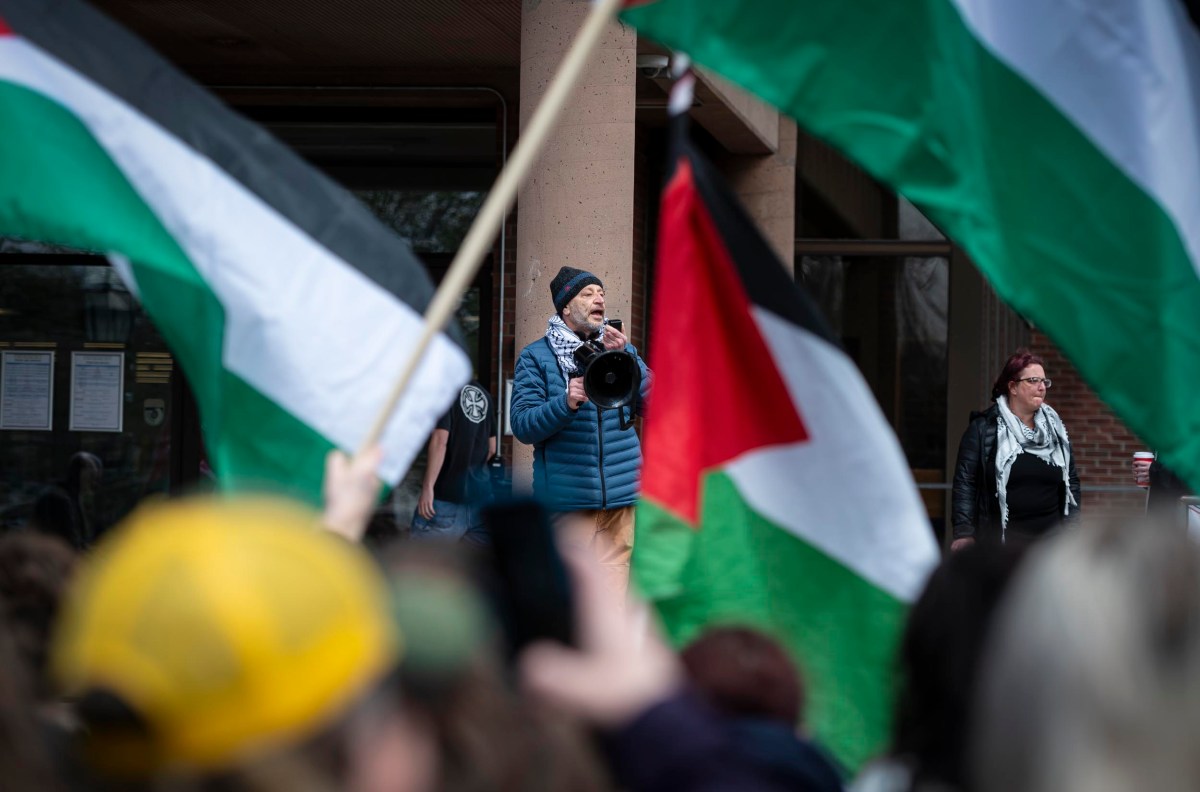
BURLINGTON — Last Monday, hundreds of University of Vermont students gathered around the steps of Howe Library and demanded that the school do more to help the Palestinian people.
Interspersed with chants of “free, free Palestine” and “long live Palestine,” protesters reiterated a list of demands for UVM, including divestment from Israel, cutting ties with Israeli academic institutions and canceling the commencement speech to be given by the U.S. ambassador to the United Nations.
Wafic Faour, a Palestinian activist and community member, urged students through a megaphone to continue fighting to make UVM’s campus “apartheid-free.”
“You are bringing hope to Palestinians in every corner of this world!” Faour said.
Over the past few weeks, protests have ignited at academic institutions across the U.S., as thousands of students have pitched tent encampments on campus amid outcry over Israel’s ongoing military campaign in Gaza.
At UVM, protesters have already notched several wins. Last week, the university agreed to release financial information about its endowment, and on Friday evening, UVM president Suresh Garimella announced the cancellation of the commencement speaker’s speech.
Those victories, however, come on the heels of months, if not years, of tensions over how the university responds to concerns raised by pro-Palestinian students and by Jewish students.
Protesters have accused UVM administrators of hostility toward pro-Palestinian voices and say the university is not doing enough to keep Palestinian and Arab students safe on campus. Some Jewish students, meanwhile, have raised concerns that the university has not taken antisemitic acts seriously enough — a charge underscored by a federal investigation that, last year, found shortcomings in how UVM responded to alleged antisemitic incidents.
In the final days of the academic year, the situation has created a test for university leadership: How do they respond to students who are angry, hurting and demanding action — without exacerbating those tensions?
“I think the administration is in a very difficult position,” Thomas Borchert, the faculty senate president, said in an interview on April 17 — the same day that Columbia University students set up a tent encampment on the New York City campus.
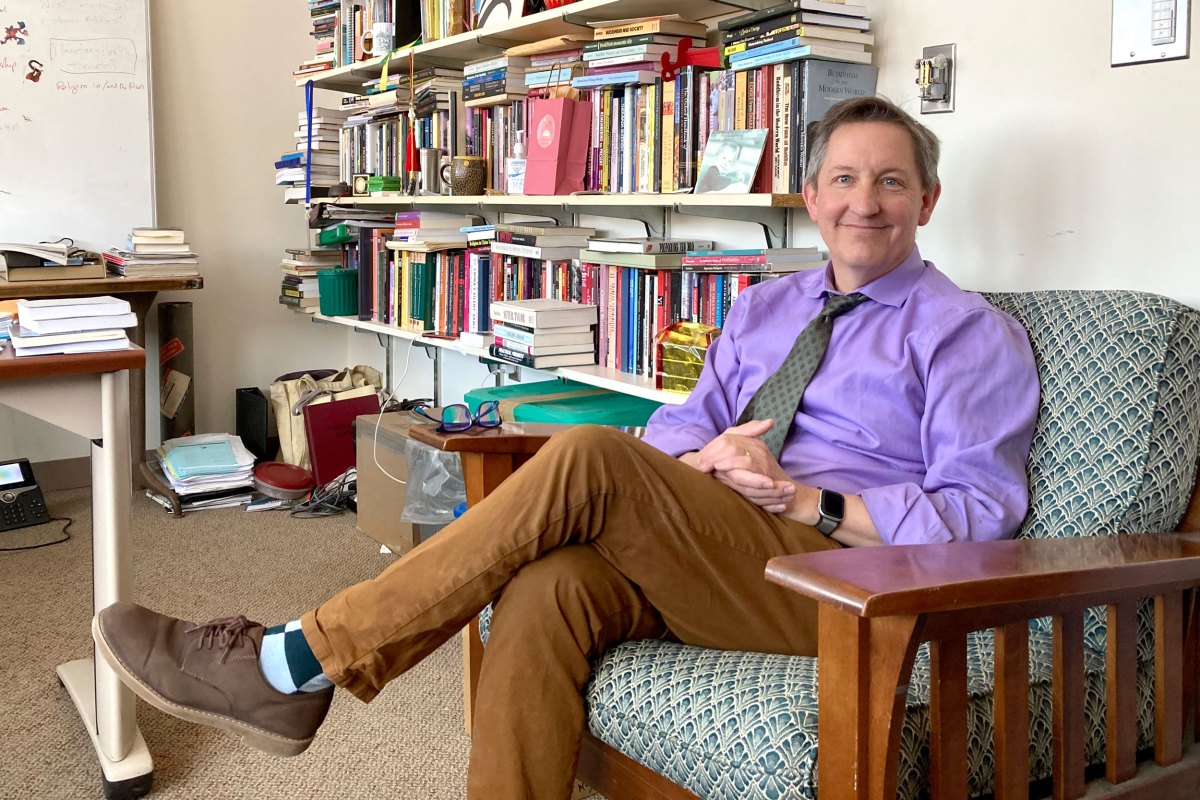
“All of the discourse around antisemitism, or Islamophobia, and Israel — all of that heightens tensions on campus,” Borchert said, “and makes it very difficult to navigate what are already choppy waters.”
‘Deeply troubled’
On Oct. 7, Hamas launched a surprise attack on Israel from Gaza, killing roughly 1,200 people and abducting about 250 others. In the following six months, Israel retaliated with an aerial and ground assault that has killed over 34,000 people and destroyed vast swaths of the territory’s homes and buildings.
At UVM, as elsewhere, students, faculty and staff have watched in horror as the violence has unfolded. Days after the October attack, Suresh Garimella, the University of Vermont’s president, issued a statement.
“Saturday’s horrific violence targeting Israeli civilians and the turmoil, anguish, and destruction that have followed leave us heartbroken and deeply concerned,” Garimella said. “Many among our community have family, friends, and loved ones directly affected by the violence, and still more have deep and meaningful attachments to the region and the people who live there.”

By coincidence, just weeks later, UVM faculty members were preparing to welcome Mohammed El-Kurd, a Palestinian poet, journalist and activist, who was scheduled to give a lecture at UVM’s Davis Center.
The event had been in the works for months. But days before it was to take place, UVM’s administration decided to rescind permission for the event.
“It is our judgment, based on global, national, and local events, that we cannot adequately provide safety and security for this event as it is currently planned,” UVM’s Division of Safety & Compliance wrote in an unsigned email to the lecture’s organizers Oct. 21.
Records obtained by the Foundation for Individual Rights and Expression, a free speech nonprofit, show that UVM administrators had received roughly 40 form emails, as well as a handful of other requests, seeking the cancellation of the event.
The emails also show that four Jewish students had met with Jennifer Strickler, the chair of the sociology department, and expressed alarm.
“Some Jewish students are very concerned about antisemitism on campus (which has been documented as a problem that the UVM administration has not handled well),” Strickler, whose department co-sponsored the talk, wrote to one of the event organizers in an Oct. 9 email. “They are worried that El-Kurd’s speech will inflame antisemitism on campus, and they are concerned about their safety, especially in light of the war that began this past weekend.”
Bill Falls, a UVM dean, appeared to share those concerns and said he would prefer the event be postponed.
“I am deeply troubled that our colleagues have chosen to exercise their academic freedom in this way and at this time when so many of our community are suffering,” Falls wrote in an Oct. 20 email. “I am stuck between censorship (requiring the event to be cancelled) and risking harm to the community.”
A day later, UVM’s Division of Safety & Compliance told organizers that they could not use the space. The ultimate decision, according to a faculty review of the incident, was made by Garimella.
‘Equitable support’
Organizers held the lecture online. Helen Scott, an English professor and one of the organizers of the event, said in an interview that the revocation of space for the event was “deeply distressing” — but part of a familiar pattern.
Scott is the faculty adviser to Students for Justice in Palestine, a student activist group that has spearheaded campus protests.
“UVM has always been a hostile climate for those advocating for Palestinians,” Scott said. “Whenever I or anybody that I know has organized an event with a Palestinian speaker, we have had complaints, and there have been attempts to stop the meeting, and I’ve received threats.”
The incident, which pitted the concerns of pro-Palestinian students directly against those of some Jewish students, underscores what has been a simmering tension on UVM’s campus for months — if not years.

Protesters charge that UVM’s administration is unfriendly to Palestinian voices and unconcerned about the safety of Palestinian students — while being much more sympathetic to Israel. Some Jewish students, meanwhile, have raised concerns about their own safety and what they see as a lackluster response to antisemitism on campus.
National advocacy organizations have reported spikes in both anti-Muslim and antisemitic incidents in the U.S. during the Israel-Hamas war.
In late October, UVM’s Student Government Association issued a resolution condemning both the revocation of space for the talk and Garimella’s statement on Oct. 10. The cancellation of the venue amounted to “a silencing of a Palestinian voice,” the resolution reads, and Garimella’s initial statement was “not equitable in mentioning the hardships of the Palestinian community.”

“The UVM SGA encourages the UVM administration to show equitable support to Palestinian and Jewish students on campus through language used,” the resolution reads.
Adam White, a spokesperson for UVM, declined to make Garimella or other administrators available for an interview for this story last week, citing their busy schedules and the campus protests. White declined to provide answers to an emailed list of questions.
“There will be an appropriate time to reflect on past events following the conclusion of our academic year,” White said in an email.
But on Friday evening, Garimella released a lengthy email addressing students and community members, in which he assured students that he had heard their concerns.
“I see your efforts to bring attention to your viewpoints and to make your city and your university safe places of which you can be proud. The voices of our community are as diverse and powerful as the issues are complex and heavy,” he said. “I hear you all. I, too, wish for an end to these seemingly intractable disputes and hope that would bring us all some measure of comfort and restore our sense of security and community.”
The message went on: “There is no room at UVM for antisemitism, Islamophobia or any discrimination based on race, national origin or ancestry.”
‘We can no longer politely ask’
Roughly a month later, three young men of Palestinian descent — Hisham Awartani, Kinnan Abdalhamid and Tahseen Aliahmad — were shot on North Prospect street, near UVM’s campus. At the time of the shooting on Nov. 25, Awartani, Abdalhamid and Aliahmad, all students at out-of-state universities who were visiting Burlington, were walking in the neighborhood while wearing keffiyehs, traditional Palestinian scarves. Awartani was paralyzed from the chest down.
A suspect, Jason Eaton, has pleaded not guilty to three counts of attempted second-degree murder. Prosecutors have not publicly identified a motive, and Eaton has not been charged with a hate crime.
The incident drew international headlines, and UVM and Burlington reacted with an outpouring of horror and disbelief, organizing vigils and rallies in response. In the wake of the violence, Garimella announced that UVM was “enhancing security operations” on campus.
“Our hearts go out to the victims and to all who are impacted by this incident,” Garimella said in a statement the day after the shooting. He also urged community members to “pay close attention to the sources and authenticity of information” about the shooting and to “do your part in helping to avoid speculation as the investigation progresses.”
After the shooting, according to the Vermont Cynic, protesters marched to Garimella’s office and staged a “die-in,” lying on the floor and refusing to move, to demand that UVM do more for its Palestinian students. Students were particularly frustrated that Garimella’s initial statement did not specifically address anti-Palestinian and Islamophobic sentiment in the community.
That frustration was evident in a February resolution issued by UVM’s student government association that urged the president to “respond with compassion, nuance, and empathy for impacted communities.”
“President Garimella’s suggestion to ‘avoid speculation’ ignores overarching national issues of Islamophobia and anti-Palestinian rhetoric surrounding recent events worldwide, that has seen an increase in violence across campus,” the resolution reads.
‘I don’t feel safe’
Those simmering frustrations, along with a nationwide pro-Palestinian protest movement on college campuses, set the scene for the establishment of UVM’s encampment last week — the school year’s last week of classes.
VTDigger spoke with over half a dozen pro-Palestinian protesters at UVM, nearly all of whom declined to provide their names, citing fears over safety and retaliation, such as doxxing, from pro-Israel organizations.
In interviews, protesters pointed to the cancellation of the El-Kurd lecture, as well as what some described as difficulty in getting other pro-Palestinian speakers to campus and the choice — now canceled — of Linda Thomas-Greenfield as commencement speaker, as evidence of administrators’ indifference to Palestinian voices.

Protesters see Thomas-Greenfield, the U.S. ambassador to the U.N, as complicit in the U.S.’ decision to veto three U.N. resolutions calling for a ceasefire.
The movement appears to have broad support on UVM’s campus, and includes — and, in some cases, is led by — Jewish students. A prominent sign on UVM’s encampment reads, “Jews in Solidarity With Palestine,” and on their first night, protesters held a Passover seder at the camp. VTDigger spoke with multiple Jewish students who were in support of the protest’s goals, and at least one Jewish student group has helped organize protests.
It’s impossible to gauge the sentiment of UVM’s Jewish community as a whole, which numbers roughly 20% of the student body, according to UVM Hillel. But at least some Jewish students have raised concerns about safety on campus amid the activism.
“No, I don’t feel safe at UVM,” said first-year student Lexi Sussan, who, on Wednesday, was among a small group of pro-Israel counterprotesters across a sidewalk from the encampment. “And I think a lot of Jewish students feel the same. We don’t want to walk alone at night. We tuck in our Jewish jewelry.”
Since Oct. 7, “I’ve sat with more students and helped them fill out bias and harassment forms due to antisemitic harassment, or questionable content in the classroom, than I ever have in the past decade-plus,” Matt Vogel, the executive director of UVM Hillel, said in an interview.

For UVM, charges of failing to address antisemitism hit close to home. In September 2022, the federal Department of Education’s Office of Civil Rights opened an investigation into allegations that the university had failed to properly respond to complaints of antisemitic incidents on campus.
In April 2023, the university announced that it had reached an agreement with the federal agency to strengthen its anti-discrimination policies and procedures and reaffirm its commitment to combating antisemitism.
The federal agency had indeed raised concerns about the university’s handling of allegations that Jewish students were harassed or treated differently, finding that UVM had “declined to investigate any of the complaints,” even when students made “serious allegations of harassment.”
A month later, faculty and staff called on Garimella to apologize for UVM’s handling of the probe, saying that statements he made during the investigation may have discouraged students from coming forward.
Now, some students and community members are accusing pro-Palestinian protesters of using antisemitic language, pointing to contentious rhetoric such as “from the river to the sea” and allegations that Israel is committing genocide.
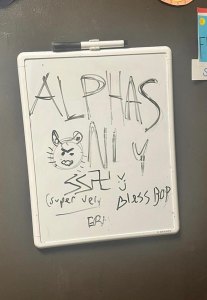
Other incidents have no evident connection to the protests. Last month, according to Hillel, unidentified people entered a residence hall and drew swastikas and “SS” signs on whiteboards. And earlier this year, students found a swastika drawn in the snow in a parking lot.
“UVM hasn’t said anything about the antisemitism on campus,” said Halle Sisenwine, a fourth-year Jewish student.
Scott, the professor and adviser to Students for Justice in Palestine, warned against “the very false and dangerous equation of antisemitism and anti-Zionism.”
“Antisemitism is on the rise, as far as we can tell,” she said. “And it’s coming from right-wing, straight-up antisemitism. It’s not coming from nonviolent student protesters who are protesting genocide.”
In his Friday evening message, Garimella said he wanted “to ensure that the demonstrators at the (encampment) site do not unduly disrupt nor target their classmates or other members of the community.”
UVM “will not tolerate acts or threats of violence nor targeted harassment of others based on their identity or viewpoint,” Garimella warned. “Such actions will be swiftly addressed to the fullest extent of university policy and the law.”
‘What we do is talk’
As of Sunday, according to Students for Justice in Palestine, 91 tents were pitched on UVM’s Andrew Harris Commons. UVM has, thus far, taken no action to forcibly remove the encampment, although it maintains that tents are in violation of university policies around temporary structures on campus.
On Friday, the university appeared to signal a firmer response to the protests. In his message, Garimella announced that UVM had begun disciplinary proceedings for students who “have persistently violated university policy” at the encampment.
“While I am grateful to the students and university leaders who have engaged in conversation, I note that the demonstration has been continuously in violation of university policies since its inception,” Garimella said.

Students for Justice in Palestine has announced plans for a Monday afternoon rally to protest the “reprehensible” disciplinary proceedings. In a statement posted to Instagram Sunday, the group said that multiple students had received notices of potential disciplinary actions, including protest leaders and “disproportionately students of color,” the group said.
But, at least as of Monday morning, the situation on campus has not devolved into the violence and mass arrests that have taken place at other institutions around the country, including dramatic scenes at Dartmouth College, some 90 minutes southeast.
Erica Caloiero, UVM’s vice provost for student affairs, said last week that the university’s first priority was communication — making sure administrators and students understand each other.
“What we do is we talk,” she said. “We talk with students, first and foremost, and always.”
