


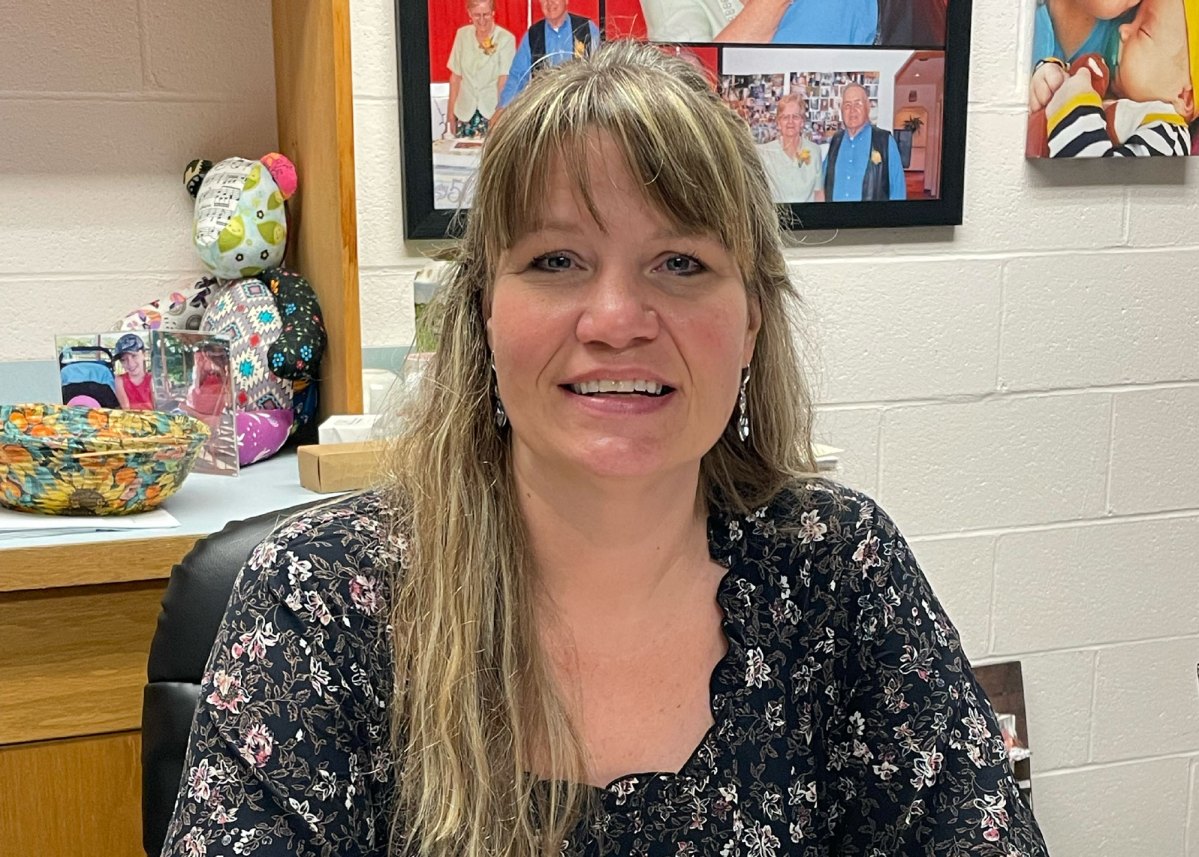
Elaine Collins, the superintendent of North Country Supervisory Union, sat down before the Vermont House Education Committee on Thursday morning and apologized to those in the room.
“I wrote this testimony at 4 a.m,” she said, adding that she was “too tired” to go off script.
Collins had a story of resilience to tell — her own story — which clearly moved the lawmakers who were listening.
It was a story of how school can save a student, maximize their potential. A story of how growing up poor and as a survivor of childhood trauma, she relied on school, worked her way over three decades from paraeducator to superintendent, from being a foster kid herself to fostering more than 50 children. A story of the value of public education.

Around her sat superintendents, school board chairs and lawmakers, all present to discuss the cost of education and what to do about the 30% of school budgets that voters rejected on Town Meeting Day.
Collins was one of about a dozen school and school board leaders testifying before House Education in a joint hearing with the House Ways and Means Committee, the two panels wrestling with an education finance system in crisis.
How, Collins asked, can school leaders draft budgets that meet students’ needs and garner community support? How can the Legislature make Vermont affordable?
“I don’t have the answers for how to do that,” Collins admitted. “But I do have a story to tell. And in the telling, I hope to convey why continuing to grapple with these immense problems, and coming up with a solution for them, is so important.”
So Collins told a tale of finding the potential and possibility in all students.
She was born in Irasburg, a rural Northeast Kingdom hamlet of about 1,000.
“My parents were extremely poor. I was the youngest child of three. We often didn’t have enough to eat. We had one or two changes of clothes if we were lucky,” Collins said. “I lived in a 1950s trailer. If you left water out the night before, it froze in the winter time.”
And her family, Collins said, had a secret. A family member was abusive.
“My first childhood memory is being cold, standing up, and crying in my crib with a wet diaper,” Collins said. The family member, she said, “slapped me silly, and yelled at me to go back to sleep. I remember laying back down and quietly, very quietly, crying myself to sleep.”
When she began school in the 1970s, few if any teachers had received trauma-informed training. Mental health was not a topic of conversation, Collins said, and students — herself included — sat quietly in class, ready to learn.
“I applied myself to learning with a zest,” Collins said, and teachers probably assumed she was “well-adjusted” with a “pretty predictable life.”
“That assumption could not have been further from the truth,” she said. “I didn’t really understand until I was (an) adult what trauma was and how it might affect a young child and how it affected me.”
While her immediate family was dysfunctional, Collins recalled a broader family network of support. Her grandparents, aunts and uncles — dairy farmers — looked after her, and an aunt and uncle eventually became her foster parents.
School, Collins said, was a “saving grace.”
Her extended family and her natural know-how “worked in my favor,” she recalled, “and I was able to learn to be resilient.”
Today, the science of trauma and the science of resilience are the work of schools, Collins told lawmakers. To build resilience is to counteract trauma, and all children benefit from resilience. Schools foster positive relationships, offer predictability and safety.
“We have positive outlets for channeling big feelings,” Collins said.
“The difference we see in today’s children is that trauma is often multi-generational,” she noted. “The effects of untreated mental illness, the unpredictability of family systems, the harmful effects of drug addiction, home insecurities, food insecurities, all of that play a part in our current context.”
School, then, is the “only normalized experience,” Collins said, and schools have more to contend with than they did in the 1970s. Schools clothe kids, help them do their laundry, provide showers, drive them to doctors appointments — work North Country supports through its Community Schools Act grant.
Or take, for example, Collins’ experience as principal of Newport City Elementary School. There were six principals in five years prior to her arrival, according to Collins. There were 320 students and a poverty rate reaching nearly 80%.
In her first year in charge, Collins said the school had 890 restraints, seclusions and escorts — incidents in which staff physically control students who may be acting out. Six years later, the number dropped below 50.
“It is very clearly the right work to do, but it comes at a high cost, and if we don’t do it, the cost is potential and possibilities,” she said.
In a post-Covid world, teachers report that students show up with new and greater needs. Limited social-emotional skills and language skills and “very low tolerance for things that are frustrating,” as Collins put it.
And perhaps, she suggested, the schools with the greatest needs are least financially able to meet those needs — a conundrum lawmakers attempted to address with the state’s recent education funding changes.
“When schools are poor, rural and sparsely populated, it makes it more difficult and more expensive to educate our children,” Collins said. “But our spending is well below average, and it is often in the bottom tier of spending per child.”
North Country also lost access to $750,000 per year in funding due to Vermont’s recent switch in how it pays for special education, according to Collins.
Despite the region’s poverty, 14 of North Country’s 15 school budgets passed on Town Meeting Day.
“It was a minor miracle — or a major miracle,” Collins said. “It demonstrated that even though we are poor, our communities have great trust in our schools and recognize the importance of finding and realizing potential and possibilities.
“I’m worried, though, that this was a one-time gift of trust.”
If, Collins asked, communities can no longer afford to support schools, what would be lost?
“I was fortunate to develop and learn resilience, and I have a moral obligation to do it for the students that are in my community and in our schools,” she said. “We don’t know the potential and the possibilities of the students in our schools. But it would be an unacceptable cost to take away the same opportunity to flourish and grow to the next generation of Vermonters.
“Education is a huge investment, but it is the great equalizer for our children who are less fortunate,” Collins said, “and the potential and the possibilities are worth it.”
With that, she ceded the witness chair to the next superintendent.
Correction: An earlier version of this story misstated the boundary of North Country Supervisory Union.
