


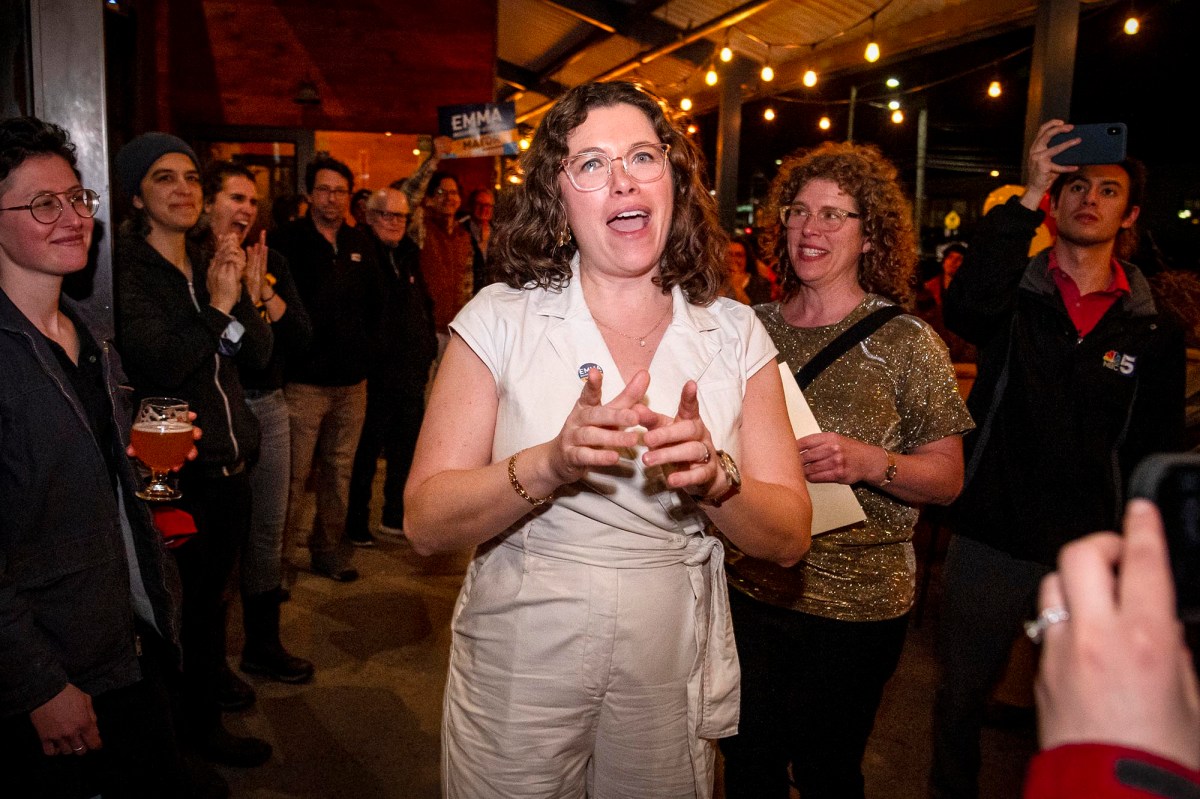
Burlington’s newly elected mayor, Emma Mulvaney-Stanak, brings a number of firsts to the post: She is the first woman, and first openly LGBTQ+ person, to hold the office. She is also set to be the first Progressive to serve as mayor in a dozen years.
Her election came as Democrats won enough City Council seats on Tuesday to hold a plurality. So how exactly did Mulvaney-Stanak win? And how will she govern a city that, over just a few years, has seen party control of its two branches of government flip?
“There has been, I think, this unfair oversimplification of what kind of leader people are based on the political stripe they’ve chosen, whether it’s Progressive or Democrat,” Mulvaney-Stanak said in an interview Wednesday. “Listening to people deeply in this community really made all the difference.”
She was speaking less than a day after declaring victory Tuesday night at the Zero Gravity brewery in the city’s South End, traditionally a Democratic stronghold. The location was notable: It is in Ward 5, home to her main opponent in the race, veteran Democratic City Councilor Joan Shannon.
Mulvaney-Stanak lives in the Old North End, the Progressive Party’s home turf, and runs a consulting business with a focus on community organizing. She also represents parts of Burlington in the Vermont House and plans to remain in that seat through the end of this year’s legislative session, she told VTDigger.
Citywide, Mulvaney-Stanak earned 51.4% of the vote, while Shannon garnered 45.2%, according to unofficial results. Two independent candidates, Will Emmons and Christopher Haessly, essentially split what was left over.
Shannon carried Ward 5 by about five points over Mulvaney-Stanak, but the daylight between the candidates — 1,185 votes to 1,075 — was notably slim, some local leaders noted. They said they had also considered Shannon the favorite to win the race overall.
“We did really, really well there,” said Councilor Gene Bergman, P-Ward 2, a longtime Progressive and a Mulvaney-Stanak supporter who was reelected to his seat on Tuesday. “If you can come within 100-something votes of Joan in her home ward, woah — that just speaks to the fact that we ran a campaign that reached those folks.”
At the same time, Mulvaney-Stanak outperformed the losing, Prog-endorsed candidate for council in Ward 5 — Lena Greenberg — by more than 300 votes. Mulvaney-Stanak said that it was places like this where she likely picked up a key demographic: people who split the ticket and voted for her but also a Democratic council candidate.
In every part of the city that elected a Democratic councilor — wards 4, 5, 6 and 7 — the Progs scored at least 145 more votes for mayor than for council. Mulvaney-Stanak won about 1,550 more votes, citywide, than the last Prog to stand for mayor, Max Tracy, who narrowly lost to incumbent Democratic Mayor Miro Weinberger in 2021.
Mulvaney-Stanak also benefited from high voter turnout in wards that traditionally lean toward the Progs, Bergman said, pointing to Ward 8 as an example, which includes the University of Vermont.
Every ward saw higher turnout than during the 2021 election, with the largest increase — about 11% — coming in Ward 8, city election data shows. Overall, about 47% of voters cast ballots in the city election, compared to 39% in 2021.
“I think they understood that their path to victory wasn't in the people who have been voting in city elections for 10 years,” said Jane Knodell, a former Progressive councilor who served as Shannon’s campaign treasurer. “So they had to expand the electorate with their voters, and they did a very successful job of that — particularly in Ward 8.”
Ali Dieng, an independent city councilor who also worked on Mulvaney-Stanak’s campaign, suggested that high turnout was driven in part by national issues, including this year’s presidential election and debate over the Israel-Hamas war — both of which have come to bear in local politics over the past several months.
Tuesday’s mayoral election was also the first without an incumbent in a dozen years, after Weinberger announced last fall that he was not seeking reelection. The mayor said in an interview that this contributed to what he called “record-setting” turnout as well.
Asked in an interview why she thinks that she won, Mulvaney-Stanak pointed to community organizing over institutional and major financial support.
Shannon enjoyed a fundraising advantage over Mulvaney-Stanak for much of the campaign, though the most recent financial disclosure filings with the state show the Progressive candidate started to catch up toward Town Meeting Day.
As of March 1, Shannon had raised about $167,000 for her campaign, while Mulvaney-Stanak had raised about $107,000, according to state filings.

Overall, Mulvaney-Stanak said that she sees her victory this week as “more of a coalition success” than a win solely for the Progressive Party. She said that while her campaign had support from the Progs’ “infrastructure,” such as its voter rolls, many of her campaign volunteers were Democrats or those without a party affiliation.
Mulvaney-Stanak, a former chair of the Vermont Progressive Party and former city councilor, became animated speaking about Burlington party politics.
“Some people are still harping on the Progressive versus Democratic divide and starting to plant these seeds of doubt before I’m even in office around how this Progressive mayor is going to harm the city further. And I really have such low tolerance for that attitude,” she said on Thursday. “For people to still hold on to that partisanship is so harmful for what’s ahead of Burlington.”
Still, some voters could have been swayed to vote for a Progressive mayor, and a Democratic councilor, under the guise of creating checks and balances, Knodell suggested. She also said that significant challenges facing the city with crime and drug use, as well as affordability and access to housing, may have led people to seek a change after a dozen years with Weinberger at the helm.
“So if we've had a Democratic mayor for 12 years, and we're in this place, I think some of the dynamic was, ‘We need change,’” Knodell said. “And change means a new party in the mayor's office, trying some new approaches.”
The Shannon campaign treasurer added that she thinks some voters cast their ballots for Mulvaney-Stanak purely as a repudiation of Shannon, who has been on the council for much longer and thus has a longer record of local policy decisions to scrutinize.
At the same time, both she and Weinberger acknowledged that Mulvaney-Stanak’s campaign did a good job convincing voters that the latter’s proposals to address issues including public safety, affordability and climate change were the right path.
“Emma ran a great campaign,” Weinberger said. “She inspired a lot of people to get involved and work hard to get her elected. I was impressed by the energy.”
Both candidates made public safety central to their campaigns, though Shannon placed a greater emphasis on policing and enforcement, whereas Mulvaney-Stanak preferred the phrase “community safety” and framed her approach as more comprehensive.
The latter has called for staffing levels at the Burlington Police Department that match the recommendations included in a 2021 consultant’s assessment. And — albeit with the hindsight of today’s political winds — she has expressed concerns with the results of a 2020 City Council racial justice resolution that included a reduction in police officer staffing. Mulvaney-Stanak wasn’t on the body when the resolution was voted on.
Adam Roof, chair of the Burlington Democratic Party, said he thinks Mulvaney-Stanak and other Prog leaders have spoken about public safety in a way that’s more aligned with many Democratic voters than in the past — an approach that may have broadened the party’s appeal on a key issue.
Roof and other Democratic leaders pointed this week to the continuing plurality of seats that Democrats have on the city council as evidence of their party’s support, with Roof saying that it sent “an important message.”
Mulvaney-Stanak said she is eager to include Democrats in the earliest stages of her administration. She plans to assemble a team of advisers in the next week to guide the process, she said, and has brought campaign staff on as transition team staff.
When she takes office next month, Mulvaney-Stanak will have the authority to appoint some two dozen city department heads whose terms are set to expire in June. She said in an interview that she wants there to be “very minimal” turnover in city leadership after she takes office, “because continuity of government is very important to me.”
One appointment that local leaders will be watching closely is that of Police Chief Jon Murad. Seven Days reported last month that Mulvaney-Stanak seemed “wary” of Murad, whose appointment was initially blocked by council Progressives.
"Nobody knows all the answers," Mulvaney-Stanak told the paper. "Any leader who comes in with that kind of attitude is probably not going to be a team player that I will need to help lead the city forward."
She said this week that she plans to meet with Murad soon but has not “made any determinations at all” on whether or not she’ll ask him to stay in the job.
