
When Kirsty Greeno was growing up, she moved around a lot. “I grew up all around Vermont, and a little bit in Maine, too,” she says. She, her sister and her single father moved from Rutland, to Salisbury, to Middlebury, to Whiting, to Cuttingsville—all before Kirsty finished high school. “It was lonely. You’d meet people and make friends, but you’d also know you were going to move eventually.”
In fact, because of all the moves, it wasn’t a given that Kirsty would be able to graduate from high school on time. “One of my early high school counselors said I wasn’t worth their time because I wouldn’t make it to college,” she says.
Those words hurt—so much so, that Kirsty herself didn’t put much time into college preparation, until she first sat down with Monda Kelley, an outreach counselor with VSAC, at the start of her junior year at yet another new school—this time, Otter Valley Union High School in Brandon.
“When I got to Otter Valley, I remember Monda saying to me, ‘what do you mean you haven’t started preparing for college?’” Kirsty recalls. “At the time, I was still hearing the words of that other counselor in my head, that I wouldn’t make it. But Monda helped me improve my resume and apply for scholarships. And I took a full course load my senior year to make up my lost credits.”
Monda recalls Kirsty’s determination and dedication. “She had a real interest in learning, and she was driven to make sure she got everything she needed in order to attend college.”
Kirsty graduated from Otter Valley with her class in the spring of 2013, and went on to Johnson State College (now Vermont State University-Johnson). “Getting that acceptance letter from Johnson gave me the most freeing feeling I’ve ever felt. It told me and the world, I’m going to do more with my life,” Kirsty recalls.
At Johnson, she majored in psychology, minored in sociology and anthropology, and earned a certificate in nonprofit business management. Now, seven years out of school, she looks back at her time there as a life-changing experience.
“College really turned my life around. Growing up and moving around, I didn’t have a good sense of community or home. When I went to Johnson for college, that community completely welcomed and accepted me,” she says, noting that she got her first job there while she was a student, and also worked with the Dream Program, where she served as a mentor to young people from second to ninth grade. “It was empowering to know I could hopefully make a difference for these kids. I really wished I’d had someone believe in me when I was that age.”
Kirsty also participated in eight service trips, which introduced her to community service work. After college, she served with AmeriCorps for four years, helping communities across the country recover from wildfires, tornadoes, and hurricanes, building homes in Montana with Habitat for Humanity, and supporting underserved youth in several communities in California.

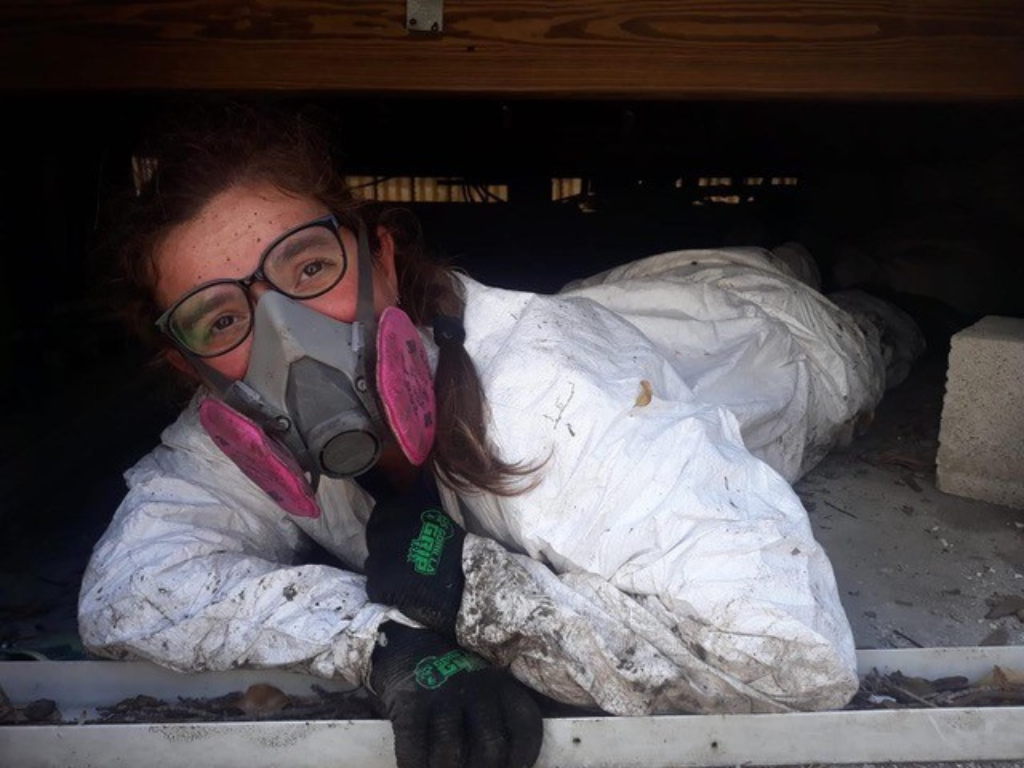
In 2021, she started learning the demolition trade, so she could be more hands-on in disaster zones. Kirsty signed on with the relief group All Hands and Hearts, first as a volunteer, and eventually as a full-time staff member. (She is now a Site Supervisor with the organization.) Her relief work has taken her to Louisiana after Hurricane Ida; to Paradise and Berry Creek, California, to support restoration and rebuilding after several wildfires; to Amory, Mississippi, after a tornado; and to Fort Myers, Florida, for ongoing response to Hurricane Ian.
And, after the river flooding last summer, she came home to Johnson, Vermont.
While she says it felt really hard to see her beloved college town in such a bad state, “it was nice to be able to give back to a community that had given so much to me.”
Kirsty also says her familiarity with the area helped direct All Hands and Hearts to Johnson, as well as to nearby Cabot and Marshfield, when the group was initially drawn to the higher-profile capital region. “But I said, ‘guys, there’s all these other communities that were also hit hard,’” Kirsty recalls. “I told them, ‘We need to help these small towns that are getting overlooked.’”
After a flood, like the one Vermont experienced last July, recovery teams like Kirsty’s are mostly focused on “mucking guts,” or removal of damaged household materials and items. Kirsty herself has crawled underneath mobile homes to remove wet insulation, and operated chainsaws to remove downed trees from homes and yards. “When we first respond, we’re working six days a week, 10- to 12-hour days, helping people get their homes opened up so they can start drying out.”
Kirsty recalls working with one family—a set of grandparents who were staying with their grandson while his father was away on military service—who’d had to be rescued at 2 AM when flood waters surged through their house and rose up to their chests. “And afterward, they had nowhere to go,” Kirsty recalls. “I held them in my arms while they just cried.”
“I wish people knew how long it takes for families and communities to recover from something like that,” Kirsty says. “It can take years, even decades. The disaster lasts a lot longer than the news cycle, and people need our help for a lot longer than most of us realize.”
Monda Kelley has followed Kirsty’s work on social media over the years. “She is a young person who has taken her education to the next level in her volunteerism. I’m astounded at the amount of work she does to help out others. And all of that started when she was in college.”
Kirsty, who is a first-generation college graduate, agrees that college changed her life. “But it wasn’t my psychology degree that was my biggest takeaway,” she says. “It was finding my passion for community and for helping others.”
When asked about her long-term goals, Kirsty is quick to respond that she hopes to continue giving back. “For now, I’m really content and fulfilled doing disaster relief, so that’s my plan for now. In the future, I’d like to get back into construction, and I’d like to give that knowledge and opportunity to kids and young people, to help them get into the trades. As long as I’m empowering and helping, that’s what I want to do with my life.”

This story is produced by Vermont Student Assistance Corp., created by the Vermont Legislature in 1965 as a public nonprofit agency, to advocate for Vermont students and their families to ensure that they achieve their education goals. Our vision is to create opportunities for all Vermont students, but particularly for those—of any age—who believe that the doors to higher education are closed to them. We begin by helping families save for education with Vermont’s state-sponsored 529 savings program. To help Vermonters plan and pay for college or career training, our counselors work with students in nearly every Vermont middle school and high school, and again as adults. Our grant and scholarship programs attract national recognition, and our loan programs and loan forgiveness programs are saving Vermont families thousands of dollars in interest. Visit vsac.org to learn more.

