

When Zac Blondin sat in Vermont courtrooms from 2014 to 2021, the cameras were always pointed at the back of his head.
His identity was shielded through the numerous criminal and civil cases and appeals that progressed through Vermont’s courts — his face never on camera, and his name substituted for a pseudonym in court filings.
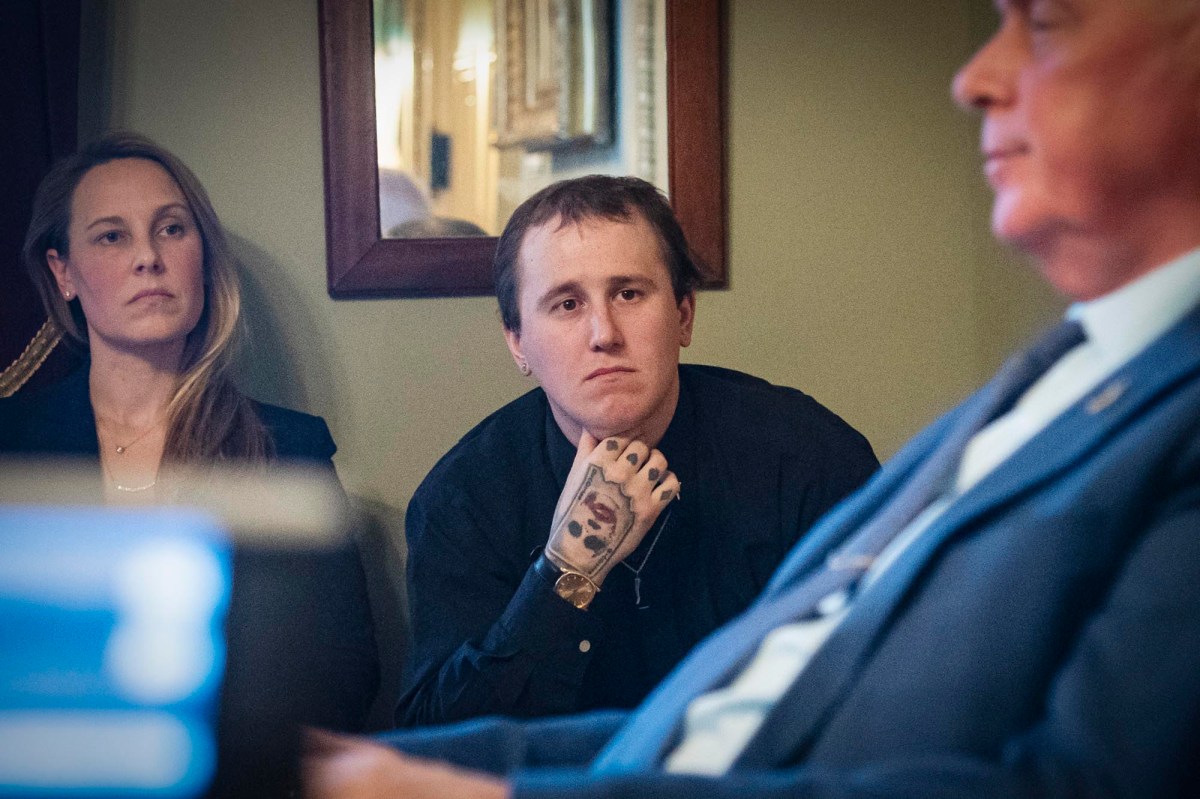
But last month in the Vermont Statehouse, Blondin for the first time faced the cameras as a childhood survivor of sexual assault.
“I want to make a change, and I don’t care if I have to put my face out there to do it,” Blondin told a panel of legislators last month.
The change he’s trying to make is to a Vermont law that allows judges and juries to rest partial blame for a sexual assault on the survivor in civil court.
It’s called the comparative negligence standard. In a civil case where a plaintiff is suing a defendant for damages and an admission of liability, the defendant can argue that the plaintiff had partial responsibility — comparative negligence — that led to their predicament. So long as that comparative negligence is calculated by a judge or jury to be 50% or less at fault for the incident, a defendant can still be found liable.
But if a plaintiff is found to have partial responsibility, that percentage of liability they are determined to share — calculated subjectively — equals the percentage deducted from their settlement.
Stilettos in an ice storm
Lawmakers this year are weighing S.278, a bill that would bar the consideration of comparative negligence in civil sexual assault cases. The legislation last week cleared the Senate in a unanimous vote and will now be taken up in the House.
Blondin and his attorney, Celeste Laramie of Burlington’s Gravel & Shea firm, are pushing for its passage.
Appearing before the Senate Judiciary Committee on Feb. 1, Laramie offered legislators a “classic law school example” of the standard in practice: the slip-and-fall case.
Picture it: A tenant is walking up to her apartment building during an ice storm. Her landlord did not salt the sidewalk, and she slips and falls and injures herself. She sues her landlord for liability. But during the trial, evidence reveals that the tenant was wearing stiletto heels when she sustained her injuries.
“Our comparative negligence statute here in Vermont would allow the defendant landlord to argue to the jury that by choosing to wear stilettos in an ice storm, the plaintiff bears some responsibility for and caused, in part, her own injuries,” Laramie told lawmakers in February.

“And this law makes sense right? In the world of negligence, we talk about the reasonable person standard,” Laramie continued. “We expect landlords to act reasonably and salt their sidewalks. Likewise, we expect passersby to act reasonably and wear some sensible winter shoes. Where both parties act unreasonably by not salting and by not wearing sensible winter shoes, each party should then bear proportionate responsibility for their own unreasonable decisions.”
But, Laramie argued, there is an area of civil law where comparative negligence “does not make sense”: sexual assault cases. And, she told lawmakers, there is one major case where it especially did not make sense: Blondin’s.
‘A little tyke’
Blondin was a 14-year-old freshman — “a little tyke” by his own description — when, he recounted to VTDigger during an interview last month, his Milton High School football teammates sexually assaulted him in 2012 as part of a brutal hazing ritual at an off-campus team dinner.

“I must have been four-foot-eleven, five-foot maybe,” he said. “Maybe 130 pounds if you dunked me in water.”
Blondin was not the only victim. His teammate Jordan Preavy, also subjected to the hazing, ultimately died by suicide in 2012 at 17 years old.
According to court documents, five players — including two involved in Blondin’s assault — were charged for and ultimately pled guilty to criminal charges of harassment, hazing and assault.
But Blondin’s most intense legal battle would be fought in Vermont’s civil courts, where he and his family sued the Milton Town School District. Blondin and his attorneys argued that the school district was aware of the pervasive hazing but failed to stop it.
“We weren’t suing the kids,” Laramie told VTDigger in an interview alongside Blondin in late February. “What we were suing is the entity responsible for supervising those kids.”
According to court documents, in August 2013, Blondin — then a sophomore — was called into the principal’s office after the principal heard that another student did not want to play football due to rumors that new teammates were violently initiated. Court documents don’t name the principal.
“When the principal told (Blondin) that she would shut down the football program if the rumors proved to be true, plaintiff denied the rumors because he feared retaliation from other students for causing the football program to be shut down,” a Vermont Supreme Court ruling reads. “The principal then directed (Blondin) to speak to the incoming freshman” and “tell him he had lied.”
“When the principal informed the district superintendent about the rumors, the superintendent declined to do anything further,” the ruling continued.
Trial blinders
A jury trial was held in 2019. Blondin recalled to VTDigger that during jury selection, his legal team wanted parents — fathers, specifically — on the jury, “because a dad looks at this as a failure to … protect their kid.”
During the trial, attorneys for the school district uncovered Blondin’s metaphorical stiletto heels: A week before the assault, he attended a similar off-campus team dinner, where he play-boxed with a fellow teammate. He should have known, the district argued, that the dinners were unsafe.
Laramie told VTDigger that she should have seen the argument coming, but thought at the time that it was simply too “outrageous.” She chalked it up to “trial blinders.”
“‘Good luck to them, if they’re going to say that,’” Laramie remembered thinking at the time. “Like, how outrageous is it that they would argue, because Zac got knocked out one week at a football team dinner, that the next week, he should be consenting” to sexual assault.
Burlington-based attorney Pietro Lynn represented Milton Town School District in Blondin’s case. He told VTDigger in an interview Friday that comparative negligence does not ask the question of whether a survivor was assaulted; that’s a question for criminal court. “The question is this,” he said. “Do juries have the right to weigh comparative fault?”
“Whose fault was the incident … and to what extent is one party responsible and to what extent is the plaintiff raising the claim responsible?” Lynn said. “I have confidence that Vermont juries — especially in instances where there are allegations of sexual misconduct — that they will do the right thing. And so I’m supportive of the concept that we should let juries make those decisions when deciding how much and whether to compensate plaintiffs who are seeking money damages.”
It was seven years after the assault by the time the case went to trial. Laramie and her colleagues showed the jury a picture of Blondin taken when he was 14, the year he was assaulted. He looked so little, recalled Laramie, who used the photo to pose the question: How could this child have been responsible for his own assault?
“Our thought was that a jury would be mad and would punish the defense for arguing that,” Laramie continued. “And they didn’t. And that was, you know, we should have seen that issue.”
Forty percent
On the day of his jury verdict, Blondin stopped into Garcia’s Tobacco Shop on Church Street in Burlington while court was in recess.
“I bought a cigar and I said, ‘This cigar is either going to mean I won, or I didn’t,’” he told VTDigger.
The verdict that ultimately came down occupied some gray space in between. The jury ruled that the school district was mostly at fault, yes, but Blondin shared 40% of the blame for his assault.
The jury awarded Blondin $280,000 in damages for “his pain and suffering connected to his negligent-supervision claim,” according to court documents. It was a figure that paled in comparison to the $2.5 million that Blondin and his legal team initially sought, but still, the judgment became yet another subject of courtroom debate: Blondin’s attorneys argued that the jury took Blondin’s comparative negligence into account when landing on the $280,000 figure, while the school district fought to cut the dollar amount by 60%.
In the stark black-and-white of legal terms, the jury verdict was a victory for Blondin — the school district was found negligent. But it didn’t feel like one.
“I got in my car and I drove to Jordan (Preavy), and I sat on his tombstone and I smoked the cigar,” Blondin said. “I was sitting there and I was like, ‘Well, I tried, bud.’”
“I just fought this mental argument in my head,” Blondin continued. “Because in my head, I lost. Any form of blame on myself for what occurred was a loss in my eyes.”
Blondin got in his car and started the drive home to his parents’ house from Preavy’s grave, but then had an idea. He turned his car around and drove to Body Art on Main Street in Burlington. He thought, “I’m never going to forget this moment.”
He walked in and got his first tattoo: “40%” in elaborate cursive font on his left middle finger.
Showing it to VTDigger in February, he flipped the bird. “It’s essentially, ‘Fuck you and your 40%,’” he said.

Snow boots in the summer
The verdict’s impact on Blondin wasn’t just monetary. He shouldered the mental burden for years.
“It really highlights that you’re responsible for your own situation. That was something that I really sat with,” Blondin said. “I guess I should have been aware of this ill in the world, because at that time, I didn’t know the world was all that harsh of a place.”
Mentally, Blondin armored himself in sensible snow boots, even in fair weather.
“What happened to Zac factually communicated a legal duty to all sexual assault survivors and to anybody walking down the street that you have a duty to protect yourself from sexual assault, and that’s just wrong,” Laramie said.
“When you’re in college, your parents tell you, ‘Don’t walk home alone drunk from the bar,’” she continued. “But this was the legal system saying you have a duty to not do that. And if you do do that, it’s your fault if something happens to you. You asked for it. You wore a short skirt. You were drunk. You went back there.”
Blondin cut in: “You should have known better.”
Lynn contended to VTDigger that comparative negligence is “not a question of blaming the victim.”
“I don’t believe that any of us would want there to be victim blame,” Lynn said. “That’s not what comparative negligence is about. It’s about apportioning appropriate financial responsibility.”
“These are claims for money damages. They’re not criminal cases, where it is decided whether somebody has committed a crime,” Lynn continued. “Comparative negligence is a doctrine of law that allows juries to right-size the amount of money that plaintiffs get to recover.”
But Sen. Tanya Vyhovsky, P/D-Chittenden Central, who is the primary sponsor of S.278, argued that the very nature of apportioning any civil liability onto sexual assault survivors is victim-blaming.
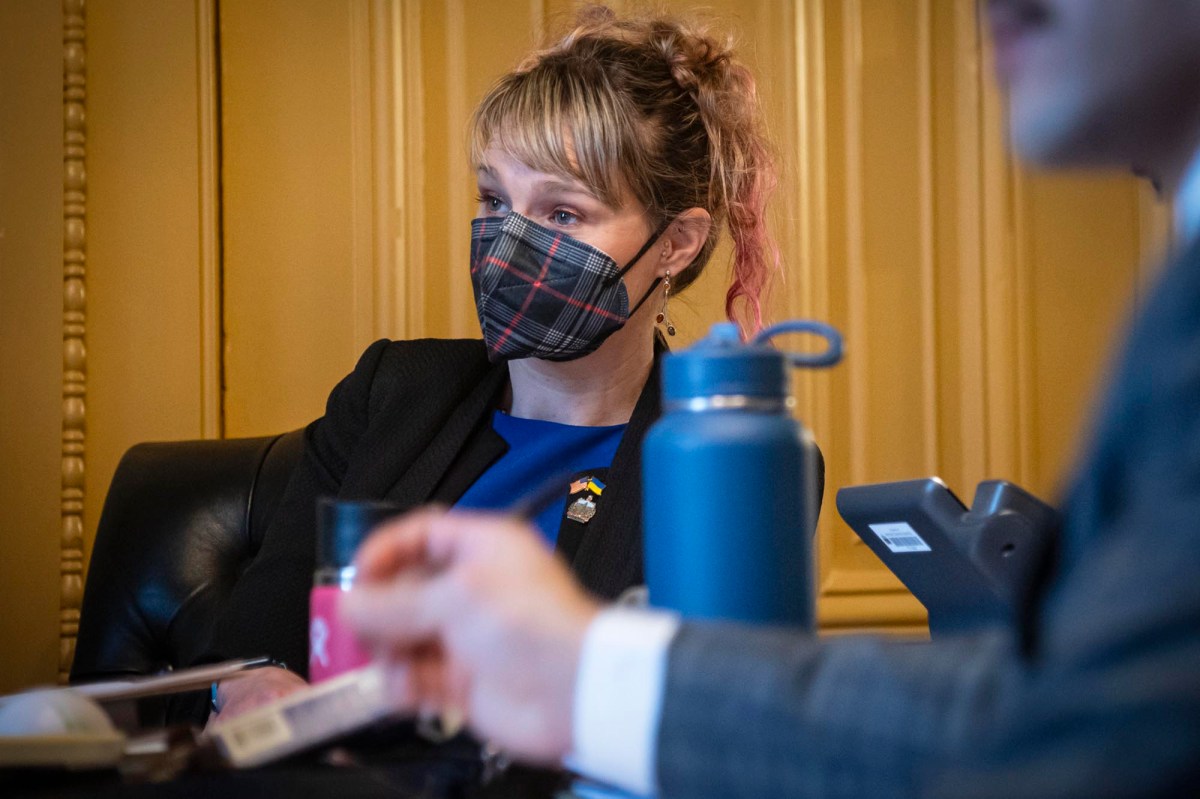
A full-time social worker outside of her duties as a state senator, Vyhovsky told VTDigger that when she works with sexual assault survivors, “The very first thing that we always sit down and say to a sexual assault survivor is, ‘This is not your fault.’”
“To have a jury and a judge look at a sexual assault survivor and say, ‘Actually, this was 40% your fault,’ is just so incredibly damaging,” Vyhovsky said in a February interview. “I moved this bill forward … in large part to acknowledge that it’s never a sexual assault victim’s fault, in any part.”
‘You can’t take me back’
S.278 is being considered at a time when, in the grand scheme, lawmakers and members of the judicial system are reckoning with how to best adjudicate sexual assault cases while doing the least harm to survivors.
In order to secure a criminal sexual assault conviction, a prosecutor must prove beyond a reasonable doubt that the assault occurred — a high burden of proof for a crime that so often takes place behind closed doors. What that often means for survivors in a criminal case is invasive evidence collection, exhaustive depositions and grueling cross-examination.
“There are a lot of reasons why someone may not go down the road of a criminal prosecution, or might and might also choose a civil case,” Vyhovsky told VTDigger. “The criminal legal system, as it is structured now, is incredibly traumatizing to victims.”
According to a 2018 report by The Washington Post, less than 1% of sexual assaults and attempted sexual assaults result in felony convictions. The same report found that upward of 89% of survivors report experiencing distress after their assaults, such as post-traumatic stress disorder, depression, anxiety or substance use.
It’s those damages that a civil case can seek to rectify.
Blondin recalled to VTDigger a conversation he had with his other attorney, the late Jerry O’Neill, back when they were working on his civil case. He insisted to O’Neill that he didn’t care about the money.
“He was like, ‘Well, unless there’s a time machine created in the next couple of years, that’s the only goddamn thing that you can get,’” Blondin recalled. “I was like, that’s a really good point. You can’t take me back.”
‘Through the wringer’
Blondin appealed his 2019 verdict to the Vermont Supreme Court. In 2021, he won his appeal — and for real this time. The state’s highest court ruled unanimously that the Milton Town School District was legally negligent and failed to protect students they had reason to believe were in danger.
Laramie joked that Blondin should change his tattoo to “100%.”
In the hopes of preventing future survivors from having to go through what Blondin did, he and Laramie are working together to advocate for S.278’s passage. They greet each other and depart with the familiar hug of old friends.
“We’ve been through the wringer together,” Blondin said.
When testifying to a panel of state lawmakers or interviewing with a reporter, Blondin is exceedingly polite, generous with his answers and disarmingly cheerful — even when talking about the worst thing that’s ever happened to him. On the day he met Laramie and a reporter at Gravel & Shea’s downtown Burlington office, he donned a sunshine yellow hoodie that proclaimed in black font, “You are enough.”
In the years after his assault and the ensuing string of lawsuits, Blondin’s story was largely out of his hands. His anonymity was meant to protect him, but it also rendered him voiceless as others took his story and ran with it. A television documentary special aired about the hazing scandal. A popular fictional legal show produced an episode that nearly mirrored his case.
But on Feb. 1, Blondin, now 26, sat down in the overstuffed witness chair at the head of the Senate Judiciary Committee’s long table to talk about S.278. This time, he was in front of the camera. He smiled as he testified, and barely looked at his notes.
It was during that testimony, Laramie told VTDigger, that Blondin reclaimed his story.
“You felt his power,” she said. “It was palpable in that room.”
