

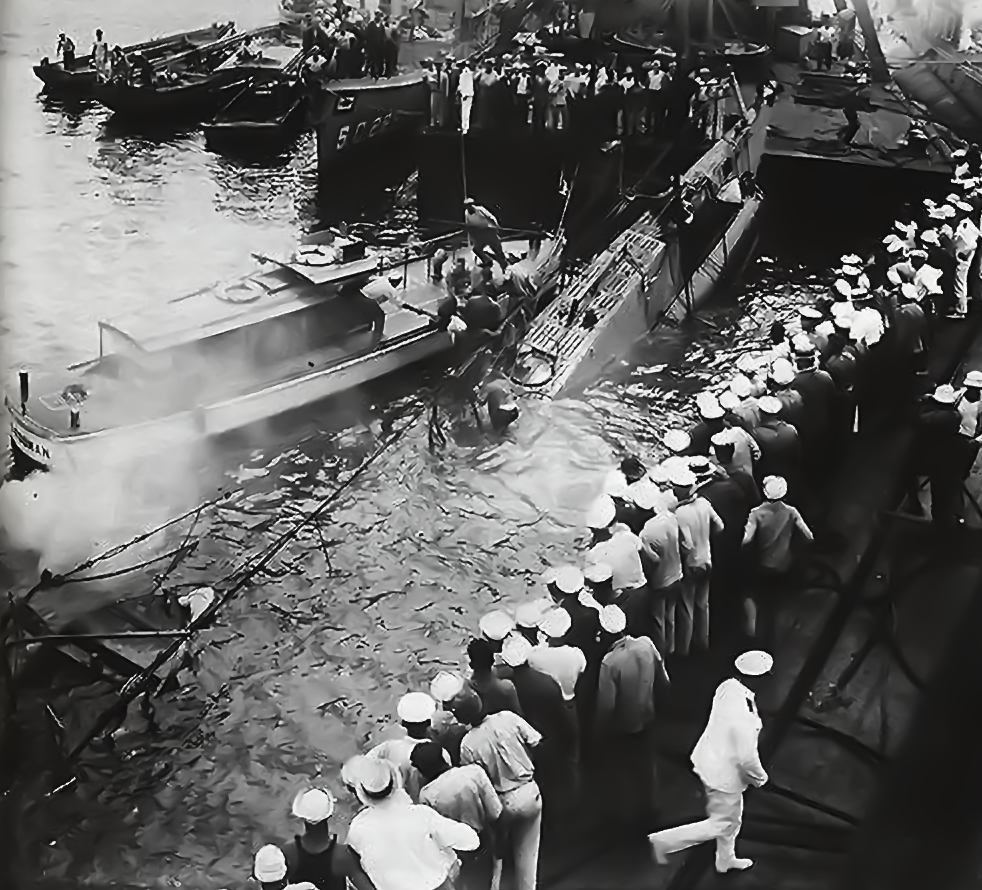
Shocking news reached Henry Breault’s home in Grand Isle on Aug. 28, 1923 when a messenger arrived at Ridge Crest Farm to hand deliver a telegram.
The cable, sent at 2:06 p.m. by the Navy’s Bureau of Navigation, read: “Regret to inform you that your friend Henry Breault Torpedoman second class was found missing following sinking of the USS O-5 in the Canal Zone as result collision with steamer period No word has been received regarding recovery of body period The Navy Department extends sincerest sympathy to you period. Address all inquiries to Bureau Navigation Washington DC”
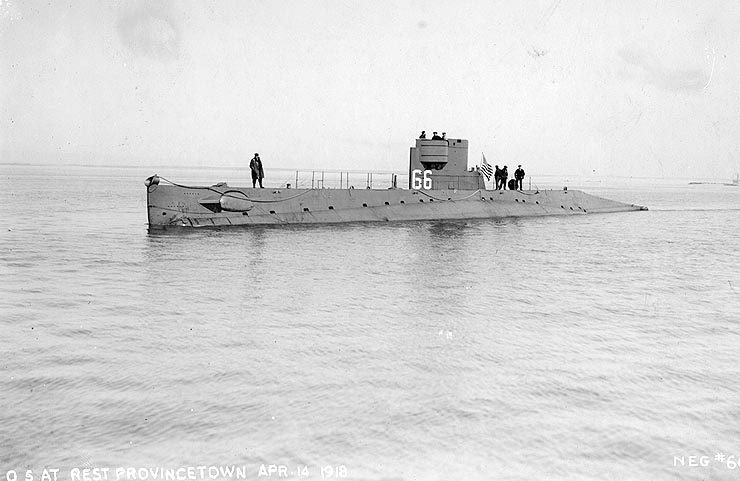
Just hours earlier, Breault had been one of 21 men aboard the submarine USS O-5 as it motored on the surface in Limon Bay, Panama. It was leading three other submarines, as they prepared to enter the Panama Canal and head to the Pacific.
Shortly after 6 a.m., due to a series of communication and navigation errors, the SS Abangarez, a steamer owned by the United Fruit Company, was drifting ominously toward the USS O-5. The submarine was literally powerless to avoid the collision; its engines had just been turned off to shift from diesel to electric motor drive.

The sub’s commander, Lt. Harrison Avery, recognized the peril and urgency of the situation shortly before impact. He ordered all men to come up on deck, lest someone be trapped if the vessel took on water.
The Abangarez dwarfed the O-5. At 380 feet, the steamer was more than twice as long as the submarine and weighed nearly 10 times as much. The Abangarez was undamaged as its bow struck the O-5, punching a 10-foot-long and three-foot-wide hole in the submarine’s starboard side.
Avery ordered his men to jump overboard immediately after the collision. Crewmembers of the Abangarez threw life preservers, life rings and mooring lines into the water to give the O-5’s men something to grab ahold of.
Sixteen members of the O-5’s crew were quickly rescued. Five were missing, including the 23-year-old Breault, who had been in the torpedo room when the vessels collided. He managed to make it topside, but from his position in the top hatch he realized the ship was sinking fast. Ducking back into the submarine and closing the top hatch above him, he searched for any crewmembers who might have been unable to evacuate.
He quickly found Chief Electrician’s Mate Lawrence Brown, who had been resting in the forward battery room before his watch. Brown had felt the collision, but hadn’t heard Avery’s orders or realized the severity of the situation. Brown and Breault tried to escape. But the ship was sinking too fast. They raced into the forward torpedo room and closed the watertight door.

All this had happened in seconds. Witnesses said the O-5 sank less than a minute after impact.
About 45 minutes after the submarine sank, an explosion ripped through it. Seawater had flooded the forward battery room. As the saltwater rose, it shorted out the batteries, creating chlorine gas, which immediately exploded. The torpedo room door held.
Rescue efforts were already underway. Coming to rest in about 7 fathoms (42 feet) of water, the sub must have felt tantalizingly close. But no technology existed to save the men while the submarine was underwater. If there was any hope for Breault and Brown, the vessel would have to be raised to the surface.
It would take a massive crane barge to attempt that feat. Fortunately, two such cranes were in the vicinity, 50 miles away, toward the Pacific end of the canal. Unfortunately, the path of either to the wreck site was blocked by two enormous dredgers that were busy clearing a landslide in the narrowest section of the canal.
Hoping that one of the cranes would arrive in time, rescuers checked whether there was anyone left alive in the submarine to save. A stream of bubbles rising to the surface marked the O-5’s location. Rescuers believed trapped men were tapping the boat’s compressed air reserves to stay alive.
Sheppard Shreaves, dockmaster, shipwright and supervisor of the canal’s salvage and diving crew, assigned himself the task of searching for survivors. He didn’t feel right risking the life of one of his men.
Navy divers informed Shreaves where on the O-5 any survivors were likely to be found. Wearing a bulky diving suit, complete with metal helmet and weighted shoes, Shreaves worked his way through the gaping hole in the vessel’s side and, three hours after the sinking, reached the engine room bulkhead. He rapped it with his diving hammer. He heard a faint tapping in reply.
Breault and Brown had decided to simultaneously pound on opposite sides of the ship, according to Brown, who later gave an account of what was happening inside the torpedo room. “In this way, the rescuers would know that there were two of us,” he explained. “Breault played a kind of tune with his hammer, indicating to the diver that we were in good shape and cheerful.”
The O-5 was resting, with its bow tipped forward, on a layer of soft mud, several feet thick. Shreaves used a fire hose to try to blast a gap beneath the submarine’s bow, hoping all the while that the vessel wouldn’t roll and crush him. He was eventually able to clear enough mud to pass a guideline attached to a thick cable beneath the bow. The cable would, in turn, be attached to the crane barge’s hook — if the barge arrived in time.
Brown and Breault had no food or potable water, and were standing in saltwater up to their shins. They did, however, have a flashlight to pierce the gloom and the belief that they probably had 48 hours’ worth of air.
At about 2 p.m., the massive dredges were finally moved to allow ship traffic to pass. By 9:30 p.m., one of the crane barges, the US Ajax, had been towed to the wreck site.
An hour later, the Ajax was ready to try to lift the O-5. The weight of the vessel and the suction power of the mud were too much. The cables almost immediately snapped. Rescue crews spent hours rigging a new arrangement of cables and straps. But a second attempt also failed.
Inside, Breault and Brown were suffering. “The air pressure gave us violent headaches after 20 hours,” Brown said. “We did very little talking or moving about; it excited our heart action too much.”
“A long time afterward,” Brown said, “when we had forgotten time and did not want to think of our plight,” another hoisting attempt was made. It was a little after 1 p.m. on Aug. 29; 31 hours after the wreck. As the sub slowly rose, the pressure inside the torpedo room increased. “It seemed like an eternity,” Brown said. “The last 20 minutes were terrible.”
“Then we heard the water splashing over the top, and our comrades walking on the deck, and we knew we were up,” Brown said. “Breault opened the hatch and the light was so bright I could not find my way up.”
The jubilation of rescuing Brown and Breault must have been muted by the discovery inside the submarine of the bodies of two of the missing men. The body of the other missing man was never recovered.
Brown seemed no worse for wear, but Breault was clearly struggling. He was suffering from what is variously called decompression sickness, the bends or caisson disease, which divers can experience from the rapid change of pressure from rising too quickly. Among the many symptoms he might have experienced were vision issues, confusion and even loss of consciousness.

A United Press reporter said he spoke briefly with Breault before he was rushed away for treatment. “I didn’t know whether there was anybody inside or not, and if there was, I wanted to stay and help, if I could,” Breault said.
That’s all he had to say publicly about the incident that would make him a national hero. In his own interview with the United Press reporter, Brown gave all the credit to Breault. Brown’s comments were picked up by papers across the country.
But before news of their survival could be published in the nation’s newspapers, a telegram courier again arrived at Ridge Crest Farm in Grand Isle, this time bearing much better news: “The Bureau of Navigation is pleased to inform you that your friend Henry Breault Torpedo man second class has been rescued alive from the submarine O FIVE,” it read.
The wording is interesting: “your friend.” These sorts of telegrams were typically sent to next of kin. Some historians wonder if Breault was estranged from his family at the time. Although his father, stepmother and four sisters were all alive when he enlisted in 1920, his paperwork lists a Mrs. L.R.B. Hale as his “beneficiary or next of kin.” It was to her that the telegrams were sent and it was her address that he listed as his home.
Genealogical and archival newspaper research reveals that Mrs. L.R.B. Hale was born Leith Rae Blanche Mudgett in New Hampshire. She married a man from Montreal and lived in that city for a time, but by 1920 she had separated from her husband and was living with her mother, Mary, and her married sister, Irene, on the Grand Isle dairy farm of her brother-in-law Rupert Barney. In later years, newspapers would refer to Blanche Hale as the one running the farm. It was this household that Henry Breault, who was born in Connecticut, referred to as his home for a number of years.
When Breault was making headlines in 1923, the Burlington Free Press was confused about why the Navy was saying he was from Grand Isle: “(A)ll investigation by the Free Press has failed to discover any one on the island who knew the young man,” the paper reported.
The Burlington Daily News dug a little deeper and learned that a few years earlier, Breault had briefly worked at the farm. So why did Breault list the Grand Isle farm as his home and how did he end up there? One possibility is that he knew Blanche or her family from Montreal. Breault’s father was from that city and at least two of his sisters were born there. But at this point, we can only guess.
Harrison Avery, the O-5’s commander, recommended Breault be awarded a Navy Cross for devotion to duty and selfless bravery. As his recommendation passed through the Navy’s chain of command, a rear admiral elevated the recommendation, suggesting that Breault deserved the prestigious Medal of Honor, and the secretary of the Navy agreed.
Breault was due to be awarded the honor at a White House ceremony on March 6, 1924, but he couldn’t attend. Some newspapers reported that Breault, who was still in active duty, had missed the ship that was supposed to bring him to Washington. Others claimed that Breault had stood up the president and secretary of the Navy because he was busy getting a new dress uniform for the occasion, which seems less likely.
The small, formal ceremony finally took place on March 8. President Calvin Coolidge, himself a native Vermonter, personally draped the nation’s highest honor around the neck of Henry Breault.
Postscript
Breault reconnected with his family following the sinking of the O-5. When he reenlisted in the fall of 1924, his paperwork listed his father as his next of kin and his family’s home in New York State as his home address. His connection with Vermont seems to have ended at this point. But in truth, he didn’t spend much time on land anyway. Over the next decade and a half, he remained in the Navy, serving on two dozen different vessels.
During the fall of 1941, at the age of 41, Breault experienced difficulty breathing and chest pains. Navy doctors had been tracking his heart issues for several years. Breault was admitted for observation at the U.S. Naval Hospital in Newport, Rhode Island. After dressing one morning, he started sweeping the floor in his hospital ward, then suddenly collapsed. His death was judged to be almost instantaneous. The date was Dec. 5, 1941. Two days later, after the Japanese attack on Pearl Harbor, the United States entered World War II.
Note
On March 15 at 9:30 a.m., a ceremony in the House chamber at the Vermont Statehouse will commemorate the centenary of Henry Breault’s Medal of Honor award. Organizers encourage veterans, especially those who served in the Navy, to attend. A group of active duty submariners from the Naval Submarine Base in Groton, Connecticut, and members of the Vermont Submarine Veterans Green Mountain Base plan to attend. Rep. Michael Morgan, who represents the Grand Isle-Chittenden District, is lead sponsor of the resolution honoring Breault, the one-time Grand Isle resident who is the only enlisted submariner ever to receive the Medal of Honor.

