

On a chilly February morning, a group of parents gather with a common goal: to learn effective strategies for managing parenting challenges, and to strengthen bonds with their children. They are participants in the class Breakthrough Parenting: Curriculum Navigating Trauma Across Generations (BPC), offered by Counseling Service of Addison County (CSAC).
Unique to other parenting classes, Breakthrough Parenting is specifically trauma focused – both for supporting parents in understanding how their own experiences of trauma may impact parenting and decision making, and also in how to support children who have experienced trauma. BPC is based off the Resource Parent Curriculum (Caring for Children Who Have Experienced Trauma: A Workshop for Resource Parents), or RPC, originally designed for foster and adoptive parents.
Kim, mother of three and now a CSAC BPC Parent Peer Facilitator is enthusiastic about the class’ impact. “I love this class. It’s the cat’s meow!” she exclaims. Kim recalls her initial experience as a participant in CSAC’s first class offering, back in December 2022, during a particularly difficult period following the loss of her partner. “I was a mess, my kids were a mess, and I reached out to [CSAC] for help. I was in a hole. My main life focus was how do I get my kids through this?”
Her journey from participant to Facilitator in September 2023 is testament to the transformative power of the class. “It’s been life changing,” she reflects.
“This class is hard work because you’re talking about trauma, and that’s hard. But doing that shows strength.” Kim, CSAC BPC class Parent Peer Facilitator
Kim reflects on her childhood trauma and the revelations she had during the class. She shares that you start to understand what’s normal and what’s not: “When you take the class, you realize oh, that’s not normal… [with the class] you learn a different way of doing things.” This realization leads to learning new approaches in parenting. Betsy King, CSAC BPC Coordinator, contributing her insights, mentions how the class aids in recognizing and learning about generational trauma and validating for people that they received the wrong messages when they were children. Betsy co-teaches the class with CSAC’s Sarah Muss, a CSAC Outreach Clinician.
The change people experience is gradual, as Kim and Betsy both emphasize. Kim recalls a significant moment in her learning process when the class watched “The Still Face Experiment” by Dr. Edward Tronick. This experiment, showcasing a mother’s interaction with her baby, illuminated for Kim the importance of being aware of her responses to her children. She now practices more mindfulness in her responses, ensuring she acknowledges her children’s needs and communicating with them more effectively. Shares Kim “I acknowledge that they need me. If it’s not something they need immediately, then I just say one minute and I’ll be with you. You learn something in class, and then you make a shift in the moment.” This experience underscores the class’s impact on fostering real-time positive changes in parenting behaviors.
Betsy King highlights that typically midway through the 10–week BPC course participants report significant positive changes. Around the fourth to sixth class, many observe calmer home environments, reduced chaos, and greater understanding of how generational trauma affects families. They also mention making changes that ease daily life, leading to increased support and decreased reliance on external services.
“My kids know they can come talk to me. They can come ask me questions. I wasn’t raised that way. I think it’s really important to be open with my kids…..I’m breaking the cycle. I’ve made a pathway for them to know ‘mom might not like what I’m going to tell her, but I feel safe asking her.’ Kim, BPC Parent Peer Facilitator.
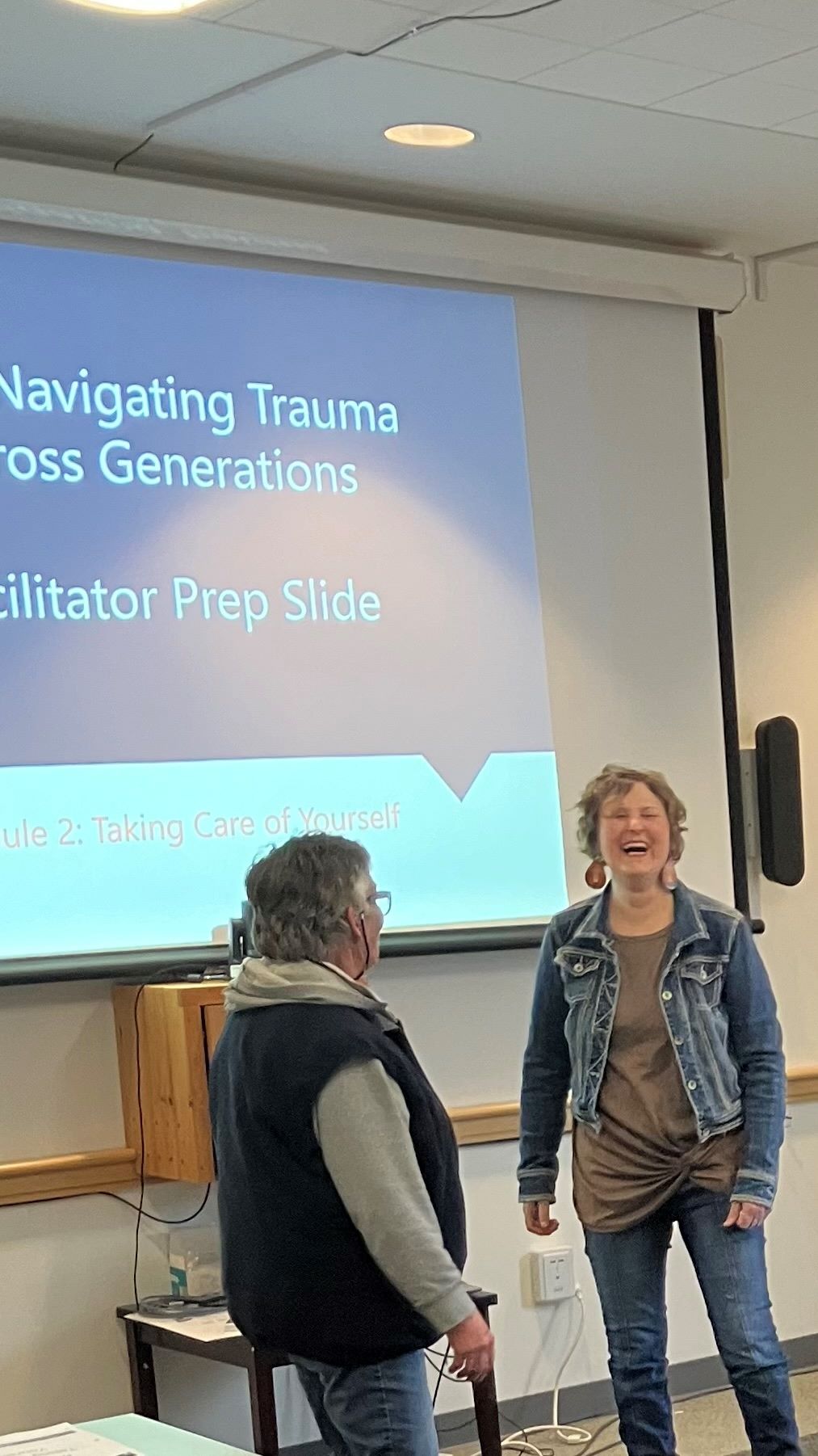
Breakthrough Parenting Classes Dive Deep into Understanding Trauma
The curriculum covers a wide range of topics through a trauma informed lens, including trauma informed parenting, taking care of yourself, the impact of one’s childhood on parenting, understanding trauma’s effects, and learning to manage emotions and behavior changes. It emphasizes the importance of understanding complex developmental trauma and its effects.
“My kids are going to grow up feeling confident – that they are strong, beautiful, brave, and worth it. If I can change their childhood…when they are an adult they will do amazing things. If we can get everyone to understand trauma and what it is, my hope is that someday no child will know what abuse is, and I think this class is a good start.”
Kim, CSAC BPC class Parent Peer Facilitator
Kim as a Facilitator likes “seeing people get engaged in class. I like seeing that light bulb go off.” The class helps parents open up conversations with kids; it helps them open up about trauma, and it helps parents foster deeper connections with their kids. Betsy King describes the class as psychoeducational, offering a space for learning and optional sharing of personal experiences. The Co-Facilitators, including Betsy and Sarah, provide support for people who choose to share, ensuring a responsive and relevant learning environment.
Confidentiality is a cornerstone of the BPC, as Kim emphasizes, “What’s said in that room, stays in that room.” This assurance of privacy, coupled with her dual role as a facilitator and supporter, helps create a warm and welcoming atmosphere. Kim speaks to the welcoming environment as integral in helping people feel comfortable. There’s amenities like breakfast food (sometimes homemade!), coffee and tea, and coloring sheets; it feels warm, welcoming, and comfortable.
Both Betsy and Kim underscore the necessity for participants to be open to change for the class to be truly effective. “You have to be willing to want to shift things at home and see a different outcome,” Betsy explains. This openness facilitates growth of a supportive community of parents where everyone helps each other in their progress. Of the class, Betsy shares “I have people say can I take it again?”
Reflecting on her experience, Kim shares “It’s an amazing experience to take this class. Looking back on my first class – I didn’t feel judged. I felt safe. It’s been a huge change. My kids are now using the language that I’ve been using with them and it gives me hope. “
“I noticed when we first started this work, I wasn’t there the way I needed to be there [for my kids], and now my kids strive to do well and feel good when they succeed. For parents, we have to want to be the first ones on the ship to make that change, to lead the way…not to dictate what [our kids] do, or force them, but to model and lead.”
Virginia, CSAC BPC class Parent Peer Facilitator
Virginia, also a CSAC BPC class Parent Facilitator, and parent of three, shares “Deciding to call CSAC three years ago was the best thing I could have done.” It was Virginia’s initiative and phone call that connected her with Betsy King, at the time a CSAC Outreach Clinician. Virginia and her partner were in the process of reuniting with her children, who had been living with her parents during her struggles with addiction. This partnership focused on shifting perspectives, understanding trauma, and establishing healthy boundaries for her children.
Virginia speaks about the profound insights she gained before the formal introduction of the BPC course at CSAC. Through Betsy, she learned about the impact of trauma on children at various developmental stages, which helped her identify gaps in emotional maturity caused by trauma. Virginia describes this knowledge, and making shifts in her approach and response to her children as “life changing” as it not only illuminated the effects of trauma but also helped her recognize and manage her own triggers.
“.. this class is a place to get support and have a place to talk about it. We can’t control or
predict everything in the world, but now I know I’m doing a service to my family and my children….my kids are insightful, compassionate people. It’s like an engine – once you understand how it works, you can fix it! This work radiates and spreads. The more people we can get this information to, the better. The more the merrier!”
Virginia, CSAC BPC class Parent Peer Facilitator
Betsy and Virginia share that the root of the class and the work is that it teaches and supports parents—not necessarily teaching people how to parent, but about self-discovery: learning who you are, how trauma affected you, and how things trigger you. Virginia shares “Once you see things about yourself and your triggers, you can’t un-see it, and you get a sense of what your morals are. When I’m anxious now…I can acknowledge it and own it and deal with it in a healthy way.” Virginia’s experience was so impactful that it inspired her to help share her knowledge and support others as a Parent Peer Facilitator, underscoring the value of the BPC program in fostering positive change in families.
As a Parent Peer Facilitator in the BPC, Virginia, like Kim, serves as a valuable resource for participants. She empathizes with the feelings of judgment parents often face in their communities, stating, “I know what it feels like to feel judged in your community and I want parents to know ‘I’m just like you, I’m just further on this path.” She emphasizes the importance of the course materials and discussions about trauma, but highlights the value of the learning and support participants get from each other: “the participants – the real life conversations and things we’re going through are such a resource. It builds community and the compassion and connections we have are huge.” She finds it rewarding to see the recognition and understanding in the faces of other parents during classes, which typically consist of 6-12 parents in a 10-week curriculum. “That makes it so worth it to me.” CSAC’s Sarah Muss also shares that one of the benefits she sees from participants is the bonds it builds among parents.
“If we can keep this class going, in 10 years, the whole community will be more trauma-informed.”
Virginia, CSAC BPC class Parent Peer Facilitator
Virginia also discusses the significance of modeling behavior and response strategies, a key aspect of the course. She advocates for being a role model for children saying, “In order to support our children, we have to be their advocate, but we have to learn how to do it in an appropriate way. Modelling behavior, walking the walk.” She notes the positive changes in her family and how her children now understand and navigate interactions with others more effectively.
The course also includes mindfulness strategies and self-care practices. Virginia shares her personal experience with ‘belly breathing’ a mindfulness activity that brings calm and focus. Shares Virginia, “I do ‘belly breathing’ 4-5 times a week. Learning about bringing oxygen deeper into your body, how that physically changes you and calms you.”
She credits the class with significantly improving her life and her relationship with her children, expressing gratitude for the journey and the progress they’ve made together. “There’s no way I’d be where I am and my kids where they are, and have our quality of life without this class. If three years ago someone would have told me this is what your life would be like…I wouldn’t have believed them. It’s taken me so many years to earn my kids back. To be able to go on vacation together. I’m so blessed and happy to be me. I’m so proud.” CSAC’s Sarah Muss shares “If we can build up parents’ confidence and resilience, then that’s success: for them, for us, and for the kids!”
More about CSAC
Youth and Family Services, an integral part of CSAC’s services, provides therapy, community supports, and case management to children, youth, and their families in school, office, home and community-based settings. CSAC’s Youth and Family (Y&F) team offers the Breakthrough Parenting class as a resource for parents and foster parents. Referred by CSAC clinicians, participants enroll in a ten-week class, diving deep into understanding trauma, impact, and trauma response on children and youth. Weekly classes are 2.5 hours long – time spent learning curriculum and for discussion. CSAC provides two separate offerings: for parents and for foster parents; both are coordinated and led by CSAC staff, and are Parent Peer facilitated. According to Betsy, “We’re here to learn about trauma: what it is, what it does to us, to our kids and to our parenting.” A CSAC Youth and Family Outreach Clinician for many years, Betsy now focuses on coordinating and teaching BPC with colleague Sarah Muss. CSAC’s Director of Youth & Family Services, LuAnn Chiola, shares “We are strong believers that parents are the experts in the lives of their children so these classes simply offer parents some more expertize! These are some of the practices that many caregivers did not learn when they were growing up; and, there is no shame in needing parenting support, especially if you had a difficult childhood yourself. The classes offer information on trauma, behavior management skills, and connections with other parents, and in the process the whole family may begin to heal together.”
Are you looking for meaningful employment? Find current opportunities here. Contact apply@csac-vt.org with questions.
Across CSAC’s Youth and Family Services (Y&F) in 2023, CSAC supported 868 youth and provided 72 families with family services. CSAC’s Y&F Services serves youth and families through office based psychiatry and therapy services, crisis supports, outreach mental health clinicians, school based mental health clinicians, a JOBS employment program, home-based autism services, and adolescent substance use services.
In addition to offering the BPC for parents, CSAC is committed to and working towards becoming a trauma healing organization, and envisions being a part of a trauma healing community. Becoming a trauma healing organization and moving towards a trauma healing community involves trauma training for staff, and partnering with other community organizations and partners to learn and train about trauma and trauma healing.
By Counseling Service of Addison County (CSAC)
February 23, 2024

Counseling Service of Addison County (CSAC)
By offering comprehensive services and supports for social and emotional well-being, CSAC helps nurture communities where individuals and families thrive.
CSAC envisions a compassionate and resilient community that honors everyone’s full potential. Follow us on Facebook,sign up for our e-newsletter, or donate today.
89 Main St., Middlebury, VT | 802-388-6751
24/7 Emergency Services | 802-388-7641

A United Way of Addison County Funded Agency
This article is part of a collaboration produced by members of Vermont Care Partners. Vermont Care Partners is a statewide network of sixteen non-profit, community-based agencies providing mental health, substance use and intellectual and developmental disability support.

